What do you do with power when you gain it?
The question that redirected Metamorphosisthe disk with which Nnux explores the feminine in different mythologies.
Nnux is the project of Ana Lopez Reyesmultidisciplinary artist, composer and producer born in CDMX and currently based in Berlin. His work moves between electronic music, acoustics, performance and digital art, always at the service of a story.
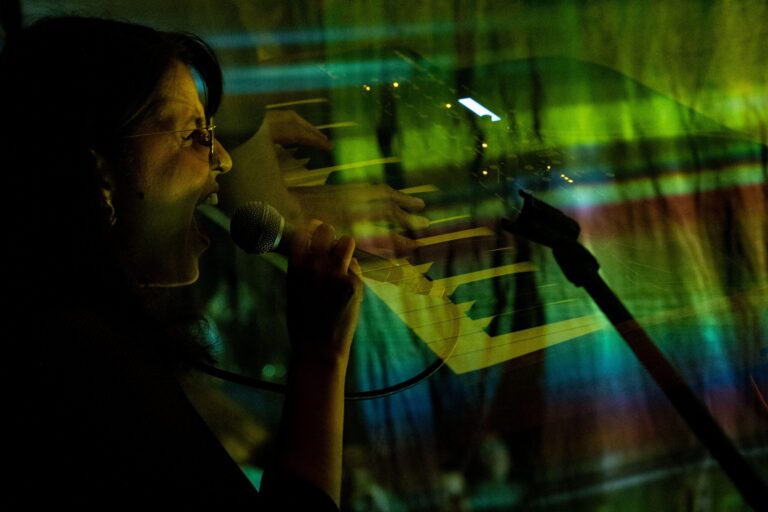
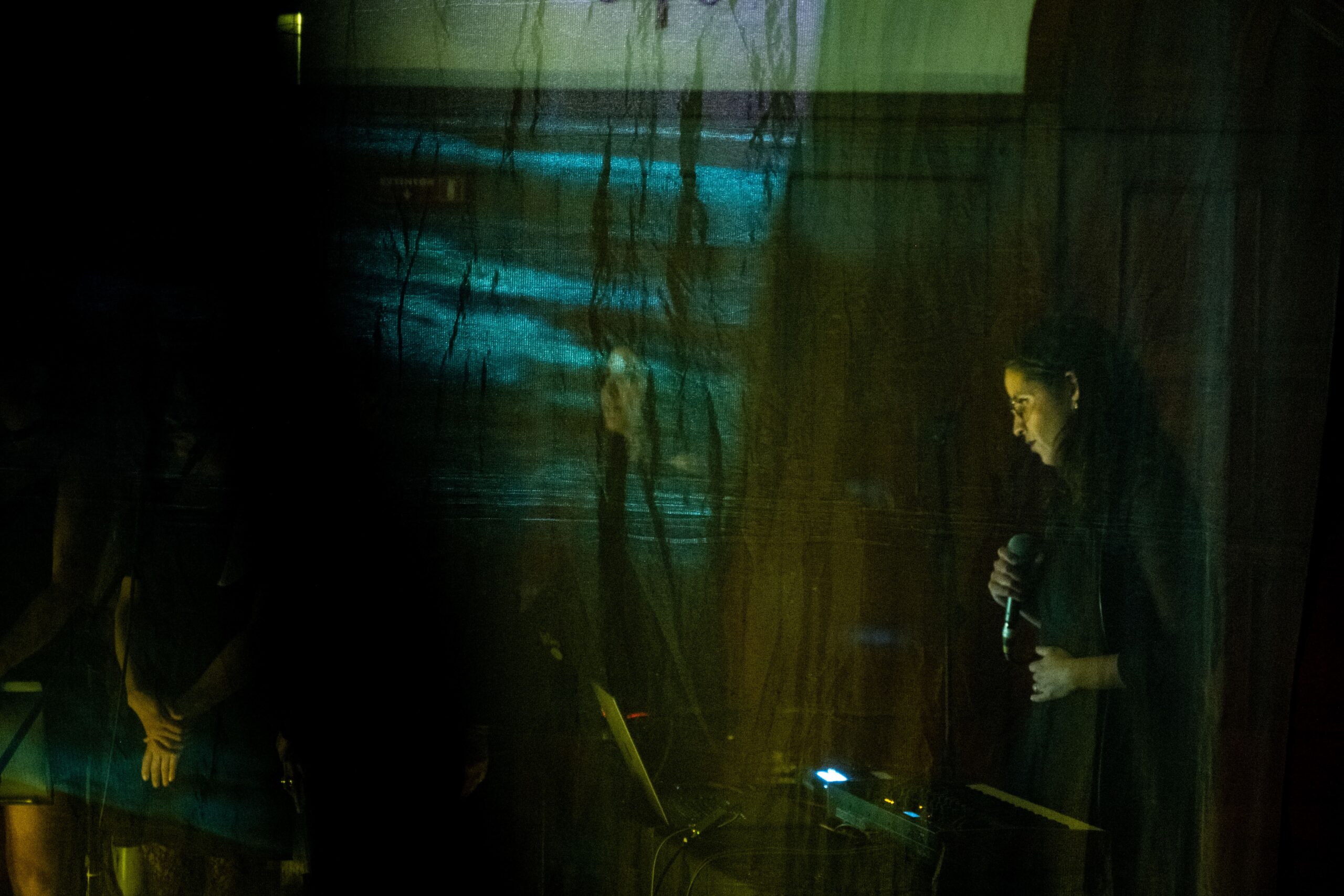
We are drawn to the presentation of Metamorphosishis new album, which he brought to the stage with AVAJI (Georgian polyphonic choir). It is an album that explores femininity in different mythologies: myths, goddesses, archetypes, shape-shifting figures, all constructed and told with layers of voice and avant-garde electronics. But the most interesting thing is that the album transformed while it was being made: what began as an exploration of the feminine and oppression ended up asking what happens when power changes hands. He talked to us about this, the challenges of such an ambitious project, what he learned along the way and what’s to come before going out to play.
Photography by Cesar Torres
Indie Rocks!: Ana, you do composition, production, you sing, you play synths, multidisciplinary art. For someone who is discovering you today, could you introduce yourself?
Nux: Clear! Am Annthe name of my project is Nnux and I dedicate myself to music: mainly composition and production of electronic music. I also sing, play synths, and have done digital and multidisciplinary art things.
GO!: I know that you have worked on different conceptual works. For example Absenceswhich explores this part of grief, our relationship with death, with those who are absent; and now Metamorphosiswhich explores the feminine in different mythologies. Something common in these two jobs is that you rely a lot on electronics to communicate. I would like to ask you if you find anything in that language (in electronics) that makes it easier for you to address these types of complicated topics.
N: Yes, a good… well, I think there are many things, but in general it is the possibility of molding the sound, of grabbing sounds that already have references and meanings, and being able to do that work like clay with them. In the project of AbsencesFor example, my idea was to make like a sound altar: capture sounds from people who are no longer present and, through that memory, be able to work with that material. Electronics allow you to do that, take these little bits of sound and modify them, stretch them, cut them, repeat themall this.
In MetamorphosisFor example, there is a song that is “Storms”which the idea was to represent an electrical storm. Analog synthesizers run on direct electricity, so it was that idea of capturing the electricity and shaping it. It’s all that flexibility that I think allows the language to expand a lot.
GO!: I totally see it. I think it is a very useful tool for expressing abstract and complicated things. Fairly Metamorphosisyour new album that you are going to present today, is an enormously ambitious album: not only in conceptual terms and in all the research behind it, but also in the execution—all the choruses, the layers of voices and more. Of everything it involved, what do you think was the biggest challenge?
N: I think the consistency of everything, because it is a very big project and committing to finishing it is quite difficult. I did have support during some stages—my scholarship Young Creators of FONCA It was for this project, and that helped me a lot to commit to finishing it, to doing all the research. But then the discipline of doing it myself, mixing it, recording the vocals, and actually seeing it through to completion… It’s quite difficult, because it’s such a big project that you can get overwhelmed and throw in the towel halfway through. That was the most difficult.
GO!: I also know that it is the first album that you mixed by yourself. I would like to know what led you to make that decision and what the experience of doing so was like.
N: Well, actually I went with a mixing engineer friend of mine, a very cool engineer called Zubin Hensler. I went to his studio and said, “Hey, I want you to mix my record.” Together we reviewed my sessions and he told me: “This album has so many layers, so many voices, that only you are going to be able to mix it at a level that you feel happy with. If I did it, it would take many hours. Why not do it yourself, and I’ll give you advice on whether it’s going well, if there is any frequency cutting that you have to do?” And he was very cool: he gave me some advice, he explained some mixing tricks that I didn’t have well figured out.
The process was super interesting and empowering. It took much, much longer, but it was very good. And what he told me does make sense, because now I listen to him and say: of course, all the decisions are there because I wanted them, I made them. So it was worth it.
Photography by Cesar Torres
GO!: Definitely. If you had given it to someone else to make it the way you wanted, it would take many hours, many correction sessions. As for the conceptual part of the album, you explore how the feminine is approached in different cultures. I read that in the research process you put together a table where you crossed the myths of different cultures and looked for similarities. I’d like to know how you jumped from the tabla to the first sound: when did it stop being research and become music?
N: I think it happened more or less at the same time. In other words, I was reading, researching and completing the table. I had some initial ideas, more or less a line drawn, but as I read more I added things, and the direction of the project changed a lot. I very much had the idea of exploring female archetypes in different cultures, different mythologies, different regions, different spaces in time, and of talking a little about the oppression of female figures in different cultures.
But as I researched more and learned more, my question became more like: “Well, what happens when you free yourself from that oppression? What do you do with the power when you gain it?” And that was when the thing of transforming it began more, so as not to replicate the same themes of oppression. It was like a journey about that, which arose from researching at the same time as composing the music.
GO!: That whole part is fascinating. And it leads me to ask you how it feels to finish an album—especially, how it feels to finish an album that precisely talks about changing shape. Would you say the process changed you?
N: Lot. Yeah!
GO!: At what level?
N: Well, just at that level that I mentioned. I had been thinking a lot about the oppression that one suffers—especially as women—but this process helped me think about our ability to assume different positions, different roles regarding power and oppression. And also to delve into my own ugly, fragile or violent parts, and inhabit them for a little while.
For that, symbolically and physically, I worked a lot with my voice. It was like: “Let’s see, the rudest, most violent part of me, how do you hear it?” —and he was in the studio screaming—. Or my most fragile, most fearful part, how do you hear it? —and he was breathing in certain ways—. And so I inhabited all these forms in the process, I went through all these characters, these forms, myself. I walked out of there like wow, what just happened?
It has been a very cool process. One of my obsessions in life is the idea of power and our changing roles with respect to it: in different contexts you are going to have different roles—sometimes oppressed, sometimes oppressor—and staying fixed can be very dangerous. Inhabiting that and questioning all the time is a learning that I will take with me for life after making this album.
GO!: I read in an interview that you defined Nnux as a mix between the intellectual and the emotional, which seems quite accurate to me. In Metamorphosis It’s definitely present, but in which song or chapter do you feel that mix is stronger?
N: In “Fires”. I think that was the exploration of the most violent part—there are many textures, noisescreams. It was a very visceral emotional part, but at the same time it’s a super nerdy track musically: it has some very nerdy, conservatory harmony stuff, which I feel was a little more cerebral. It’s all there mixed up.
GO!: Now you are about to present your album live. I saw a video of yours where you mention that, since you started making this type of music, you always imagined it presenting it live, do you think there is something in Metamorphosis that only truly exists in the live format, that in the recording it cannot be transmitted?
N: Yes—especially with AVAJI live-. AVAJI It is the choir I am collaborating with; They sing very well and have really gotten into the songs. Listening to live voices has no comparison, it is always a very unique experience. I think it appeals to something very human: whenever you hear choirs, voices, people singing together, it pulls you. That’s very powerful live, it can’t be replicated in any other way.
GO!: And now, the last one. I know that you are studying a master’s degree in Sound Art in Berlin, I am interested in knowing how you think this experience will nourish your project. And not only for the academic part, but the entire experience of living in another country.
N: I feel like seeds of things are already being planted but I still don’t see it very clearly. It has been interesting to interact more with sound art people. I come from a music background—I was always in music, piano, and composition schools—and sound art is something else. It is not always music, but ways of thinking about sound that I find interesting and that will sow ideas. Sound art people think a lot about space, about how you think spatially, which is something that maybe I hadn’t thought about as much.
Stay tuned for Indie Rocks! for more details.
TikTok / Instagram / x / Facebook