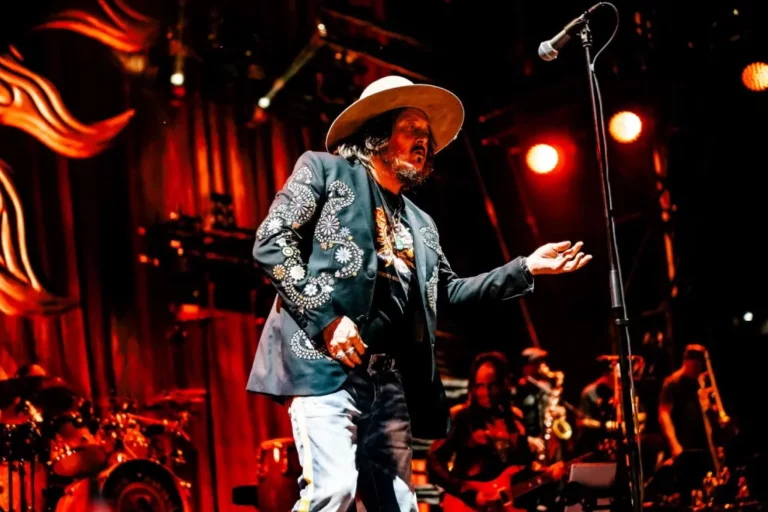
Forty years of career, over sixty million records sold and a trajectory that has brought Italian blues to stages all over the world.
In conjunction with the concert at the Dall’Ara Stadium in Bologna, one of the most significant dates of toursZucchero met with the press to retrace an artistic journey that few in Italy can describe with the same authority.
Between memories and reflections, Adelmo Fornaciari goes through four decades of music, focusing on the meetings that marked his career, from collaborations with Miles Davis, Brian May and Robert Plant to the great international events dedicated to Nelson Mandela. Anecdotes that tell of an artist capable of building a universal language without ever losing the connection with his roots.
There is also a look at the present. Zucchero addresses the theme of the transformation of live music, the explosion of concerts in stadiums and the increasingly decisive weight of social media in the success of new generation artists. A change that he observes with curiosity, while claiming a path built in an era in which it was above all the records and the stage that spoke.
The result is a portrait of a musician who continues to look forward without indulging in the celebration of the past, aware that credibility, more than success, remains the most difficult asset to conquer and defend.
THE INTERVIEW
In recent years you have probably become the most international Italian artist. Looking at your career, between collaborations and concerts all over the world, what are the memories that remain closest to your heart?
There are so many, I even struggle to put them in order. One of the most exciting moments was when Brian May called me to participate in the concert dedicated to Freddie Mercury. Then the collaboration with Miles Davis, which was something extraordinary.
I also remember the concert in South Africa for Nelson Mandela, one of those events you never forget.I also remember the twenty-four dates at the Royal Albert Hall supporting Eric Clapton. But beyond the magnificence of the stages, the gut choices remain imprinted on me, those that defend an ethic: like when, having to cover two events on the same day between Rome and Paris, I categorically refused the private jet.
I told management, “No private flights. Let’s organize ourselves with the police if necessary, but I go to Fiumicino with scheduled flights.”
I didn’t want speculation about fake ecological activism supported by privilege. These are positions that remain, just like great music.And then there are more personal episodes, like the first time I saw the Northern Lights together with Robert Plant in Norway, again on the occasion of an event for Mandela.
Today stadiums are getting bigger and concerts have become gigantic events. You have gone through very different eras of live. How do you look at this evolution?
There is an obvious two-faced Janus. On the one hand we are witnessing a global increase in the demand for live music post-Covid, an understandable desire for aggregation.
I myself have sown a lot in this sense and I am reaping the fruits.
On the other hand, however, today’s young artists are not simply communicators: they are real war machines.
Through social media they have eliminated propagation times, making any comparison with the past impossible.They move on immense stages, run, dance, sing little, sample and create monumental scenography. It is a phenomenon that does not have a single explanation, but the numerical impact is undeniable. I don’t belong to that world, I don’t understand its codes.
“Blues” continues to be one of your most loved records. How do you explain such extraordinary longevity?
The longevity of Blues probably lies in its geometric architecture and its intellectual honesty: nine tracks, of which eight became instant and visceral hits.
There was a sincerity of purpose that intercepted the zeitgeist of an era.
I think of the texts that Gino Paoli wrote for me With your hands oh Baila (Sexy Thing)written with my brother-in-law who was a painter, not an author, had a rare specific weight.
And then the rhythm, that «Hey man, it’s you who chose me» immediately became a generational manifesto. As for the band, stability is my strength.
Musicians like Polo Jones, the late Giorgio Francis, James Thompson or Adriano Molinari have been with me for twenty-five years.
They know everything. Alongside them I insert new blood sought outside the traditional circuits: I discovered the chorister Oma Jali on YouTube while Aretha Franklin sang dressed like a shaman; she has a crazy artistic animality, she arrived at the dress rehearsals without needing auditions.
Or Keeva Williams, a girl from Trinidad and Tobago who plays clarinet and sax with a formidable gospel background, and the keyboard player Peter Vettese from Glasgow, who worked with the Eurythmics and has a never boring melodic taste. With a machine like this I can afford the luxury of improvising a track in the setlist at the last second without warning. They have more than three hundred pieces in memory. The risk of error is what keeps the enthusiasm alive.
You have signed albums that have sold millions of copies, defining the collective imagination. Today, with the collapse of the phonograph market, does it still make sense to record an album? How do you justify your artistic longevity?
Writing an album today, after having signed more than 350 songs between personal repertoire and songs sold to others, is an exercise of extreme complexity.
Luciano Pavarotti always repeated something fundamental to me: «The problem is not maintaining success, the media or a good press office will take care of that. The problem is justify it».When you publish new work, you have to justify your entire story. Today, when the sales numbers of the past are pure utopia for anyone, the only reason to make a record is the intellectual comparison with one’s colleagues and with oneself.
You must take the field only if you are sure that you have eight or nine pieces in your hands capable of supporting the weight of that past, keeping the honesty of the proposal intact.
Beyond Salmo, for whom you have often expressed respect, is there anyone among the authors of the newest Italian generation who intrigues you or do you find the panorama to be flat and homologated?
Names are often misunderstood or verbal misunderstandings arise about past combinations. If I have to look at the current urban and pop scenario, I find Marracash’s writing very interesting; It has a notable density and thickness. I also really like Blanco, for his energy and freshness of performance. There is talent, the important thing is that it does not allow itself to be tamed by the algorithmic logic of multinationals.
THE DATES
8 July at the Adriatico Stadium in PESCARA
11 July at the Arena Santa Giuliana (Umbria Jazz) in PERUGIA
14 July at the Franco Scoglio Stadium in MESSINA
16 July at the Historic Walls (Lucca Summer Festival) in LUCCA
After the tour in Italian stadiums this summer, a big event in 2027 to celebrate 25 years of “Baila”, one of the most loved songs of his career
BAILA 25TH SAN SIRO
Under the moonlight
THE GRAND FINALE
10 June 2027 – San Siro Stadium – Milan
Also in 2027 there will be 10 dates around Zucchero’s birthday at the Verona Arena and for Blue’S 40th another 10 dates in 2028.
INFO & TICKETS
Click to purchase tickets
WEB & SOCIAL
www.zucchero.it