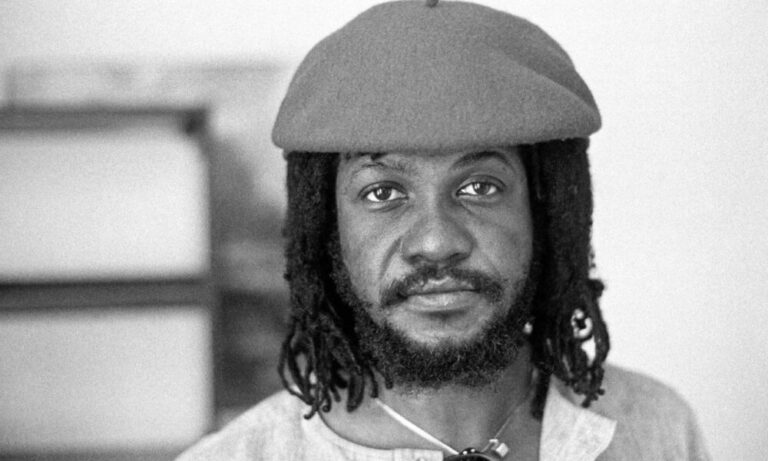
Along with bassist Robbie Shakespeare, Sly Dunbar recorded and produced countless hits and played a crucial role in the modern evolution of reggae.
Sly Dunbar, the legendary Jamaican drummer who helped guide the modern evolution of reggae while providing rhythm for countless recordings, has died. He was 73 years old.
Dunbar's wife Thelma confirmed his death to the Jamaican newspaper The Gleaner. “Around seven o’clock this morning, I went to wake him up and he wasn’t responding, I called the doctor and that’s the news that came”she said. The exact cause of death has not been specified, although Dunbar had apparently been ill for some time.
Dunbar was just 15 years old when he joined his first band and recorded his first song. It was the start of a prolific and deeply influential career, with Dunbar gaining worldwide fame for his work alongside bassist Robbie Shakespeare (died 2021). It is estimated that over the decades, Sly and Robbie have performed on more than 200,000 recordings, including original tracks, remixes and the many songs that sampled their work.
Sly & Robbie: the “Riddim Twins”
As rhythm section (and production duo) Sly and Robbie, the pair played on reggae classics by Black Uhuru, Jimmy Cliff and Peter Tosh, developing a reputation that would lead them to work with artists like Bob Dylan, Grace Jones and the Rolling Stones. Sly and Robbie also released numerous albums under their own names and were crucial in propelling reggae into the future through the adoption of electronic instruments and more syncopated rhythms.
Lowell Fillmore Dunbar was born on May 10, 1952, in Kingston, Jamaica. In a 2021 interview, Dunbar credited his sisters with filling his childhood home with the music of Otis Redding, Booker T. & the MGs, and Sly and the Family Stone (it was his love of the latter group that earned him the nickname “Sly”). But it was hearing Lloyd Knibb play with the Skatalites that Dunbar had the revelation to become a drummer. Before he had his own drum set, he played on his desk at school, as well as tin cans. At the age of 13, he managed to convince his mother to let him drop out of school to devote himself to music.
Dunbar's first gig was with a group called the Yardbrooms, while his first recording session was with Lee “Scratch” Perry and his band, the Upsetters, during which they recorded “Night Doctor”. In 1969, Dunbar played on the album Double Barrel by Dave and Ansell Collins, whose title track reached number one in the UK charts.
In 1973, Shakespeare saw Dunbar performing in a nightclub and was immediately won over by his prowess. He recommended Dunbar for a studio session, and the connection instantly struck. “The first time we played together, I think it was magical”said Dunbar in 2009. “We fell into that groove immediately. I listen to him and he listens to me. We try to keep things simple. »
The inventor of the “Rockers” style
Soon, Dunbar and Shakespeare were playing with the Revolutionaries, the house band at Channel One studio in Jamaica, while touring and recording with Peter Tosh. Additionally, the so-called “Riddim Twins” formed their own production company, Taxi, and spent the seventies working with major reggae figures such as Gregory Isaacs, Dennis Brown and Barrington Levy. Much of their success lay in their role as pioneers of the “rocker” rhythm, which allowed them to inject more syncopation and energy into the then-ubiquitous “one drop” rhythm.
Outside of Shakespeare, Dunbar has performed on some of the most lauded songs in the genre's history, including Junior Murvin's “Police and Thieves” and Bob Marley's “Punky Reggae Party.”
In 2021, Dunbar explained how rhythm rockers had been partly inspired by all the funk and disco he and Shakespeare were listening to in the late seventies, as well as their tour with Tosh (opening for the Rolling Stones) in 1978. During that tour, Dunbar explained, the duo “discovered his fears, and we had to change and try to bring some energy into reggae because the one drop was a little light for playing indoors in a big arena, a big stadium… When we came back to Jamaica, we started experimenting with the open snare with Black Uhuru, and the snare came to life. »
The digital revolution and Dancehall
This more energetic sound defined Sly and Robbie's work with Black Uhuru. With their support, the group released several successful albums, including Red, Guess Who's Coming to Dinner And Anthemwhich won the first-ever Grammy for Best Reggae Album in 1985.
The success of Black Uhuru led to greater recognition — and more work — for Sly and Robbie. They worked on several albums with Grace Jones, including her 1981 classic Nightclubbingand played on three Dylan records, including Infidels (1983). They have also recorded with Mick Jagger, Yoko Ono, Jackson Browne, Joe Cocker, Ian Dury and Carly Simon.
During the 1980s, Dunbar began incorporating electronic drums and samplers into his work. At a talk at the Red Bull Music Academy in 2008, Dunbar said that most Jamaican drummers had ” fear “ drum machines, even though he found them fascinating. “I just want to make beats and it’s cool to sit down and program something that you feel”he said. “It’s a different way of recording, so I wanted to try it.” »
With this new technology, Dunbar also helped drive the evolution of reggae into dancehall. In the early nineties, Sly and Robbie created the highly influential Bam Bam riddim with just a guitar loop and Bhangra-influenced programmed drums (there is no bass on the track). This riddim served as the foundation for several early dancehall hits, including “Murder She Wrote” by Chaka Demus and Pliers.
Sly and Robbie continued to produce, teaming up with artists like No Doubt, Sinéad O'Connor and Marianne Faithfull. In 1999, they won their second Grammy for their own album Friends.
Speaking in 2012, Dunbar summed up his approach to drumming, linking it to his endless curiosity and desire to always innovate: “When I see the red light (of the recording), I go there. I take risks and offer something different. I am always on the research side. I'm still searching, looking, listening every day to find ideas. »