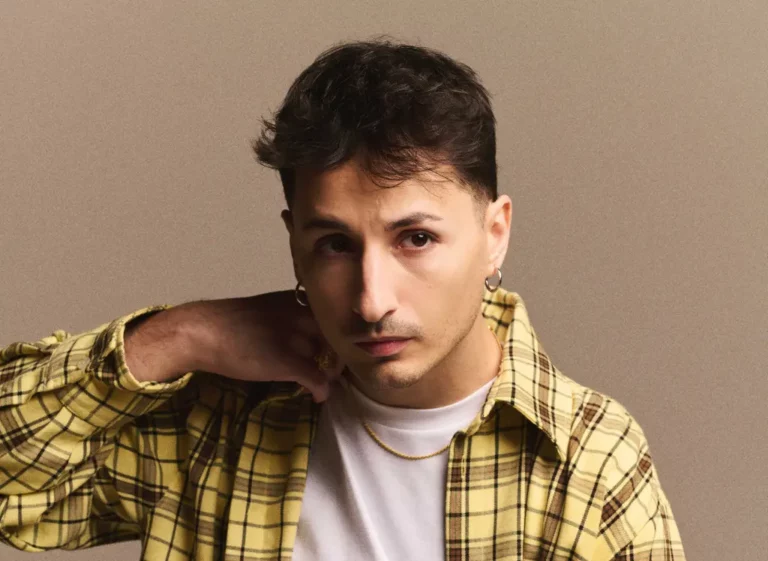
There is a moment, in the sonic research of naytin which writing stops chasing form and starts questioning the world around. “theor Individual“the tenth chapter of his discography, fits exactly there: not as a simple linear evolution, but as a conscious friction between identity and representation.
A year and a half after “Letter Q”nayt builds a record made of thirteen tracks that act as a field of tension between individual and community, between exposure and subtraction, between language and perception.
Rap hybridizes with a posture closer to songwriting and writing remains the nervous center, but opens up to visual, conceptual, even philosophical interference.
A record with doesn't have the posture of rap and the search for hits. Just a delicate and profound collaboration of “Stupido pensiero” with Elisa: an artistic meeting between two souls that results in an emotional piece, on a guitar loop that returns for the entire duration of the song.
The album also includes the Sanremo song “Prima che” (written by nayt and produced by Zef), born from the need to question what remains when you remove all the social structures, customs and habits that often get in the way of human relationships, thus returning to meeting and getting to know each other for who you really are, and “A man”, released last October, and perfect synthesis of the central theme of the project, with its illustrative question: “how does one go about being a man?”.
Here's what he said during the presentation of his album.
THE INTERVIEW
In Sanremo you brought a piece that was anything but accommodating. What was the experience like, beyond the rankings?
I left Sanremo very satisfied. It was important to me to bring that kind of language to that stage. It wasn't obvious that such a rap song, even a complex one, could have that kind of response. It was an opportunity exploited to the full, without compromise.
There are two very intense spoken interludes on the album. One is with your mother, the other? And why include these entries?
Yes, my mother is in the first one. In the second there is a fundamental person for me, a sort of mentor.
I have always been interested in inserting external voices into my records. It's a way to broaden the field, so as not to remain closed in my point of view. In those interludes we talk about devotion, idol worship, contradictions. These are issues that concern everyone: the individual, society, even me as an artist. There was no need to explain anything else, those voices already say it all.
The title I Iindividual it's almost an oxymoron. How was it born?
It emerged through writing. I noticed that the word “individual” kept coming back. And I realized that the crux was precisely that: the difficulty of feeling part of something without losing oneself.
The album revolves around this question. How are we together? How do we stay together? And I try to respond through different relationships: emotional, social, professional. I'm talking about the industry, the audience, the origins, the personal relationships. It is an investigation rather than an answer.
The song with Elisa is one of the most surprising moments of the album. How did the collaboration come about?
It didn't come from me. It was proposed by her. We met in the studio one morning and stayed there until late at night, building everything from scratch.
It was a very strong experience. I think he brought something that was missing from the record. When I perceive that a presence makes sense, then I really want it in the project.
And in this case it totally happened. It's one of the songs I'm most proud of.
“Meeting Point” seems like a reckoning with the past, especially in the relationship with the feminine. Is that so?
It's part of a journey. If you look at the tracklist, there is a sequence: “A man”, “Origini”, “Meeting point”. It's a movement.
I continually try to question what it means to be a man. And to do this I have to go back to my roots, understand where I come from. “Meeting Point” seems aimed at a woman, but in reality it speaks to the feminine in a broader sense.
He doesn't give answers. It doesn't close. It is a striving towards something that perhaps will never be achieved. I don't work on regrets, I'm not interested in judging what happened. I'm interested in observing, focusing, continuing to search.
If you had to describe the emotions you experienced while writing the album, what words would you use?
It's difficult to answer in a linear way. This is a research record, so the emotions are not one single, defined thing.
Everything that's inside, everything that comes to the listener, is exactly what I felt. They are fragments, different moments, put into music and words.
I prefer that others define them. If I did it, I would risk closing something that should remain open.
Compared to your previous works, do you feel you have found something or are you still searching?
I don't know if I found something or if I keep looking for it.
Definitely compared to Raptus everything has changed. Eleven years have passed, and it is natural that there has been growth, maturation. Today I have more awareness of my resources, as a person and as an artist, and I can put them better into music.
From a technical point of view I have developed a more precise language, a more complex but also more readable writing. And I think I have a clearer vision of my taste, of my musical identity.
But the point is not to arrive. Each album, when it ends, leaves new questions. And rightly so. If they stopped being there, the rest would probably stop too.
The animal theme returns a lot in the visual project of the album. What does it mean?
It's a path that also comes from the previous album. There were flowers there, here there are animals.
In the visuals there are different creatures, sometimes related, sometimes isolated. It's a way to remind us of our most basic nature.
I try to remove, at least symbolically, the social structures that define us. Not because they are wrong, but because there is something else underneath those structures.
I'm interested in getting there, beneath the surface, and trying to see what remains.
The cover has a very strong imagery. How was it born?
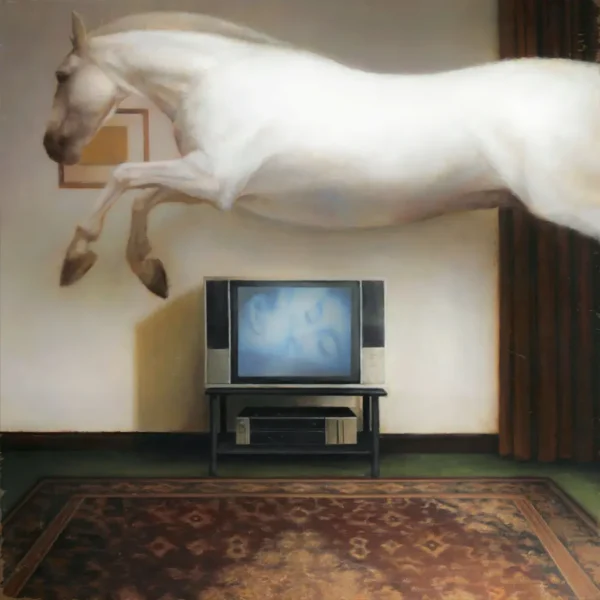
It is the result of a long research with an artist, Ozy. At one point we found a shot by Hannes Wallrafen that struck us immediately.
We decided to take it back and reinterpret it, while leaving room for free reading.
For me the central symbol is the white horse bursting into an artificial space. It's a powerful image: something alive breaking a construction.
It was important to do it in an analogical, human way. No digital artifices. Even the paintings are real, physically displayed. I wanted this concreteness to be perceived.
Here are some photos of you that accompany the album. Furthermore, the immersive installation presented in Sanremo, between mirrors and words, seems to broaden your language. How important is it for you to intertwine different aesthetics and keep the word central? What relationship do you have with photography?
These are reflections that I feel a lot.
I always try to build an immersive experience, something that involves all the senses. Mirrors, for example, are a strong symbol: they represent the fragmentation of the reality we live in today.
There is a continuous repetition of the image, a sort of duplication of the identical. It is a mechanism that we also find in algorithms, which tend to show us only what resembles us, which confirms what we already are. This distances us from the other, from comparison, from the possibility of real dialogue.
Photography fits into this discussion. In recent years I have started shooting analogue, I started in Japan and then continued elsewhere. It has become a form of expression parallel to music.
In the album project we chose not to put me on the cover, nor an explicit symbol of the individual. The idea was that the individual became the beholder, the listener. Once again, move the center from the artist to the other.
Inserting the photographs into the disc comes from here: representing my gaze, but leaving it open, available to those who pass through it.
Do you feel part of a passing generation?
Yes, I think so. I am 31 years old and I feel that my generation can act as a bridge.
On the one hand there are the younger ones, who are already born into technology. On the other hand, those who arrived later, with another type of training.
We are in the middle. We knew both languages.
I still remember a different way of listening to music: CDs, the time it takes to reach a track, the wait. It was a slower, more layered experience.
Today everything is immediate. And this applies to music but also to the rest.
We therefore have a possibility, but also confusion. It's hard to understand who you really are when you're pulled from both sides.
And perhaps this conflict, ultimately, is the same one that runs through the entire album.
THE COVER
The album cover is a 120x120cm acrylic painting on canvas hand-painted by the artist Ozy and inspired by the photograph “De Schimmel” (1992), taken by the iconic German photographer Hannes Wallrafen.
THE TRACKLIST
1. Writing
2. Exist (more than me)
3. The astronaut
4. You are born there, you die there
5. A man
6. Origins – Interlude
7. Meeting point
8. Strong
9. Stupid Thought feat. Elisa
10. Before that
11. Goodbye xx
12. Be us
13. Contradictions – Interlude
CLICK TO BUY THE RECORD ON AMAZON
INSTORE
Friday 20 March at 5.30pm at L'Archivolto (via Marsala, 3) – MILAN
Saturday 21 March at 11.30 am at Feltrinelli Central Station (Piazza Giuseppe Garibaldi) – NAPLES
Saturday 21 March at 5.30pm at Discoteca Laziale (via Mamiani, 62/A) – ROME
Sunday 22 March at 11.30 am at Semm Music Store & More (Via Guglielmo Oberdan, 24F) – BOLOGNA
Monday 23 March at 4.30pm at Galleria Del Disco (c/o Le Murate Caffè Letterario, Piazza delle Murate) – FLORENCE
Tuesday 24 March at 5.00 pm at Feltrinelli (via Roma, 11) – CAGLIARI
Wednesday 25 March at 5.30 pm at Mondadori Bookstore (Piazza Castello, 117) – TURIN
Thursday 26 March at 5.30 pm at Feltrinelli (via Cavour, 16) – PALERMO
Friday 27 March at 5.00 pm at Mondadori Bookstore (via Gabriele D'Annunzio, 115) – CATANIA
Saturday 28 March at 4.30 pm at the Music Center (Corso Vittorio Emanuele II, 165/C) – BARI
THE TOUR
After the Sanremo experience, a period entirely dedicated to live shows opens for Nayt in the second half of the year and with the “Noi Individui Tour” he will take his latest work around Italy.
November 3, 2026 | Bari, Palaflorio
November 5, 2026 | Padua, Kioene Arena
November 7, 2026 | Milan, Unipol Forum
November 9, 2026 | Rome, Palazzo dello Sport
November 11, 2026 | Naples, Palapartenope
CLICK TO BUY TICKETS
WEB & SOCIAL
@nayt