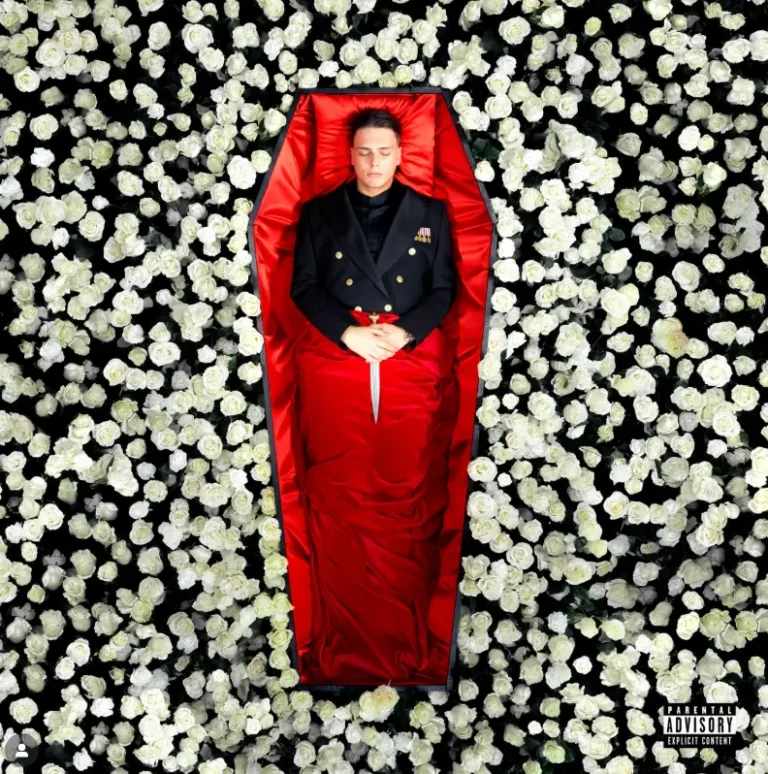
I admit that I'm having a hard time, I had a hard time reviewing “Even Heroes Die”. It is not an exercise in style, nor a simple recording act, rather a social autopsy.
The record activates two opposite and simultaneous reactions in me. On the one hand it illuminates. It is especially surprising on a lyrical level, where Kid Yugi demonstrates a rare awareness in the story of his own internal universe. The lyrics fascinate with their semantic density and narrative coherence, confirming a songwriting talent that goes far beyond the coordinates of contemporary Italian rap. On the other hand, however, the album causes anguish. Anguish for the lucidity with which he portrays a distorted world, imploded on itself, governed by incurable contradictions and by a single residual belief: the accumulation of capital as a secular religion.
It is perhaps in this unresolved tension, in this obsessive and unsuccessful search for heroism, that the key to understanding the album lies.
The opening is entrusted to THE LAST TO FALL, an invocation with an almost liturgical tone in which the voice of Giovanni Lindo Ferretti seals a symbolic passing of the baton between Francesco Stasi and Kid Yugi. There is no refrain to cling to, but an emotional progression that grows by stratification, leaving the listener suspended in a controlled vertigo. The clearest decoding of the complex lyrical structure, however, comes immediately afterwards, in a pair of songs that function as the backbone of the album: Jolly and Mostro. Two sides of the same coin, two complementary visions of the split self.
Here Francis dissects the internal fracture without complacency or absolution. The path oscillates between the iconoclastic ferocity of BULLET BALLET and the restrained catharsis of FOR SPILLED BLOOD. There is no apocalyptic rhetoric, only the observation of a reality destined for implosion, in which money has replaced every other form of meaning and ethics is reduced to a simulacrum.
On a sound level, Even Heroes Die presents itself as a complex urban organism, capable of flirting with pop and the nostalgic background of the genre without ever being tamed. Kid Yugi lucidly draws on theatrical, literary and historical references, summons ancient and modern heroes and recomposes them in a raw, direct narrative, devoid of conciliatory filters. Even the choice of featuring rejects the logic of strategic positioning: Tutti Fenomeni, Shiva, Tony Boy, Rrari Dal Tacco, Anna, Ft Kings Artie 5ive, Simba La Rue, Papa V and Nerissima Serpe are not ornaments, but companions of this project, coordinates of a precise genealogical map. It is the new school that recognizes a stable, if not definitive, center of gravity in the rapper from Massafra.
The curtain falls with DAVID AND GOLIATH, where the hero and the monster stop fighting because they discover that they inhabit the same body. The conflict is no longer represented: it is internalized. We are not spectators of the war, we are an integral part of it.
The final paradox is brutal in its simplicity: “I have everything, but I feel like a failure.” In this sentence the entire theoretical structure of the album is condensed. In an era that idolizes success as an absolute value, Kid Yugi reminds us that while power consolidates, heroes are condemned to finitude. Even Heroes Die is not a reassuring or conciliatory record: it is a lucid indictment, at times unsustainable, which refuses emotional shortcuts.
The victory of power coincides with the death of the hero.
The paradox of a boy who climbed Olympus only to tell us that, up there, the air is perhaps unbreathable.
TRACK BY TRACK
THE LAST TO FALL
“The intro contains the voice of Giovanni Lindo Ferretti of CCCP, taken from one of his songs which is almost a poem, “Occitania”, which talks about the persecution of the Cathars.
It's the song that opens the album and kicks off the journey. The song plays on the internal-external dichotomy: the me that looks inside and the me that is projected outwards. It's deliberately a track without choruses. It uses a different flow and approach than what I have done so far and contains a crescendo that culminates as a great emphasis.” Investigates how the artist's life has changed, from being Francesco Stasi to becoming Kid Yugi.
NECESSARY VIOLENCE
It's a banger where we find the usual Yugi, sharp bars and perfect joints with a dark sound. “It's a violent track: it focuses on the fact that History tells us that to create a heroic figure, we also go through violence. And it is also used by those who initially reject it.”
HEROIN
“It comes from a play on words: the feminine of 'hero' and the narcotic substance. I wrote it thinking about how a strong feeling, even if positive, causes suffering and can create addiction.”
JOLLY
It's a light-hearted, but reflective track. “Unfortunately, very often the people who emerge in today's society are not people who impose themselves thanks to their ideals or who fight for or against something, but rather 'jesters', who catalyze attention, attracting and producing money. The era of heroes is over, the era of jesters has arrived.”
MONSTER
It is the most intimate track on the album, piano and voice, without drums. “I wanted the repeating piano pattern to become the perfect background to my words. It is a confession, it investigates how much life has changed for me and who I have become today. The main theme is: every day a person makes a choice: not to give in to the wickedness of the world so as not to become a monster.”
BERSERKER
The term “Berserker” (“bearskin” in Old Norse) comes from Norse mythology and sagas and indicated a warrior whose spirit was invaded by the powerful god Odin, causing him “fury” and “ferocity” before the battle, as if in a state of 'trance'.
PUSH IT (Feat. Anna)
“You have to push yourself beyond limits to change things, or destroy them (metaphorically).” Kid Yugi raps over an urban “Miami-bass” sound. Kid Yugi experiments, pushes his boundaries and brings a bit of ANNA's musical world into the piece.
AMELIE
“It is a song dedicated to impossible and only 'ideal', therefore 'perfect' loves. When you idealize something and don't live it, it cannot be ruined and contaminated by reality”. It is a track written in one go in New York after meeting a girl, shortly before leaving for Paris. A love not destined to come true.
GILGAMESH
Inspired by the oldest epic in the world and coming from Mesopotomy. It tells of the exploits of this legendary hero-king, king of Uruk, who sets out in search of the secret of immortality after the death of his best friend. “The track speaks of how little or nothing is left of the human being in today's society, now reduced to a mere 'container of information'. Therefore, the attachment to life and immortality in such a vacuous existence is completely useless.”
CHUCK NORRIS
Inspired by the famous action TV series actor. “When I was little, in my area there was the myth of Chuck Norris, the one who can do what others can't. It's how society imagines a hero. That is, a distorted description of who a hero actually is. An indestructible person, capable of facing any adversity.”
TRISTAN AND ISOTTE
One of the most famous love stories, contained in the Breton cycle. “The song talks about a finite love, a toxic but all-encompassing love, which could only have survived if we had canceled each other out”.
MU'AMMAR GADDAFI
“He is a hero in Nietzsche's sense of a hero, a person who goes beyond good and evil and manages to move something in the time in which he works. Obviously, in reality he is a figure with many negative aspects.” A banger made for club music.
BULLET BALLET
“Inspired by one of my favorite films by Shin'ya Tsukamoto, “Bullet Ballet”. An ordinary man mortified and humiliated by the wickedness of the world rebels and therefore surrenders to violence”. A banger in pure hard-core rap style, self-congratulatory. An exercise in style.
FOR THE SPILLED BLOOD
“A song dedicated to all the kids who have lost themselves due to bad choices. Most of the time suggested in an infamous way by the context and the people around them. For anyone who has thrown their life or part of it behind ideals that didn't even belong to them”.
WHAT A FIGHT FOR YOU
“Written for my sister, at a time when she was hospitalized. The song contains all the words that I wasn't able to say to her in person, even though I would have liked to.”
DAVID AND GOLIATH
Biblical reference to the story of David is Goliath, it is the outro of the album. “He closes the album with an idea that buzzes around my head: we are not part of the conflict, we are the conflict, we are both David and Goliath. Every existence must confront the inevitability of its own condition.”
SCORE: Score 7.75
TO LISTEN NOW
Monster – Amelie – Tristan and Isolde – For Spilled Blood – Bullet Ballet
TO BE SKIPPED IMMEDIATELY
Nothing. Absolutely nothing. It's a burst of energy.