Raising the bar of one’s musical research is a necessary condition for those who want to remain an artist and not become the curator of their own catalogue.
The Pet Shop Boys have been raising it for more than forty years, and with «A man from the future» they do it in the least obvious direction: backwards.
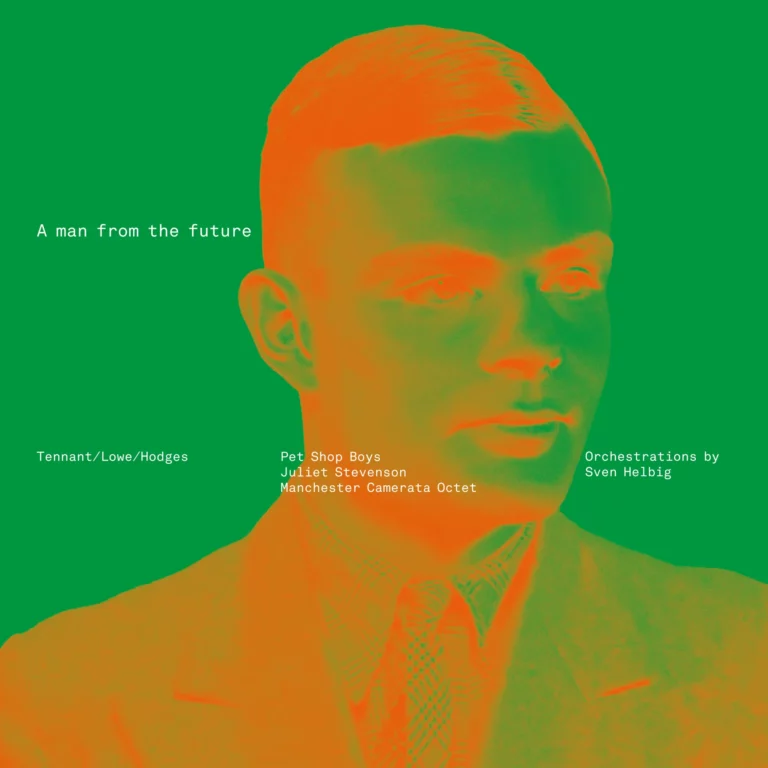
“A man from the future” is not new material. Tennant and Lowe had written it in 2012-13 with Andrew Hodges, Oxford mathematician and author of “Alan Turing: The Enigma”, and had performed it only one evening, in July 2014, at the BBC Proms at the Royal Albert Hall with the BBC Concert Orchestra and the BBC Singers. Twelve years later they dismantled and reassembled it. The electronics have gained space, the orchestra has shrunk: Sven Helbig has reduced his arrangements to the eight strings of the Manchester Camerata. The Manchester Grammar School Boys’ Choir sings in four numbers, Juliet Stevenson reads a narrative taken from Hodges’ book and expanded with Tennant. The first concept of their discography arrives on their sixteenth studio album.
Eight tracks, eight chapters in chronological order. It starts with Natural wonders every child should knowa title taken from the science manual for children by Edwin Tenney Brewster that Turing read as a child, and the choice declares the method: here the text rules. For long minutes it is Stevenson’s voice that carries the story. The boy who doesn’t fit in and retreats into himself in Sherborne, the meeting with Christopher Morcom in 1927, the nights watching the stars, the bovine tuberculosis that Morcom had contracted as a child and which took him away in 1930, Alan’s letters to his friend’s mother. Then Cambridge, Bletchley Park and the Enigma machine, the digital calculator, the prophecy about thinking machines, the 1952 conviction for a homosexual relationship, chemical castration, cyanide in June 1954.
Under Stevenson’s voice the album moves on two levels. There’s Lowe’s electronica, with carpets of analog-sounding synths that hark back to the 1980s. And there is Helbig’s orchestral writing, which in the transition from the BBC Concert Orchestra to the eight strings of the Manchester Camerata has lost the symphonic mass of the Proms and gained clarity. The scores proceed in lines, intertwining with the synthesizers instead of covering them, and letting the boys’ choir breathe when it enters. Pop rarely manages to make these two languages coexist without reducing one of the two to a decoration of the other. Here the balance holds, also because neither of them is in a hurry.
«A man from the future» is more like a radio play with songs than an album with a narrative frame. Those looking for the synth-pop of «Nonetheless» will find little to hum. Whoever accepts the pact finds Tennant in the role he has done best for four decades, that of the commentator who observes pain from a minimum distance and makes it bearable.
It’s a record that you listen to once with all the concentration it deserves and then the risk is that it settles on the shelf next to Hodges’ book, which is exactly where it belongs, in the future.
SCORE: Score 7.50
OTHERS’ VOTES:
TO LISTEN NOW
The Enigma – Only in his death – A man from the future
TO SKIP NOW:
Nothing. To be listened to and possibly not put away
TRACKLIST
1. Natural wonders every child should know
2. He dreamed of machines
3. The Enigma
4. Other ranks
5. The memory and the control
6. The trial
7. Only in his death
8. A man from the future
DISCOGRAPHY:
1986 – Please
1987 – Actually
1988 – Introspective
1990 – Behavior
1993 – Very
1996 – Bilingual
1999 – Nightlife
2002 – Release
2006 – Fundamental
2009 – Yes
2012 – Elysium
2013 – Electric
2016 – Super
2020 – Hotspots
2024 – Nevertheless
2026 – A man from the future