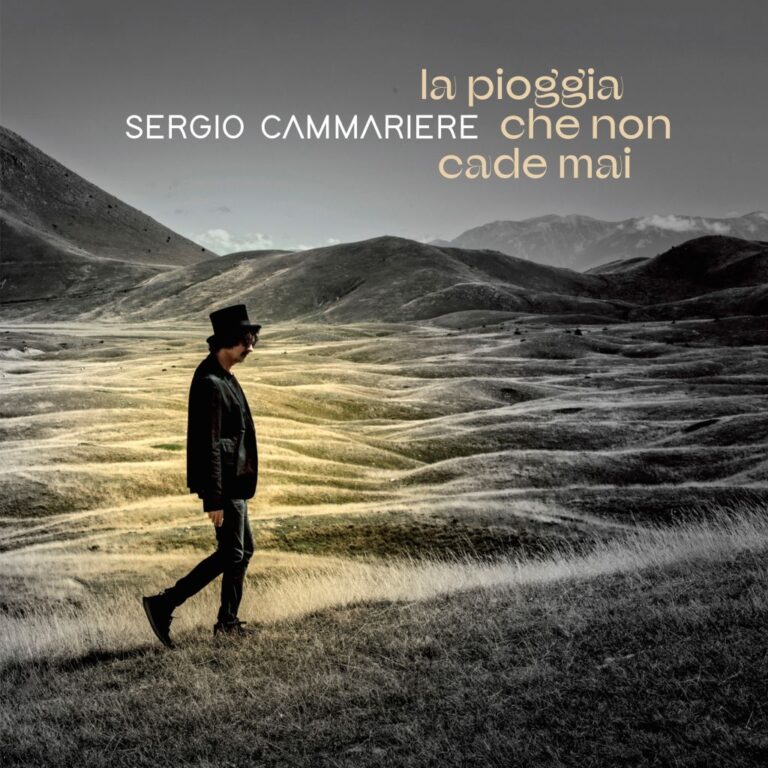
“The Rain That Never Falls” is something atypical for current discography. Refined, refined, elegant. An album of researched, played, composed and arranged author's music.
Let's clear the field of misunderstandings: defining this work as “refined” is a lexical laziness that does not do justice to its substance. The thirteen tracks are scores that reject the algorithm, built with the patience of the restorer. Where today's pop screams to be noticed in the first three seconds, Cammariere whispers, forcing the listener to lean towards the speakers, to make an effort of attention that is now obsolete.
The partnership with Roberto Kunstler is confirmed not as a collaboration, but as a psychic symbiosis. There is no disconnect between the syllable and the note: jazz and songwriting merge in an interplay that carefully avoids the trap of the “chic background”. The themes covered – memory, absence, love as a benign pathology – are presented without that sugary sentimentality that taints the charts. It is melancholy, yes, but dry, adult, without self-pity.
Musically, the album is an education in competence. The rhythm section is entrusted to Alfredo Golino and Amedeo Ariano (drums), assisted by double bass players of the caliber of Ares Tavolazzi, Luca Bulgarelli and Alfredo Paixão. We are not talking about simple session workers, but about sound architects who build anti-seismic foundations on which Sergio's piano can allow itself any digression. The interventions of Giovanna Famulari on the cello and Daniele Tittarelli on the soprano sax are not “coloritures”, but necessary fissures in the harmonic fabric, while Christian Mascetta's guitars add a material grain to the whole.
There are those who could accuse Cammariere of being static, of playing “music from other times”.
The accusation is admissible, but must be overturned: in an era of planned obsolescence, Cammariere's stylistic coherence is an important act. “The Rain That Never Falls” doesn't try to seduce Gen Z, nor does it try embarrassing hybridizations to appear young.
It is a record of sonic, artisanal and analogue “haute couture”, which offers political asylum to those who still seek warmth and harmonic complexity in a world that seems to have lost both. A work of reassuring beauty, which does not surprise with innovation, but disarms with its impeccable class.
TRACK BY TRACK
1.“Love is everything”. A statement that fits into the tradition of classic romantic ballads, the celebration of a love that resists time.
2.“The rain that never falls” is a visionary ballad that invites reflection on the need for a different human attitude towards the environment and nature.
3.“The voice of the heart” is a minimalist song with the ability to express the essential: the search for balance between heart and mind. The modal structure of the song, the rhythm and the orchestration recall echoes of alternative prog.
4.“Like a dance.” The unknown, the dream, love, salvation. The truth that is found within and not outside of us. In the arrangement the piano and strings supported by an unusual reggae-pop rhythm.
5. “A long wait” deals with sensitivity and transparency with the theme of absence, regret and the desire for reconciliation. It tells of love in its most vulnerable form: that of memory, doubt and the courage to hope again.
6.“The river comes down” is a deeply symbolic piece, inspired by Gibran's poetry, built on the image of the river as a metaphor for existence. The piano, the voice, the Mediterranean rhythm and the harmonic texture of the strings in classical form are the landscape of this vision.
7.“Certe storie return” is the ballad of the album, a song that explores the emotional territory of return, of memory and of the love that remains, despite time, distance or uncertainty.
8.“What will ever become of me” Ballad with an Andalusian style that addresses the end of a love through memories, regrets, questions and attempts to start over.
9.“Like a dream” is another song that explores the territories of love: what remains, what fades and what continues. The bolero rhythm, the piano and the voice create a soft atmosphere, an ancient song out of time.
10.“Something I Left Behind Me” is the most pop song on the album. He talks about love and its mystery as a distant light that never goes out.
11.“A secret of love” A promise kept like a secret. A bright song, an open-hearted love letter. Sunny music with strong references to pop and contemporary sounds.
12.“The uncertain reality”. On the one hand an elusive and constantly changing reality and on the other the certainty of a love destined to last. Between the fragility of dreams and memories “The only hypothesis of happiness”.
13.“Davanti all' interno” is the most lyrical song of the collection, an essential and minimalist song. Music and poetry without place and time.
SCORE: 7.25
TO LISTEN NOW
The Rain that never falls – Like a dance – A long wait
TO BE SKIPPED IMMEDIATELY
Just under an hour of quality music. Rare in recent years!!!
TRACKLIST
THE DISCOGRAPHY
1993 – Memories and people
2002 – From the peace of the distant sea
2004 – On the path
2006 – Bread, wine and vision
2009 – Caravans
2012 – Sergio Cammariere
2014 – Hand in hand
2016 – Me
2017 – Plan
2019 – The end of all troubles
2021 – Bare floor
2023 – Just one day
2025 – The rain that never falls