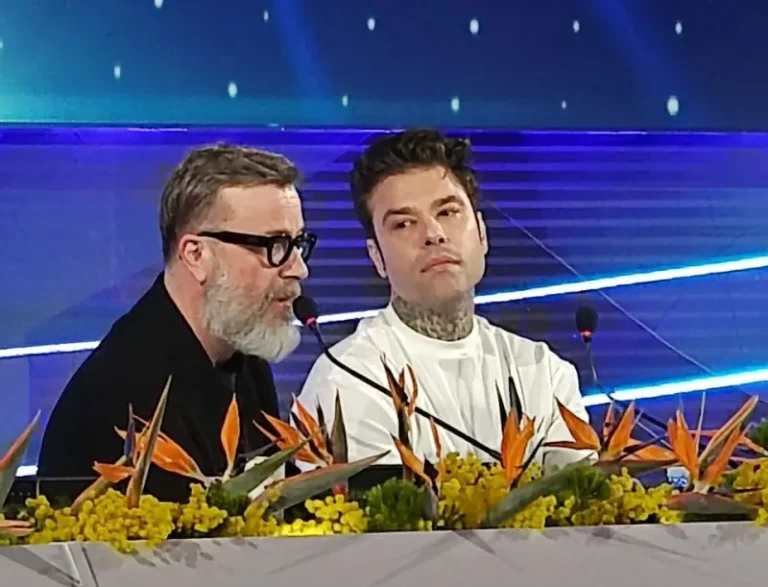
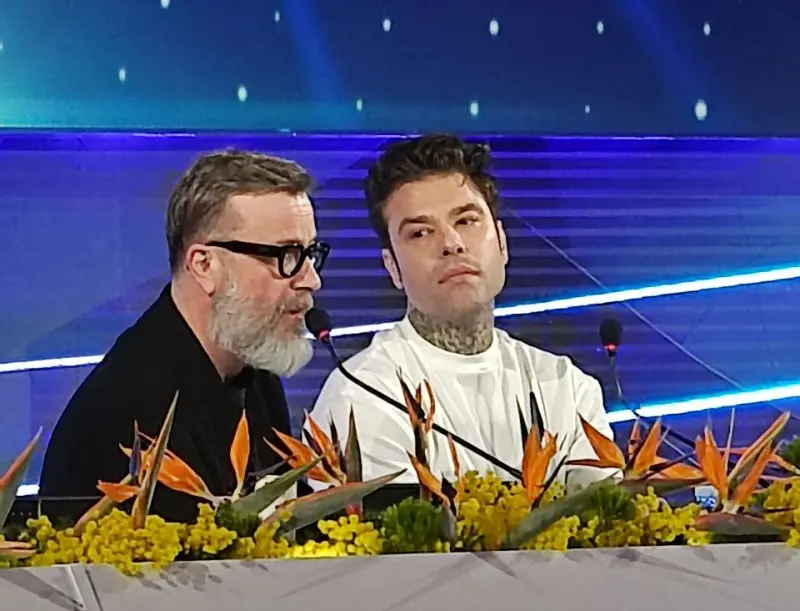
Masini-Fedez-Sanremo-2026
They are the big favorites to win the 2026 Sanremo Festival. “Male Necessario” dominates the FIMI singles chart and stands out in Italian ratings on Spotify, numbers that transform the partnership between Fedez and Marco Masini into a media case even before an artistic one.
Two distant paths in terms of generation and musical grammar find themselves at the center of consensus today, driven by a song that intercepts fragility and redemption without indulging in nostalgia.
In this climate of waiting and predictions we met them to understand what it means to arrive at Ariston with the weight of numbers and expectations.
THE INTERVIEW
Yours has become a strong friendship. What is it based on? What does Federico like about Marco and what does Marco like about Federico?
Fedez: I was struck by his calm. Behind the scenes he has an almost ascetic serenity. I've always felt like this stage was a boulder, he manages to make it habitable. By osmosis he taught me not to suffer it. And then he has an infallible method to ease the tension: talking about Fiorentina. Before going on stage he just updates me on that.
The first evening I said to him: shall we warm up our voices? He replied: go purple. That was the warm-up.Masini: Federico has a hunger that I recognize. It's not just ambition, it's a desire to question yourself. When he called me last year to reread “Bella bitch” I understood that he wasn't looking for a nostalgia operation, but a true comparison. And this interests me.
Federico, the work on the voice was evident. How much did the collaboration with Luca Jurman have?
Fedez: Very much. I met Jurman during an episode of my podcast. I sensed in him a desire for revenge that belongs to me. I said to myself: why not rely on someone who has solid skills and the same urgency to demonstrate? We talk every day. He was a crucial travel companion. I thank him publicly.
You were both divisive artists. First Masini in the nineties, then Fedez. Does being divisive and free pay?
Masini: It depends on the weather. I have been loved and hated, today it is different. Time relativizes everything, as Einstein would say. The means of communication change, the way of listening changes. When I started I didn't have social media to defend myself or explain myself. I had to pass by a television that maybe closed the door on you. Today the context has changed, so has the gaze on me.
Fedez: I don't think we can group ourselves under the label of divisiveness. Marco often received gratuitous attacks. As far as I'm concerned, I have above all been my own enemy. But I learned one thing: music turns off background noise. Last year and this year I'm happy that we can go beyond what I do outside of music. I'm trying to put the songs back at the center. The past cannot be changed, the present can.
How was “Necessary Evil” born?
Masini: It is the natural continuation of a successful meeting. Last year's experiment wasn't painless, for weeks everyone only talked about my presence and the song.
But that very tension created an artistic empathy. When it happens, you no longer think about labels: who raps, who sings, who is young, who isn't. Think about building a song.
It's the only thing that matters.
From 2025 to today there seems to be a favorable wind. We recognize fragility, pain, but also a possible solution. Is this what is reaching the public, even more than musical alchemy?
Fedez: The song we bring is a mantra. And repeating this to yourself while you're competing is essential. If there's one thing I want to take home from this Festival it's to be able to say: I enjoyed it.
Last year I avoided the comparison, even just by reading a little about what was happening. This year I chose to live it to the fullest. We don't think about the favorable or contrary wind, it is a temptation that alters the spirit. I care that the meaning of the song comes through. It's not a philosophical treatise, it's a simple concept, but if you internalize it it can help. For me the victory is this: seeing someone recognize themselves in the story we tell. The rest is a surplus.Masini: If you think about the Champions League while playing the championship match, you're wrong. You have to stay there, in the present. At 61 years old, after a career of 36 years, I found myself first on Spotify. Forty years later “You can give more”. I started as an apprentice in Giancarlo Bigazzi's studio, dreaming of Gianni Morandi, Enrico Ruggeri, Raf. Finding myself at the top of the charts today is a small miracle. I'm happy, period. The rest is statistics.
What have you taught each other along this journey?
Masini: Federico gave me the opportunity to understand from the inside how the musical language is evolving. It's not enough to listen, you have to be in the studio with those who are twenty or thirty years younger than you and work with other metrics, other dynamics. It's like learning a language: you don't study it in a manual, you learn it by living in the country. With him and the guys on his team, together with Antonio Iammarinowe looked for a new lexicon. Not his, not mine. A meeting point. This is how a credible musical world is born.
Fedez: Marco brings with him an experience that weighs in the best sense of the term. It taught me that that stage speaks for itself, more than any statement. And that the only thing you have control over is performance. Everything else is noise. Artistically it helped me focus on that. Going on stage thinking only of the song.
THE SONG
WEB & SOCIAL
@fedez
@marcomasini_official