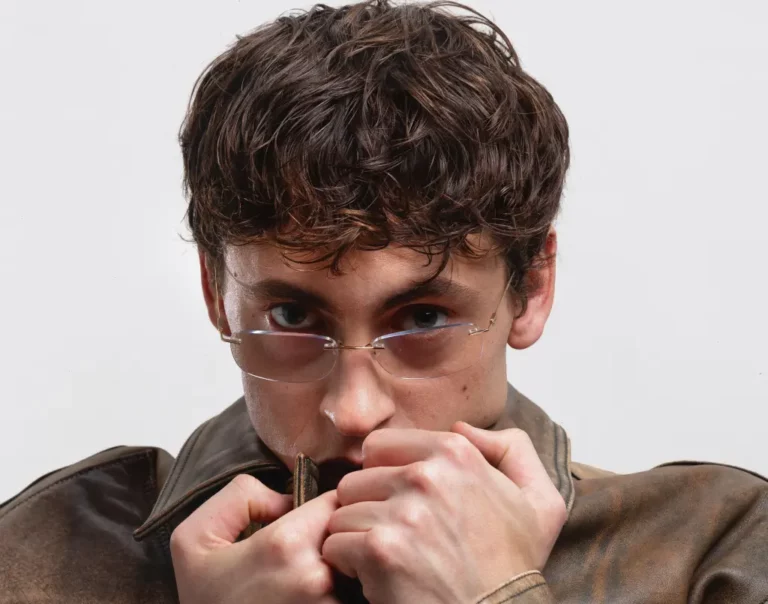
There is a subtle difference between falling and letting yourself fall, a gesture, a will, a friction with the air. Tredici Pietro arrives at the 76th edition of the Sanremo Festival with Falling mana song that already in the title becomes a statement and a condition.
The unpublished song is written by Tredici Pietro together with Antonino Dimartino. The music is by Antonino Dimartino and Marco Spaggiari. It is produced by Vanegas; additional production is by Giovanni Pallotti, Fudasca, Sedd and Montesacro.
The song tells the story of life as a continuous movement, made up of research, falls and restarts. FALLING MAN explores the natural search of the human being, that drive to never be satisfied and to constantly get back into the game, falling and starting again in a cycle that is an integral part of existence.
We met him. In this conversation emerges an artist who shuns generational rhetoric but intercepts its cracks: emotional precariousness, symbolic inflation, obsession with results. And who chooses, with an almost obstinate clarity, to defend the right to make a fool of himself, to make mistakes, to make attempts. Because perhaps, today, true disillusionment is not falling. It's to stop trying.
THE INTERVIEW
Can you tell us about Falling Man?
The song is the direct result of “Non Guarda Down”, my first album. I wrote it less than a year ago, on a sunny day, at a time when I still had everything I had tried to tell on that record.
I feel a very strong red thread. This is why we decided to include it in a re-release: I wouldn't call it a repack, it's more a way to close a personal cycle. It's as if I were putting a stop to an internal journey born of an urgency.
In the song you talk about “trying” as a necessary but painful gesture. Is it a generational issue?
I think so. They tell us that there is no harm in trying, but around me I see many peers blocked from trying. We are paralyzed by endless possibilities and expectations.
From continuous comparison. From the widening social gap. I don't want to turn a song into a rally, but it's hard not to notice.For me, negativity is not in failing, but in not acting. Depression is the end point, but first there is stillness.
We only have our bodies and a minimal margin of free will. If we don't try, what's left?
Yet “Falling Man” is also a love story.
Yes, I start from a real relationship. In the past I have talked about it too much, with little elegance. Today I prefer to leave room for the symbol. When you fall out of love, you de-idealize someone, you take them off their pedestal. But in doing so you risk forgetting that you too are falling.
To this person I say: look up, there is a man falling. Because while you put me back on the ground, I'm still trying.
We young people are idealists, then reality derealizes us in an instant. It is a continuous crash between gigantic dreams and a present that does not grant them immediately.
The fall, then, is not just defeat.
No, it's movement. The scale of life is not linear. It doesn't just go up. Accepting it is perhaps the most complex thing today. It seems like everything comes to others immediately. We live inundated with inputs that don't let us sleep peacefully. I tried to tell all this without enclosing it in a precise formula.
When I write I don't have a thesis to prove. Only now, speaking, do I understand what I was trying to say to myself too.
For the covers evening you have chosen a song that belongs to the history of Italian music and also to your family history. How does it intertwine with “Falling Man”?
I don't want to make comparisons. I'm just saying that it's a song that talks about life and friendship, and that it's part of my father Gianni Morandi's discography.
For years I said I wanted to keep my distance from that legacy. Then, as soon as I heard about Sanremo, almost without thinking, I accepted. It's as if it wasn't a rational decision. An instinct.I will bring that song with my traveling companions, Fudasca, Galeffi, Sedd and Montesacro. They are the people I built the record with.
Brothers before collaborators. Ultimately it also talks about this: about shared life.I am lucky enough to be the son of the person who sang that song before me, and this is not an overwhelming responsibility, but it is a fact. I couldn't have chosen anything else. The only alternative would have been a song by Inoki, Bologna by Night, because I also grew up with that world outside the home. But it would have been a mistake. The best thing will be singing it with my brothers on stage.
How did you react when you found out you were competing?
I was in the shower. A friend came into the bathroom shouting that we were going to Sanremo. It was surreal.
Then I understood that, beyond the enthusiasm, this stage is an opportunity to test oneself. “Falling Man” was born from there: from the need to try, even knowing that one can fall. Perhaps above all for that.
In what state of mind do you approach your first Sanremo? Was it a hard-fought idea?
Last night I really realized that I'm going to be on that stage soon. I thought I'd sing with the heartbeat I have now. And rightly so. It's a spark of life.
For years I rejected Sanremo as a concept. Coming from rap and a family linked to that stage, I felt the need to keep myself distant. Then I made peace with the idea that it is a beautiful thing. It's natural.
Do the race and the ranking make you anxious?
Nobody wants to disfigure themselves, everyone wants to win. But there are many ways to win.
Everyone has to do their own race. The best result comes when you think about yourself and not about other people's gardens.If you start thinking about the rankings, you are already looking at others. Better to avoid it.
THE DELUXE VERSION
The new deluxe version includes, in addition to the original tracks, the song LA FRETTA and the unreleased UOMO CHE CADE, with which it will compete for the first time at the 76th edition of the Sanremo Festival. DO NOT LOOK + DOWN will be available in CD, Autographed CD, red marbled vinyl and autographed red marbled vinyl formats.
WEB & SOCIAL
@tredicipietrotredici