On an island in Fiji, the country star freedived, speared tuna and cooked for the Season 50 contestants. Before picking up his guitar and making them all cry.
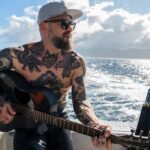
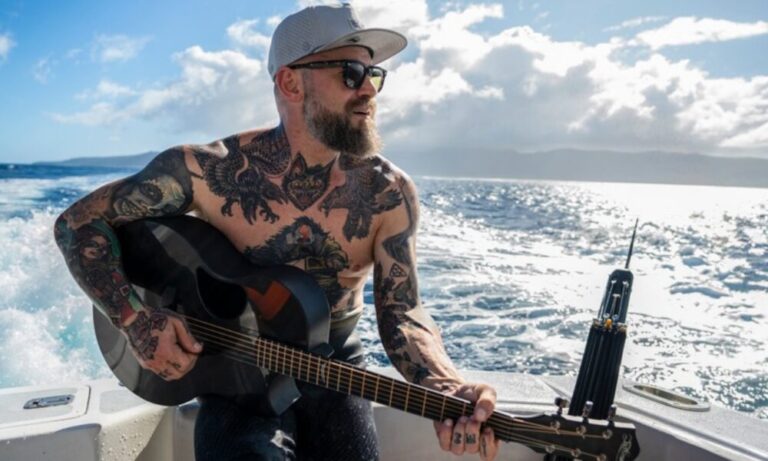
A small gray boat cuts through the turquoise waters off Mana Island, Fiji. At the helm is a man who looks more like a local fisherman who hasn't seen a razor or a hotel shower in a week than the multi-platinum country star that he is: Zac Brown. Tattooed on the right shoulder: Bob Marley. On the left, improbably: Teddy Roosevelt. He is attracted to the Rooseveltian idea of the man in the arena, the one who acts while others watch. “There will always be people who spit on what you do”he would tell me later.
On the floor behind him, two four-foot dogtooth tuna, silver bellies glinting in the sun above neat slits, speared by his hand about an hour earlier. To catch these fish, Brown, armed with a custom-made Alemanni harpoon gun, dove 75 feet into some of the most shark-infested waters in the world. He had 90 seconds to aim, shoot and haul the bloody carcass back, one at a time, through the water column before a shark snatched it from him. This has happened to him before. “Sharks are a good thing”he would say later, in the neutral tone with which one would order a coffee. “It’s a sign that there is a lot of life. » He spent over a decade training his body and mind to operate in the dark on a single breath. This requires, above all, learning not to panic.
Brown steps out of the boat onto the hot sand, holding the fish by the jaw with both hands — he runs the length of his torso, his crescent tail flapping at waist height — and flashes the kind of wide, unbridled smile of a man who's just done something most people wouldn't even attempt on a bet. Then five people come running onto the sandbar. A cameraman adjusts his strap. Two tripods are planted in the sand. And then we remember: this is the Survivor set.
How it all started at Dave Grohl
It all started, like so many things, at a barbecue at Dave Grohl's in Hawaii. Jeff Probst was there. “A girl said to me, 'Oh, Zac Brown is coming — he's a Survivor fan'”remembers Probst. “We talked for like three hours about life and Survivor, and as we were leaving, Zac turned to me and said, 'Hey, I'd love to play this game, but I'll never have a free month with my schedule and my family.' But if you ever make a shortened version, or need me for a day or two, let me know. » »
Probst put the information away. When he texted Brown about the concept of the legendary Season 50, titled “In the Hands of the Fans” — which is seeing its best ratings since 2021 — Brown responded immediately. “I’m in.” And here's what I'm going to do. I'll come catch some fish for you and cook it. I bring everything you need. Filleting knives, a Demerbox, we put on some music. » Probst pauses. “And then he said to me, 'Do you want me to bring my guitar?' I said, “Zac, if you want to play music, that's literally the cherry on top of the greatest award of all time.” » »
The man in the arena
I meet the leader of the Zac Brown Band around 9 a.m. on the morning of the reward challenge, the ninth day of filming, in a cramped production office in the jungle, a few meters from the set on the beach. He's completely alone — no managers, no label, no publicist, no one to dab foundation on him or offer him water. He is 46 years old, with a slim figure, in a black t-shirt, fitted camouflage Bermuda shorts and flip-flops. He looks like a kid on Christmas morning.
The eleventh child of twelve, Brown grew up in northern Georgia, at the foot of the Appalachian Mountains. His first jobs were always in the kitchen. When he rose to fame with the Zac Brown Band for hits like “Chicken Fried,” “Free” and “Homegrown,” he did his best to downplay his fame. In fact, Brown spent years building one of the most deliberately understated careers in American music. “I developed near-PTSD about being a celebrity”he says, with something that may or may not be irony, given that he's on the set of the most-watched reality competition in television history.
At the time of our interview, Brown is intensely preparing for his band's residency at the Sphere in Las Vegas. “I want to create something that elevates us to legendary status”he said. “We want to be a Grateful Dead or a Rolling Stones. We want to be in that air. » He self-funded the entire residency. “I love the fact that we’re a bit of an underdog. »
The Sanctuary
In the Survivor universe, the Sanctuary is an open cabin decorated like a fanciful beach bungalow. It's a setting on the island of Mana where the winning tribes come to eat, relax and drink — maybe find a clue. “Usually it’s quick, you get in and out.”explains Benjamin “Coach” Wade, 54, who participated in four seasons including this one. “That was something else. »
Wade is the first castaway to greet Brown when his inflatable boat arrives with the day's catch. “I’ve seen you all before”Zac said, scanning the assembled tribe — a maestro, an actuary, a business lawyer, an artist, a salesman, a firefighter and a cattle rancher — while preparing to clean the fish. “I feel like I know a lot of you.” I'm as excited as you are right now. »
The art of serving
Brown plunges his knife into thin cuts along the bone of the tuna and gets to work. Once the filleting is done, he makes a tropical salsa with jalapeños, red onion and cilantro, and grills the fish. (He accommodates the tribe's vegan with wood-grilled tofu and vegetable skewers.) On other game shows, the celebrity guest is the reward. Here, Brown is their butler. He just can't help it.
While cooking, Brown carries on three conversations simultaneously: “I have a fair amount of ADHD, so I listen better when I'm doing something. » He talks about his love for Jimmy Buffett, his concert at Fenway Park, the time he met Beyoncé and Jay-Z at the Grammys after wolfing down an In-N-Out Burger in the van outside. “I shake their hands with a hand that stinks of onions. I was so ashamed. »
Brown spots Joe Hunter, captain of the Sacramento Fire Department, finalist of Season 48, and says to him: “I think you should have won”as if he had crossed the Pacific just to deliver this verdict. “I saw his hands trembling”Wade told me later. “That’s when I knew he didn’t come to be a star. He came to be one of us. »
The guitar at dusk
The late afternoon light has changed in angle but not in intensity as the production descends on the beach and the castaways settle into the cool sand. Brown watches them and picks up his guitar, a sleek black carbon fiber instrument designed to withstand humidity, and begins singing a cover of Jason Isbell's “Cover Me Up.” When he talks about writing his own music, he describes it less as entertainment and more like surgery. “I want something where the message, the melody and the harmony come together to pierce you”he said. “I know that if I cry while writing it, it will do the same for others. »
At 14, he moved in with his father, but the situation was tense. His stepmother let him stay for a year and a half, then they moved to Atlanta. At 16, he had no adult supervision — just a bed above a friend's garage, his father paying the rent, and a drive to Chattanooga every weekend to play in a band. “I had to grow up so quickly that I was already an adult in many ways”Brown said. “All these things had to happen, no matter how fucked up they were. »
It was while taking an abnormal psychology course in college that he first encountered the clinical vocabulary for what his mother suffered. “That’s when all the anger turned into compassion”he said. “Because it wasn't his choice to be like that.” » Brown ultimately helped his mother get diagnosed after she, he says, forged his signature on a life insurance policy. “I told him: ‘You’re going to get treatment’”he remembers, before welcoming the change he has witnessed. “After 60 days, she was normal. I call to check on her, and they say, “Your mom is amazing — she helps everyone with their art.” » »
Empathy as a sixth sense
His roller coaster childhood left Brown with a nervous system finely tuned to the pain of others. “In general, empathy comes from trauma”he said. “If I know you, I can tell if there’s something wrong — you don’t have to say anything. I feel it. Not only do I notice it, but I feel it physically. » He pauses, aware of the strangeness of his words. “I know it's weird, but I can see with my hands.” If I close my eyes, I can really see what I'm touching. If I put my hands on someone, I can feel exactly where the knots are, where the pain or suffering is. »
The downside of this gift was that he carried it with him everywhere. “Dating someone, being in a relationship — if that person was constantly suffering from something, then I was suffering too”he says. Brown worked for years to find the ability to hold space for someone else's pain without it overwhelming him. He finally succeeded. “I had a bowling ball in my chest, and five hours later it was gone”he said. “And she’s been gone ever since.” »
Camp Southern Ground
Inspired by his journey, Brown founded Camp Southern Ground when his career in country music gave him the means. The singer created the facility near Atlanta with at-risk youth and veterans in mind, partly because of what happened to him at the camp as a child, and partly because of what he sees now in the kids who go through it. “There is a poverty of spirit among many American children”he said. “When you don't know how to appreciate what you have, when you didn't have to work for it or struggle or wait — it just creates entitlement. Some of the richest kids are some of the saddest. » He's seen enough to be afraid of it. He has children of his own.
True joy
Many people are unhappy, according to Brown, because they are too busy protecting themselves to give anything. “Many people miss the true joy in life, which comes from serving others. It’s what truly makes you happy deep inside.”he says, without realizing that he has just summarized his entire Survivor experience.
This feeling explains everything: freediving, where you surrender or die. Inspirational tattoos. Fierce cooking. Camp Southern Ground. And most importantly, why is Brown here, barefoot on a beach in Fiji, playing songs for people until he made some cry.
Probst, who has spent 26 years watching people disintegrate and transcend under impossible conditions, wants to add one final point about Brown's visit to the set. “He flew to fucking Fiji.”he said. “I can't imagine asking someone to do everything they've done and then sit down for an interview. All this only happened because he wanted it to happen. »
On the boat that morning, it was obvious. Before the cameras, before the castaways, before the songs and the tears and the fillet knife and the jalapeños, Brown, breathless and radiant, was exactly where he wanted to be. “What we receive spiritually by going where no one ever goes”he said. “It feels small in the best way possible. »