For years, the Amazon rainforest has been presented as a fragile giant on the brink of collapse. Rising temperatures, erratic rainfall and deforestation have all fed the idea that its future was all but written. Yet recent scientific findings suggest a far more complex and unexpectedly hopeful picture. Quietly, persistently, the forest has been changing in ways few anticipated.
A forest we thought we understood
For decades, the story of the Amazon has sounded bleak. I remember sitting through geography lessons where the fate of the rainforest felt sealed – rising temperatures, dwindling rainfall, and an inevitable slide towards savannah. That narrative has shaped public debate, policy, and even pop culture. Yet new long term research suggests the forest has been quietly rewriting its own script.
Instead of shrinking or thinning out, the Amazon has been doing something rather unexpected. Its trees have been getting bigger. Not selectively, not in pockets, but across the board. It is the sort of finding that makes scientists pause, reread the data, and then pause again.
The most ambitious forest study ever attempted
The scale of this research is almost hard to picture. Beginning in the early 1970s, nearly a hundred researchers worked across South America, monitoring 188 forest plots over more than four decades. Some of these sites were revisited year after year for thirty years, creating an extraordinary record of change over time.
Their focus was the basal area of trees – essentially the surface occupied by tree trunks at ground level. It is a reliable way to track biomass growth and overall forest health. By the time the study concluded in 2015, the dataset had become one of the most comprehensive portraits of the Amazon ever assembled.
What it revealed ran counter to almost every gloomy forecast.
Growth that breaks ecological expectations
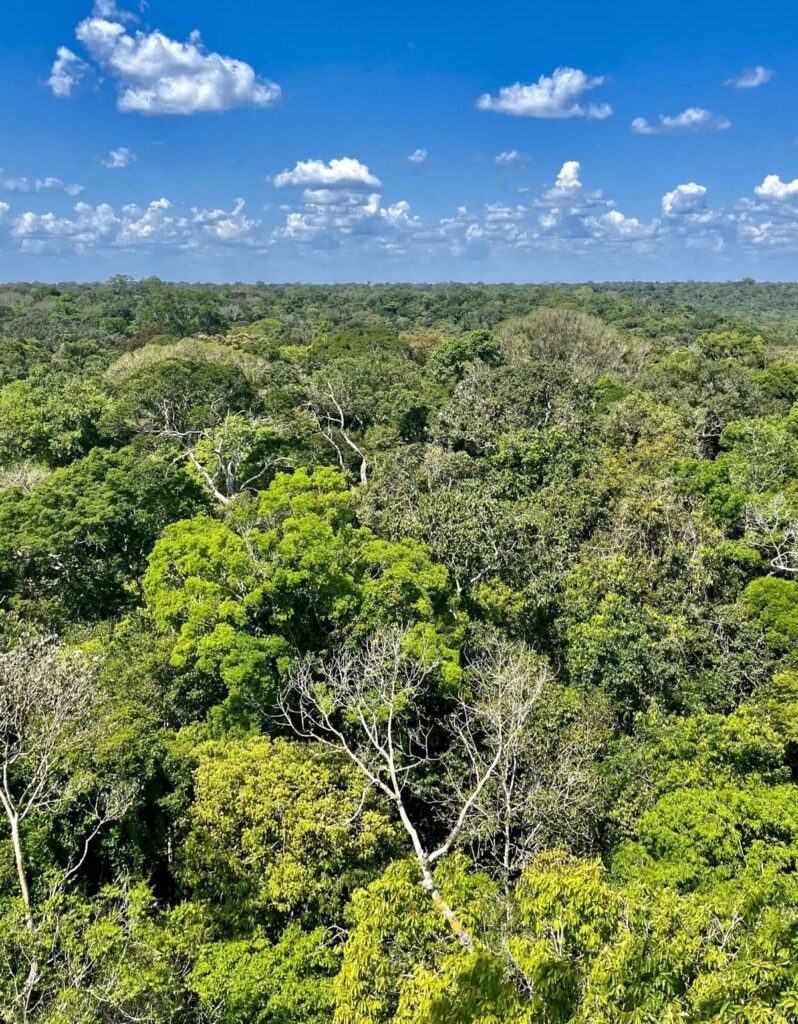
Since the 1970s, the average circumference of Amazonian trees has increased by around 3.3 percent per decade. That may sound modest, but spread across millions of square kilometres, it is staggering. More striking still is how universal the trend appears to be.
Young trees struggling for light, towering giants already ruling the canopy – all of them are growing. This flies in the face of classic ecological theory, which assumes that only the largest, best placed trees would benefit in a changing climate. Instead, the forest seems to be sharing the gains.
For anyone who has watched a neglected houseplant suddenly thrive after being moved closer to a window, the idea is oddly relatable. The Amazon, it seems, has found a new source of nourishment.
Carbon dioxide as an unlikely ally
That nourishment comes from the air itself. Rising levels of carbon dioxide are usually framed as a threat, and rightly so. But for plants, CO2 is also a raw material. Trees use it to build wood, leaves, and roots, a process known as the CO2 fertilisation effect.
Scientists from leading universities and research institutes have noted that tropical forests can convert this excess into growth more efficiently than expected. In this case, the atmospheric surplus has acted like a global fertiliser, fuelling expansion more powerfully and for longer than climate models once predicted.
It is a reminder that nature rarely responds in straight lines.
Three theories and one clear winner
Before the results came in, researchers outlined three possible outcomes. One predicted a winners take all scenario, where large trees would dominate even more. Another suggested smaller trees would respond fastest, finally catching a break. The third option was the most optimistic – a shared benefit across the forest.
Reality sided with optimism. Growth has been broadly distributed, suggesting a kind of ecological balance that few dared hope for. This unexpected carbon storage boost has turned the Amazon into an even more effective climate regulator, soaking up vast quantities of atmospheric CO2.
Not a single monitored plot showed an overall decline during the study period, despite rising temperatures and episodes of drought.
Resilience, not immunity
It would be tempting to read this as a happy ending, but the scientists themselves urge caution. This surge in growth may be temporary. Climate models still warn of more intense droughts, higher heat stress, and increased fire risk. Over time, those pressures could slow growth or increase tree mortality.
The real lesson here is about ecosystem resilience. Given space and protection, the Amazon has shown an extraordinary ability to adapt, even turning a global problem into a short term advantage. But resilience is not the same as invincibility.
For now, the forest is defying expectations, quietly growing stronger while the world worries. Whether it can keep doing so depends less on atmospheric chemistry and more on the choices humans make next.