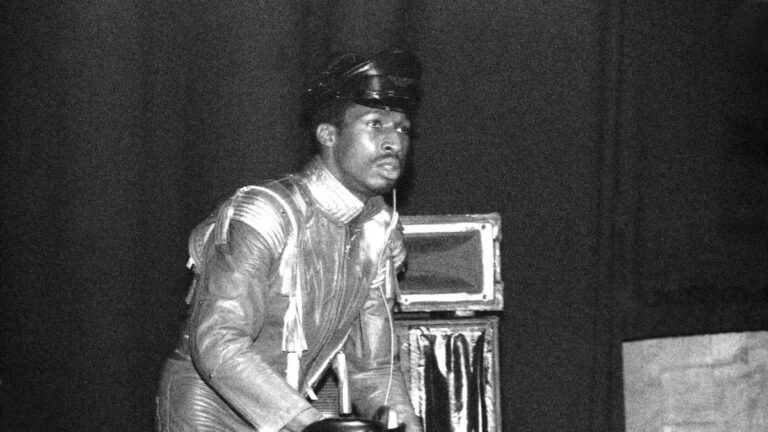
It is very important to finish the year well, but it is almost more important to start the new stage on the right foot. January 1 is always a day that invites reflection. Good, Well, on January 1, 1958 Not only did the year start well: that day man was born which, among several others, would give life to one of the currently dominant cultures, hip hop.
Joseph Saddler of Barbados, in the Bronx
Joseph Saddler, better known as Grandmaster Flashwas born on January 1, 1958. Like many Jamaican families of the time, Flash and his family emigrated when Joseph was just a child.. They arrived at Bronx, impoverished neighborhood of New York, where hip hop was bornin part thanks to this boy from Barbados. From a very young age he showed signs that he would change the culture. He was seen to have a very special taste for everything that had to do with electronics: “everything that was plugged into the wall, the hair dryer, the washing machine, the curling iron. If you could unscrew it and see the inside, I would take it apart. And I was also fascinated by things that rotated, like the clothes dryer, bicycle wheels… I would spin them and stare at them,” says in the documentary series Hip Hop Evolution.
Later he felt the need to know everything about those devices, disassemble them, reassemble them, fix what didn't work and so on until he came to the creation of what became the basis of hip hop: “What he liked was to stay in the shadows and absorb everything: what the DJ was doing, the audience, the equipment, the music. When he returned to his room, armed with his screwdriver, his electric welder and his insatiable curiosity, the boy who everyone would later know as Grandmaster Flash would theorize about turntables and mixers, reflect on the presentation of parties, in an attempt to figure out how to turn beat-making and audience interaction into a true science”, this is how he tells it Jeff Chang in the book Can't Stop Won't Stop. A History of the Hip-Hop Generation (Picador, 2005).

WECB
WECB
Theory of Quick Mix
Flash revolutionized the technique of that turntable that moved the steps of the first b-boys and b-girls on the track, or accompanied the first MCs. This is how he achieved it with his theory of Quick Mix. At that time it could not be given that name; At the time they referred a lot to break. By this they meant cutting the rhythmic bridge of a song (such as the solo or drum intro) and repeat it by playing it first on one record player and then on the other. For this, Flash and the Bronx DJs They bought two copies of each vinyl.
Herc did the opposite: an abrupt mix, a “chaos in unison,” said Flash. The DJs did the mixing by shifting the needle of the turntable from one place to another on the acetate, so Flash concentrated on the turntable, watching it spin. From there the genius came alone and began to experiment: “I knew there must be another way and, after trying different things, I put my fingers on the vinyl. I let them go, I stopped it, I let it go, I stopped it. I thought: 'I have total control over the record', but the taboo was that you weren't supposed to touch the center of the vinyl; DJs will hate you, people will hate you, you were going to ruin the records.” So Flash ended up deciding to create the new techniques that would change music forever. Flash took a marker and made a mark where the break entered and exited, that melodic part that was what he was interested in for its loop repetition.and that were the parts of a song that most animated the party.
Flash did name his new creation: he called it the Quick Mix (“Rapid Mix”), which included cutting, backspin and double-back. The first is something similar to a mini scratchwhich is produced by moving the disc forward with the hand and creating that scratched effect so characteristic of the entire path that this culture has traveled. Backspin, explained in Jeff Chang's book, is generated by create a loop that plays indefinitelywhile in the double-back, in addition, slightly delays the playback of one of the two discs and then makes the music “bounce” between both, passing the same section alternately in one and the other.

At the beginning, when in hip hop everything was field and it was barely based on anything, from the outside nothing seemed professional or that there was any scienceas could be seen in other cultures or music. Nothing could be further from the truth: there was people like Herc who knew how to start something new from scratch, without even knowledge. Then enter Grandmaster Flashwhich became the mad hip hop scientist. He studied, he observed and no one taught him, and yet he knew how to create from scratch, he knew how to be an innovator and an inventor. Hip hop couldn't be anything without figures like Flash.