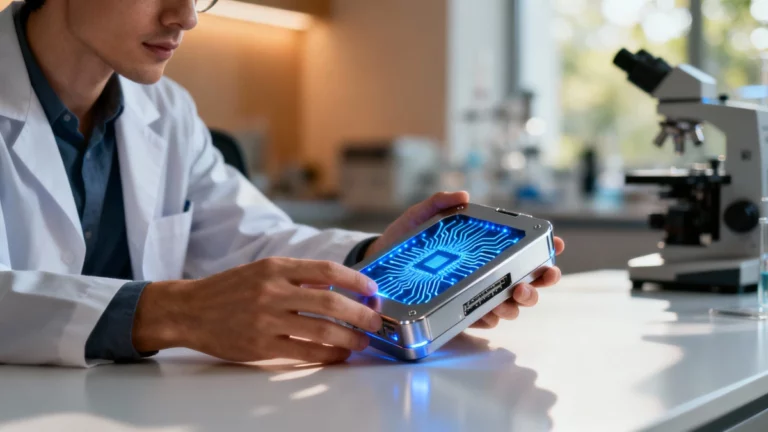
Quantum Security: Science Fiction Comes to Life
In the buzzing atmosphere of VivaTech in Paris, between start-ups promising to revolutionize the future with AI and tech giants unveiling their latest innovations, two rather plain-looking Toshiba racks quietly marked a turning point for French cybersecurity. Thierry welcomed me, ready to explain, and the conversation quickly took an exciting turn.
“Look, when I activate quantum protection, the eavesdropper sees absolutely nothing,” Thierry says as he toggles the interface. “But what’s even more impressive is that both people communicating are instantly, immediately, and automatically aware if anyone tries to spy on them.”
A few clicks later, he’s shown me the future of our top-secret communications. And this future tackles a problem most of us don’t even realize exists.
“The reality is that hackers are already storing our encrypted communications today, hoping to decrypt them in 10–15 years,” Thierry explains. “The issue with our current security, even improved versions, is that there’s no guarantee that a new algorithm in 5 or 10 years won’t break everything.”
To understand why Orange is going all-in on this technology, Thierry starts with our current vulnerabilities. And it’s enough to send chills down your spine.
“You know all our digital security today—RSA algorithms, digital signatures, every certificate—will be obsolete in a few years,” he warns… but of course, he’s got a plan.
The Math Problem and the Quantum Leap
Here’s the problem: The foundation of today’s security is a gamble—it’s considered impossible to factor extremely large numbers with current computers. It would take them millennia. But quantum computers could do it in just minutes.
“It’s incredibly fragile because it’s all based on big number factorization. Just one algorithm… Luckily for us, Shor’s algorithm doesn’t work well yet on simulators, but the day a quantum computer is powerful enough, it’ll demolish RSA,”
Thierry says, not mincing words.
Cybercriminals are already hoarding today’s encrypted communications like collectors assembling safes, waiting for that one universal key.
“Intercepting some of the light signals over optical fibers isn’t that complicated if you have the right equipment,”
he reveals.
This “Store Now, Decrypt Later” strategy means your secrets could one day be read by anyone with access to a super-powerful quantum computer.
Instead of relying on mathematical difficulty, Orange is betting on quantum physics—and this, according to Thierry, is nothing short of revolutionary.
“We manipulate individual particles of light, photons, that we polarize or encode with phases. The beauty of it? If anyone tries to intercept midway, the quantum state is automatically changed. The moment there’s a quantum measurement, the state is destroyed. That’s the very definition, the law of physics.”
Simply put: Imagine sending a message in a magical envelope that self-destructs the instant someone other than the recipient tries to open it. Except here, it’s not magic—it’s pure physics.
“Here, we can relax because it’s not about algorithms or computers. It’s true, pure physics,”
Thierry insists, with a conviction that’s genuinely refreshing when it comes to security.
Closing the Gaps: A Two-Layered Defense
Thierry discusses a danger we all overlook: digital security doesn’t age well.
“What experts validated last August might not be reliable in ten years. We make sure our clients benefit from both quantum solutions and regularly updated mathematical security.”
Not updating your antivirus sounds careless—here it puts at risk entire digital economies.
“Sometimes you just have to reinforce what you have. Double the size of encryption keys, for example. And with new algorithms, we may need to update them regularly, too.”
To help clients adapt, Orange offers a very concrete step: a comprehensive security audit.
“We do an inventory to help you spot your most critical gaps, figure out what needs updating urgently.”
Probes installed at clients’ premises reveal old protocols lurking in the shadows.
“We’ll tell you: this system is really at risk, update it quick. This one’s so critical you should go quantum.”
This progressive approach allows smart investment based on actual risk.
Quantum Magic in Action—and the Road Ahead
To explain the quantum “magic,” Thierry walks me through a live demo.
“Each box handles emitting and receiving trains of photons. What’s awesome is that only the recipient can measure the photon’s state and retrieve the information.”
This property lets both sides know instantly if someone tries to eavesdrop.
“It lets us reroute traffic, stop communications—super important, since with classic algorithms, there’s no guarantee of this level of security.”
Key generation is elegantly simple:
“Imagine a photon launcher sending them to a 50/50 separator. They’re randomly distributed between two outputs, following quantum physics laws, generating truly random bits.”
The outcome? Totally unpredictable encryption, impossible to reproduce or anticipate.
“We get an unbreakable encryption system, as long as you use the one-time pad technique—a key at least as long as the message you’re protecting.”
But Orange Quantum Defender doesn’t rely on just one approach. The service smartly combines quantum “magic” with post-quantum cryptography (PQC) for double-layered protection.
“In practice, we mix our usual mathematical cryptography with quantum key exchange, blending both keys for the best protection possible.”
This strategy directly counters “Store Now, Decrypt Later” attacks.
“The great thing is, this combo delivers tomorrow’s security today,”
Thierry emphasizes. PQC manages certificates and authentication; QKD (Quantum Key Distribution) guarantees unbreakable key exchanges.
The first client? Not just a research lab, but a major financial services player using this setup to link several sites and secure sensitive data.
“For now, the most critical applications are usually between highly sensitive client sites and a data center.”
Installation is seamless over Orange’s commercial fiber network.
“Orange Business, just like they install routers or security gear, will put these quantum devices in for clients.”
The collaboration with cloud giants like Microsoft, Google, and Amazon opens up even more opportunities.
“We’re working with Microsoft and want to secure connections with all the big cloud providers, Amazon too.”
This helps businesses protect their most confidential communications heading into the cloud.
What’s Next for Quantum Security?
To check the pace of these threats, I ask Thierry about the state of quantum computers.
“D-Wave, for example, has loads of qubits, but it’s really for optimization problems. Fortunately, they can’t yet run Shor’s algorithm.”
He expands:
“Their qubits are in various energy states, and their system does annealing. You let them drop in energy to find solutions. That’s good for optimization.”
The real challenge is logical qubits:
“Companies like IBM or Google need about a thousand physical qubits to create a single reliable logical qubit, because of errors.”
France, too, has its champions, like C12, working on promising approaches with fewer but higher-quality qubits.
Thierry is candid about the current limits.
“We don’t have quantum repeaters yet. If you use a standard optical repeater, it breaks the quantum state. There’s no possible repetition.”
But research teams are hard at work on quantum memory solutions.
“Photon coherence lasts just nanoseconds. With quantum memory, we can reach milliseconds—huge progress at that scale.”
International collaboration is key:
“We’re working with our European partners, linking France and Germany, for example, between Bundesbank and the Banque de France.”
These initiatives are part of EuroQCI, aiming to create interconnected national quantum networks. Orange leads the French efforts with the FranceQCI project, building on earlier ParisRegionQCI research. Thierry proudly highlights the dynamic French quantum ecosystem: ParisRegionQCI showed that QKD works over existing fiber lines, linking sites from Saclay to downtown Paris over about 50 miles.
The quantum field is surging:
“Airbus was telling us recently about quantum geopositioning to replace GPS.”
There are major strategic stakes:
“There’s a real sovereignty issue at play.”
Beyond cryptography, quantum technologies have striking applications.
“We can exploit extreme sensitivity—for detecting gravity variations, movement, or guiding missiles. The geopolitical importance is enormous.”
Looking ten years out, Thierry envisions full-scale quantum networks:
“In ten years, they’ll be true quantum networks. The goal is to extend quantum states between computers for quantum teleportation between sites.”
Distributed quantum computing between distant machines won’t beat the speed of light (sorry, Einstein!), but still,
“it’s awesome because you maintain the quantum state,”
he says with a grin. He outlines the technical hurdles: entanglement swapping, chaining different systems, all of which require further progress in quantum memory and remote entanglement.
What stands out is Orange Quantum Defender’s industrial focus.
“What we offer our clients is truly tried and tested. It’s the latest tech but reliable and industrialized.”
That translates into practical tools:
“We tailor the defense to vulnerabilities. These quantum devices can be installed alongside your regular gear from Cisco, Fortinet, or Palo Alto. The quantum equipment handles the keys.”
Budget-friendly phasing means only the most critical links get a full quantum rollout, while others can stick to classic cryptographic updates. The cost is still a factor, as Thomas Rivera from ParisRegionQCI has pointed out: securing a dedicated fiber link of under 60 miles with a QKD system runs about €180,000–250,000 (roughly $200,000–$275,000 as of early 2024). Orange cleverly sidesteps some costs by leveraging its existing infrastructure, with many lines ready and waiting as client demand emerges.
Our conversation soon shifts towards geopolitics.
“A lot of money has gone into boosting quantum computing—because sovereignty is at stake,”
says Thierry. Mastering these technologies brings massive strategic advantages in protecting communications and uncovering adversaries’ weak points.
Orange is working to position France as a major player in this revolution, along with European partners.
“We want to build an autonomous European quantum ecosystem.”
It’s fascinating to realize that the quantum race isn’t just about building faster chips. There’s a future where quantum physics shields our most valuable data from every possible intrusion, no matter what technological twists lie ahead. And the wildest thing? That future has already begun.