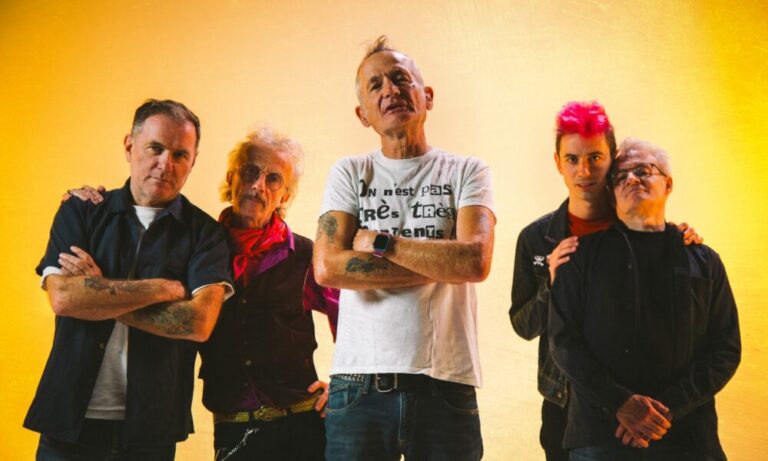
On the occasion of the release of Ou va-nous, his group's fifteenth studio album, the meeting with Didier Wampas was a pleasure announced. The “worker-punk” never lets go of anger or humor with his legendary honesty.
Find this interview with Didier Wampas in our weekly n°223. Discover our subscription plans.
Fifteenth studio album for the Wampas, forty years of existence, what impression does this longevity give?
Didier Wampas: Fifteen with the Wampas, but also five with Sugar & Tiger plus the solo albums. In fact, it's okay to last. As a teenager, I didn't know what to do with my life but punk arrived and all I wanted was to go on stage. For years I have been doing around fifty concerts per year on average, each time with the same desire to give the maximum, to give everything every night. I always have a sort of nervousness because in front of three hundred or a thousand people, you have to touch each of them, one by one.
How do you see the evolution of the group with hindsight?
I'm still fifteen years old, I don't know how to play guitar, I compose with two fingers. I arrive in the studio with unfinished pieces and without text. Real amateur work. I let the musicians work around my ideas, the Wampas are a real group, everyone brings what they want. And I let the producer make his choices. And I would like to highlight the crazy work of Fred Lefranc who channeled everyone to make a perfectly produced album. I'm the opposite of a dictator in the studio. If it were just me, we'd do lots of weird experiments that I wouldn't be sure of the outcome of. Fred makes choices that seem too clean for me sometimes but which, in the end, are very effective.
The musicians around you have been there for a long time, that must help.
Yes, Nico on drums has been there since the very beginning apart from the first 45 rpm. Jean-Mi, who was the bassist for the Sattelites, arrived in '92 or '93. Tony Truant, ex-Dogs as you know, has been there for twenty years, he does all the rhythms, the easy work, that is. And Effello, who has been there for ten years, does all the other guitars and all their re-res (the added guitars, editor's note).
Can you tell us some titles? Starting with the song: “Where are we going?”
This is the first time I've written a song on bass, hence the place it holds from the start. As usual, I sing in yogurt first to lay down the melody. I had the idea for the title in my head for a while but I made the text in the studio.
“Hanged at Forbach” promises to be darker.
This is a tribute song to a friend's nephew. I didn't want to say the real city out of respect for the family but the announcement touched me. We made an angry piece out of it.
And why this “Kenavo my Love”?
I have many ties to Brittany, my mother is Breton, my partner is Breton. In fact, it was my son who heard this phrase in a bar in the small village of Spezet, in Finistère, and who reported it to me. The expression was too beautiful. But it's also a tribute to Job Larigou, the Breton comic that I love, little known outside the region, of whom I found a double album.
“Les Coronados” seems more obvious when we know your tastes.
I've always been a Coros fan. It's one of the best groups that ever existed. With the Wampas we covered “Revanche” from their album N'tout quoi for a long time. I had recorded this song with Lionel from Liminanas and I had forgotten it. So we re-recorded it.
“Don’t Look in Guitars” what does it mean to you?
The title is a nod to Charles Trenet’s “Don’t Look in the Pianos”. The idea is the same, punk style: don't look for anything other than rock'n'roll in rock'n'roll. We don't necessarily find a meaning greater than it and that's fine too, it can just be a good time.
“Intermittent Anarchist”…
That's for the Sunday anars, their big speeches before going to get their intermission that the State gives them. This song is made to annoy them because they annoy me with this gap between their words and their actions.
In the same vein, “Punk Ouvrier” is more personal, right?
It's a song that was already on Taiz-Moi, my first solo album, that I wanted to re-record with the group because it worked well on stage with the Wampas. And it is also the title of my autobiography released at the end of 2024 by Harper Collins. A central thing, that is.
Is “Mont Ventoux” your sporting side?
I'm a fan of cycling, I've climbed Ventoux several times. I have a friend who lives at the foot, I go there regularly. This climb is the myth of the Tour de France, everything is at stake until the last meters. So I draw a parallel between the difficulties of life and this Ventoux where you can only know on arrival if you have won.
“Aline in Reykjavik” has a special and funny story.
There was a tribute project to Christophe for which I had been contacted to do a song. It was when I was in a hotel in Reykjavik that I realized that I had completely forgotten about this project and that delivery was due the next day. So I quickly put together a song that I record on my cell phone with the sound you imagine. Of course, the title is not retained, let's not dream. But I kept the idea that is there.
“Jean-Luc”, which ends the album, is an old story.
This is Jean-Luc Le Ténia, who died in 2011, a singer who composed more than two thousand songs. We had done a track – “Jean-Luc Le Ténia” – on the Chicoutimi album, he had played one of our first parts, I wanted to give him a sign.
Now, what’s next for your year?
There are around sixty concerts announced until the end of the year and dates are being added. The date at the Olympia in April is already sold out. All other projects are on hiatus but I still plan to release the sixth Sugar & Tiger album at the end of the year. Always this rock'n'roll, like total freedom.
Where are we going? is available, the tour is getting longer, the opportunity to get your dose of militant and fun proletarian punk. Didier Wampas is a rarity.
You can also view the interview via our reader below: