
At first glance, it sounds like a riddle or a glitch in the space-time continuum. How can a mother be just three years older than her newborn twins? The answer lies not in science fiction, but in the remarkable progress of modern reproductive medicine.
Thirty Years Later, Life Begins
When most people think of fertility treatments, they picture sperm banks or in vitro fertilization. Fewer realize that embryo freezing has been part of assisted reproduction for decades. After an egg is fertilized through IVF, the resulting embryo can be preserved in liquid nitrogen and stored for years — even decades — before being transferred into a uterus.
According to the American Society for Reproductive Medicine (ASRM), frozen embryos can remain viable for extended periods when stored properly, with no clear evidence that long-term freezing significantly reduces the chance of a successful pregnancy. In other words, time essentially stands still for these embryos.
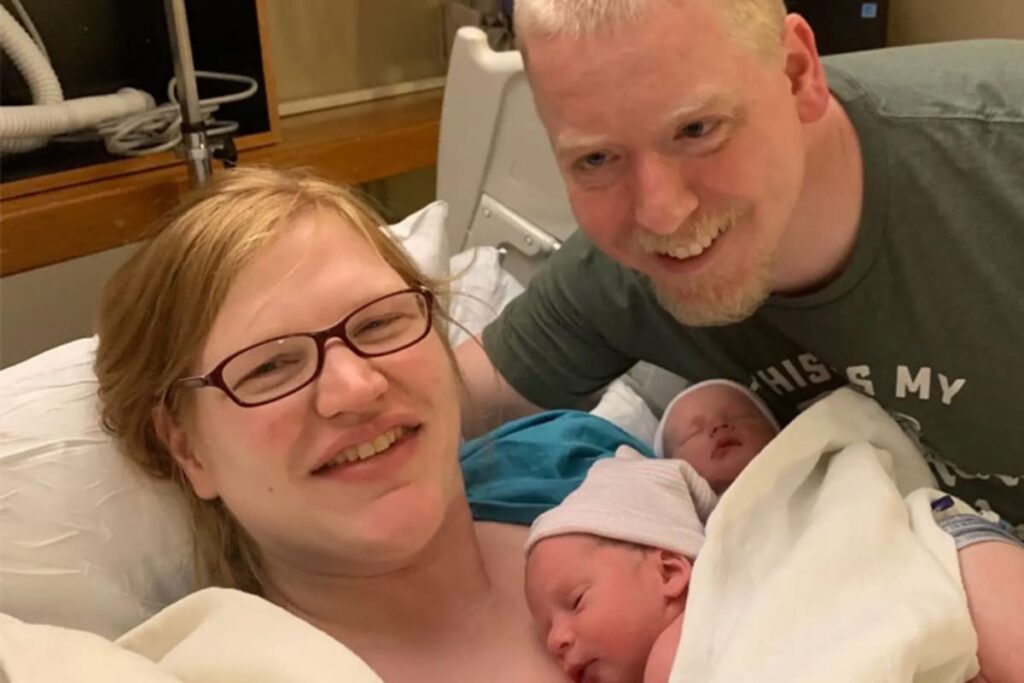
That’s precisely what happened in this extraordinary case. A mother gave birth to twins whose embryos had been frozen in 1992 — more than 30 years ago. While frozen embryo transfers are not uncommon today, the length of storage in this case set a new milestone.
It’s the kind of story that makes you pause. I once interviewed a fertility specialist who described embryo freezing as “a biological time capsule.” Hearing about these twins, that phrase suddenly feels very literal.
A Donation With Specific Conditions
The embryos had originally been created by another couple who later chose to donate them rather than use them themselves. They were given anonymously to a Christian non-profit organization that facilitates embryo adoption programs.
Such organizations often operate under specific criteria. In this instance, embryo transfers were offered to heterosexual married couples who had been married for at least three years. The twins’ parents met those requirements and decided to move forward with the transfer.
Embryo donation remains a relatively small but meaningful pathway within assisted reproductive technology. The Centers for Disease Control and Prevention (CDC) reports that thousands of frozen embryo transfers take place each year in the United States, though only a fraction involve embryos donated by other families.
For couples who choose this route, the experience can be emotionally complex. On one hand, there is the gratitude for the opportunity to build a family. On the other, there is the awareness that the child’s genetic origins lie elsewhere. Families who go through it often describe the journey as both humbling and deeply meaningful.
A Three-Year Age Gap That Stuns
Here’s the detail that truly captures the imagination: when the embryos were first created and frozen in liquid nitrogen back in 1992, their future mother was just three years old. Her husband was only five.
Of course, in legal and social terms, a person’s age is calculated from their birth, not from the moment of biological conception. But when you step back and consider the timeline, it feels almost surreal. The twins’ biological beginnings predate their parents’ adolescence.
The father reportedly described the realization as “mind-blowing,” noting that most people struggle to wrap their heads around it. And it’s easy to understand why. We tend to think of birth and conception as events closely linked in time. Here, they were separated by three decades.
Yet medically, this is entirely possible thanks to cryopreservation — the process of preserving cells and tissues at extremely low temperatures. The World Health Organization recognizes assisted reproductive technologies, including cryopreservation, as established medical practices that have helped millions of families worldwide.
Stories like this also raise fascinating philosophical questions. What does it mean to “begin” life? Is it at conception, implantation, birth? Science can explain the process, but the emotional resonance is something else entirely.
Science Moves Forward — And So Do Families
Long-term frozen embryo cases are still rare, but they are becoming more visible as reproductive medicine advances. Clinics today routinely freeze surplus embryos during IVF cycles, giving families options for future pregnancies or donation.
For the twins at the center of this story, their arrival represents not just a medical milestone but a deeply personal one. After three decades in suspended animation, they entered a world utterly different from the one in which they were conceived. The early 1990s had no smartphones, no social media, and fertility science itself was far less advanced.
There’s something poetic about that. Life, quite literally, waited.
And perhaps that’s what makes this story so compelling. Beyond the headlines and the astonishing age math, it’s about family — about parents who opened their hearts to embryos created long ago, and about science quietly expanding what’s possible.
In a world where technology often feels overwhelming, this is one example where innovation has given people something profoundly human: the chance to welcome children who, in a strange twist of time, are almost as old as they are.