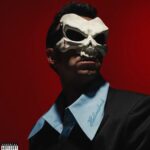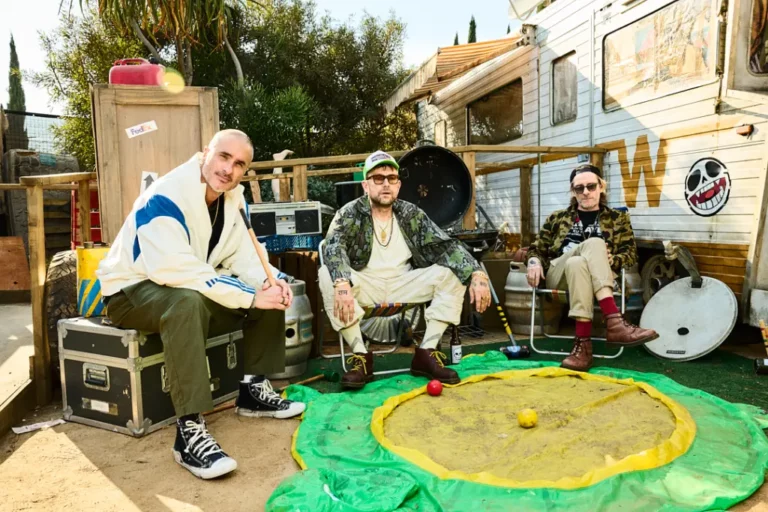
At House of Kong, an immersive space dedicated to 25 years of Gorillaz, Zane Lowe for The Zane Lowe Show on Apple Music 1 met Damon Albarn and Jamie Hewlett for a conversation about the new album “The Mountain”.
The interview touches on the themes that run through the project, from the re-elaboration of mourning to the creative dynamics that, for twenty-five years, have held together one of the longest-lasting and most changeable collaborations in contemporary music.
THE INTERVIEW
Zane Lowe: This album feels very much like a true union, just like in the beginning.
Damon Albarn: Oh, definitely. Decidedly. And it was a bit like the album after Plastic Beach. There's dissonance in between, but it still feels like it was an interesting time with a lot of interesting things in it. But as far as cohesion and storytelling and that “togetherness,” I think this is clearly something that I could call the next in that world, you know, applying the adventure principle.
Jamie Hewlett: And with a narrative that presented itself to us quite strongly. It was practically inevitable.
Zane Lowe: I have a bit of the feeling that after Plastic Beach there was a slight approach to the more conventional world for Gorillaz. It was like, “Oh, we're a touring band now,” and, you know, it's going to take away some of the mystery around it and be a little…
Damon Albarn: Well, now I'll tell you what happened. It happened because we got a last minute call to headline Glastonbury. And we had this band and we were still applying the principle that we had used in our live performances with Demon Days, where everyone is almost backlit, you know, and the band doesn't really put themselves in the foreground. You know, that's what we wanted to do. And yet, what happened was a strange kind of detachment. It looks good on TV, but a strange gap, in that huge field, and afterwards I thought: I have this band, I have to… I have to go back on this, because it's the only way to play at this size. Do you understand what I mean?
Zane Lowe: You can't stand against the light on the Pyramid Stage.
Damon Albarn: No, no, you can't. That's what I'm saying, you know. So the next weekend it was Roskilde and I said, “Fuck it, I'll do what I can do,” you know. I won't hold this back because it's simply useless in this context. So yeah, it's become more of a live band. But for some reason now we have managed to get everything back on track a little.
Zane Lowe: Nobody ever talks about the awkwardness of the beginning. Backlit interviews with the two of you as if you were in a witness protection program. You know, trying to get cartoon characters interviewed.
Jamie Hewlett: We were just trying to take the idea of celebrity out of the equation.
Damon Albarn: We were really bad at this though. Every time we tried… our first interview in America was with Rolling Stone or something, right? And we were all on different phones playing characters. Remi did Russell, I did 2D, he (Jamie) did Murdoc. I don't think Noodle was there yet. We were trying to do everything, you know what I mean, brilliantly and… you know, that side of things we never really mastered fully.
Zane Lowe: The holograms… I actually thought it was a good idea, but I know it was terrible in the room, even though it looked good on TV.
Jamie Hewlett: On TV it looked incredible.
Damon Albarn: On TV it was a success. He was really brilliant. He was great on TV. But in the hall it was terrible.
Zane Lowe: I remember thinking at the time: You can do 12 shows at once all over the world.
Damon Albarn: It was actually a conversation, before ABBA had the money to actually do it.
Jamie Hewlett: It was too expensive and the technology wasn't developed enough yet: in a live situation you had to keep the music very low, because the invisible screen vibrates when you turn up the bass and the drums, and then the animations make sounds, vibrations. When we were at the Grammys and they appeared, it was really quiet. And people were talking, they didn't even realize the show had started because it was so quiet.
Zane Lowe: One thing you've always done well with video, and I love seeing the storyboards that you've done and the level of detail that's in there, that's probably the thing that stands out the most. The music is obviously in the foreground and we have the videos that go with it, we can see the truth of it all, the artwork and so on. But this is really like a window into your process. Are you comfortable showing your process to people?
Jamie Hewlett: I don't mind. I mean, there are a lot of storyboards for a lot of videos that have never been seen. And what I do is I put as much work into the storyboard as possible, so when we start, the animators know exactly how it needs to look. Instead of just making stick figures and little sketches with camera movements and things like that, I try to do more. They got more and more complex and then I started editing storyboards to the music, so I would deliver an animatic and, you know, it ended up being like 350 drawings just to tell a four-minute video. So it's nice, it's nice to show them, I mean.
Damon Albarn: It was a happy life, I'd play a song and I'd run up to Jamie's studio in Buspace, on the second floor, and I'd play it for him, and he'd listen to it and then he'd start drawing, you know, and this happened every day. It was fantastic.
Zane Lowe: Okay, so usually what happens with music videos is someone writes down the idea and then the director decides where and how to shoot it and puts together a production crew to make it happen, but in your case, you're actually directing the video while you storyboard and break it all down. So do you build a narrative before you even start storyboarding, or does the narrative sometimes present itself as you draw?
Jamie Hewlett: I listen to the song and decide what the story is going to be and talk to him (Damon) about it. We say: yes, that's cool, and then I draw it. It's actually pretty simple. Then I change some parts and sometimes he says he doesn't like something and then I change it. It's not a big team, but I deliver the complete idea and then we bring in the animators and things like that, and they say: well, it's too expensive, you don't have enough money, and so some things have to change and you change some pieces, but I try to deliver the complete idea without the need for anyone else's intervention, you know?
Zane Lowe: So when did The Mountain start?
Jamie Hewlett: We were filming the live action sequences for the Silent Running video from the latest album and we were in Serbia together, while my wife was in India with her mother. They had to fly home and her mother had a stroke. So I had to go from Belgrade to London and then to India in early December 2022, and then we were in Jaipur for six, seven weeks until mid-January, I think, still trying to get his mother home in a coma, which was quite a tough experience and quite traumatic, but at the same time I had an incredible experience in India, you know, the people were very warm and that really helped the situation. So when I came back, I was very excited to talk to Damon about the prospect of going together. There wasn't a big plan at that point yet, just the idea of going to India together, having an experience and seeing if we could make an album, a Gorillaz record in India. And then, in between trips, we lost our fathers — first Damon's father and ten days later my father, which was very strange because we were born ten days apart. It's very, you start to perceive it as quite disturbing and strange. Not creepy in the scary sense, but like, okay, this is something big that needs to be addressed, or I don't know, we needed to think about how to move forward, because you know, when you lose your father, you level up in the big computer game of life and you become the patriarch, and it's very strange, no matter what your relationship was, whether good or bad, it doesn't matter.
Damon Albert: It changes you.
Jamie Hewlett: It changes you.
Damon Albert: It really changes you.
Jamie Hewlett: Because you've had a kind of buffer, a safety zone, all your life and when that suddenly disappears, you think: oh fuck
THE TOUR
The Mountain Tour kicks off in Manchester on 20 March 2026 and will hit arenas across the UK and Ireland, with dates in Birmingham, Glasgow (SOLD OUT), Leeds, Cardiff (SOLD OUT), Nottingham, Liverpool, Belfast and Dublin. By popular demand, a second date in Manchester and Dublin have been added, as well as a one-off show at London's Tottenham Hotspur Stadium on 20 June 2026 – Gorillaz's biggest UK gig yet – featuring Sparks and Trueno.
Gorillaz will also play in Italy at LA PRIMA ESTATE 2026 on June 27th
June 27 | LIDO DI CAMAIORE @THE FIRST SUMMER
CLICK TO BUY TICKETS
July 25 | TRIESTE @ Piazza Unità d'Italia
CLICK TO BUY TICKETS
INFO
https://gorillaz.com/