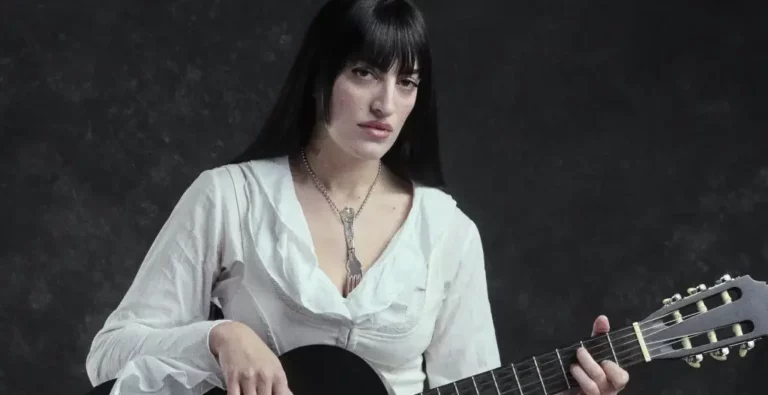
In a sunny, spring-like Milan in a pastry shop in Chinatown, among chocolates, Easter eggs and doves lined up like small ephemeral architecture, I meet Roshelle.
It has something unsettling and magnetic, an oblique grace that recalls a dark Alice off-axis, more restless, tormented than naive.
We talk about “Mangiami pure”, his album of unreleased songs while trays and temptations flow around, and everything seems to refer back to his album: a seductive, almost dangerous invitation, where desire does not console but digs.
It is in this context that the conversation drifts elsewhere. Inside the rooms of the record, inside its cracks.
I have opened a box of chocolates many times: few to celebrate a joyful event, many to sweeten my bitter mood.
How is it possible that something seemingly so pure, attractive and good as chocolate can turn into something poisonous and indigestible.
I ate a whole box of chocolates and I was sick.
I knew it, but I needed it.I also did the same with love; I abused it, because I felt a desperate need for it.
Result? I got lost. And home no longer felt like home. I tried to inhabit it, but its walls oppressed me. Having closed the door, I left my good intentions outside and entered the darkness of the bite, as if I were living inside a jaws.
“Eat me well” (I replaced the title of a song with the title of the album) is the light of salvation, the path towards a life enjoyed in the name of true love.»
Have you also compared the album to a box of chocolates, but upside down?
Yes, because something seemingly perfect can become indigestible. The stories I tell are not born from happiness, but from a melancholy, from an emptiness.
Writing was a way to fill an absence, to give shape to something that was missing.
After this emotional “binge”, what state are you in today?
Lighter. Making the record allowed me to no longer care about these stories. Now I can just sing them, go in and out of them. It's like remembering something you no longer have to experience.
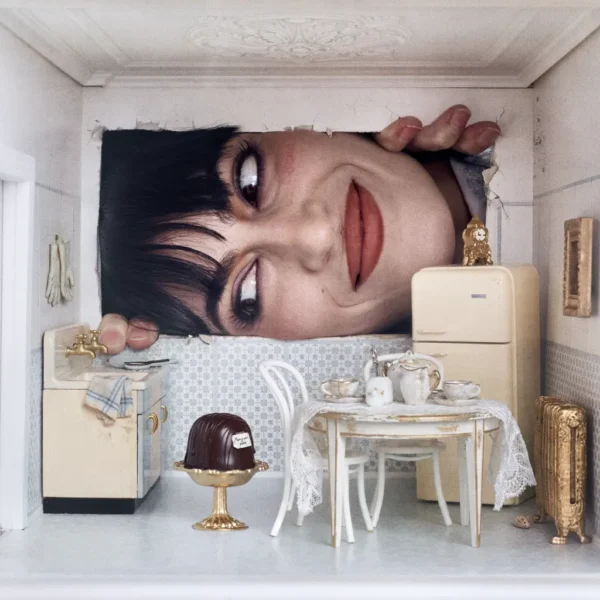
I'll start from the visual: they told me that you built the house in the album's artwork together with Thomas Ottoman. How important was this manual work?
The miniature house seen in the video clip of The origin of the world Tommaso and I made it completely by hand. That was a first version, very basic. Then we worked on many details: the floor slats, the different levels, until we built four floors. It was important that it was a living object, not just an image.
Where does this passion for miniatures come from?
Forever. As a child I had Barbie houses, the camper, the airplane. But above all I built worlds alone: with the pencil case, with a pack of tissues that became a bed. I was fascinated by the idea of governing a microcosm, having the illusion of controlling everything.
Does the house then become a metaphor for the record?
Yes, the rooms are the emotional rooms of the record. It is a space that contains everything, even what you don't want to see.
It's a record that doesn't give in right away, it grows with more listening. Do you recognize yourself in this less immediate dimension?
Yes, and it's wanted. It is a step of evolution. I focused better on my style, also thanks to the musicians I worked with. Strings, piano, certain more experimental atmospheres: I understood what really represents me.
Even on an aesthetic level you have always built a strong imagination. What is the visual center of this project?
I looked for a symbol that contained everything. The box of chocolates works because it brings together different tastes, like songs. Each song is a synthesis, a small concentration of emotions.
Chocolate, however, is not just seduction.
Exact. It's an aphrodisiac, it's linked to love, but I wanted to explore its dark side: the excess, the nausea. The moment when pleasure transforms.
And the miniature house?
It's ambivalent. On the one hand it is a box, almost claustrophobic. On the other hand it is a game of control: you can move everything, decide everything. It is a form of fictitious power.
If you had to choose: what is your “chocolate” and your favorite room?
I was very surprised by the violet one, a dark chocolate with violet jam. Then the Boer: he looks like me. It's a question of time and transformation. At the beginning it is solid, then in the darkness it changes, it melts, it becomes something else. Even my songs are born like this: from something that is not yet what it will become.
As for my favorite rooms, they are the upstairs corridor and the living room. These are the spaces in which I get lost the most. Every now and then I really go back and look at that little house, I imagine myself living in it in miniature. There is a decadent aesthetic that attracts and disturbs me at the same time. I don't know if I would really live there, but in my head that is a possible place.
How did the collaboration with Tommaso come about?
His way of joining threads and making something organic fascinates me. We worked very deeply, but without talking too much about technique or strategy. It's as if he understood my feeling and translated it better than I could.
How did that impact the sound of the record?
He made rotten stories elegant. It gave an ethereal quality to something that comes from a very earthy, almost dirty background. It brought me back in a more complete form, also from an aesthetic point of view.
Here orchestration has a central role, more integrated than in the past. Is this a turning point?
More than a turning point, it is a conscious return. I started singing as a soprano in church at eight years old. This album is a synthesis of everything I have listened to and learned. There is also a cinematic, soundtrack-like dimension inside.
Is it already a work designed for live?
Yes. I'd like to bring that orchestration to the stage, create an intimate but not static atmosphere. I would like it to be a shared experience, not just a concert.
In addition to music, you work a lot with drawing and writing. How much do they impact your process?
Very, very much. I draw every day, I'm carrying out a project in which I portray my face every day for a year. I'm almost at the end. I write a lot, I read a lot. Everything is intertwined, even if I try not to force the connections.
So they are not separate languages.
No, they get contaminated. Some drawings have become covers, others influence the way I present myself, how I wear makeup or dress. It's all part of the same imagery.
Who are you listening to today in the Italian scene?
I really like Chiello, his approach. Then I recently discovered Sara Gioielli, with whom I am also talking a lot. And I respect Alessandra Tumolillo a lot, she is an incredible musician.
And your deepest references?
Elisa and Giorgia's first records remain fundamental. Then Battisti. And I'm rediscovering Battiato: at the beginning his voice created a distance for me, but now I'm entering his world and understanding the strength of his choices.
THE RECORD TRACK BY TRACK
Two Steps in the Blue Moon (voice memo)
My first melancholic poetry. After this song I realized I could write in my own way without meaning or structure. Leaving the original recording on the album was a precious choice. What you will hear is exactly the moment of conception of this work.
Limbo
One day a friend told me that he was feeling all this discomfort in his relationship, I felt like him and I wrote this song as if it were his. Here I speak from a man's point of view.
Alone in the clouds
This song was written while sitting on a cloud feeling the deepest ennui.
Muse
My letter to the muse who inspired me songs, drawings, poems, dreams.
I felt love, hate, compassion, tenderness, aggression, repression of emotions, instinctiveness, stasis, letting go and brooding to the point of obsession.
Poison
I thought it was really love, but it's just poison.
Underwater
If in 'Alone in the Clouds' I was feeling a very deep sense of emptiness, here I fell into it. Darkness, confusion but in extreme awareness. Questions, questions, what is the meaning of things.
A sad sad night
The phrase 'I don't know how to accept it' is emblematic of the whole album. Because it is the trigger for my moods. Why can't things be the way I want?
Cigarettes
These are pages from my diary read into the microphone
The origin of the world
This song is a passage full of light, it has nothing to do with the torment felt so far. This song is pure love, it's a new beginning. That's why you'll find it at the bottom on vinyl and CD. It's the incipit of the next album.
Fever
This song was Oscar's but I forced him to give it to me. I wrote what was missing and it became my favorite tragicomic song.