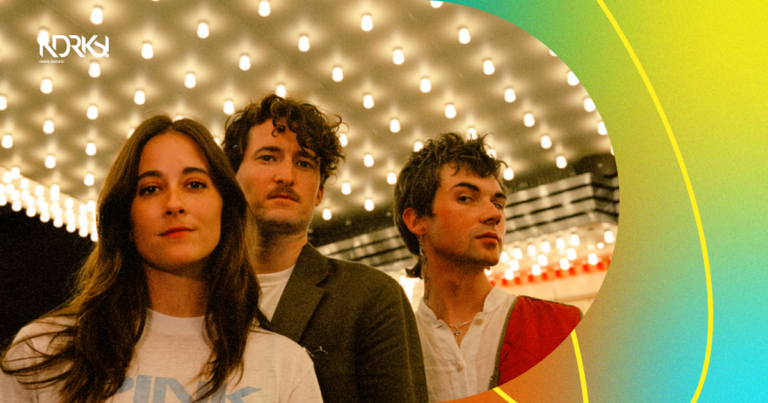
Between melancholy, intuition and the passage of time, the New York band explores how songs change their meaning when they are performed on stage.
At a time when nostalgia is often reduced to an aesthetic gesture, Nation of Language He has built a work that inhabits him from a much deeper place. His music not only evokes the past: it transforms it, recontextualizes it and turns it into a shared space. In this conversation, Ian Devaney reflects on the cycle between touring and writing, the vulnerability of playing songs live, the discipline behind creativity, and the way melancholy can become a bridge between people. More than definitive answers, Nation of Language offers something more valuable: the certainty that songs continue to grow long after they have been written.
Indie Rocks!: Ian, it's a pleasure to be here with you. I know you were recently on your biggest tour yet, is that correct?
Nation of Language: Actually, we just finished it, I think in December.
GO!: Perfect. To me, it feels like a great chapter for the band, so I wanted to start there. In a previous interview, Aidan talked about experiencing a sort of post-tour depression and how the way to cope with it is to sit down and write new music. He described it as a cycle: spinning leads to writing and writing leads back to spinning. With that in mind, I wanted to ask you about the process of live shows. Now that you have more songs and continue to create more, how do you build a setlist?
NOL: We sit down every night and decide what we're going to play. A lot of times we find that certain songs feel especially good at the beginning of the set, but then we change and think: is this a night where we want this to be the second song? A lot depends on how we feel that day and whether we want to start with a lot of energy or if we prefer to start in a more contained way and then build towards something more intense. Every night is a little different, mostly depending on how we feel that day.
GO!: It also has to do with the narrative they want to share, right?
NOL: Yes, totally.
GO!: Honestly, I'm very excited for the concert in Mexico. I remember you once talked about the fear of playing a new song in front of an audience. Does that vulnerability change the way you relate to a song afterwards?
NOL: Yes, definitely. I enjoy that fear of touching something for the first time. But something also happens when you play a song a thousand times on tour: you start to find new meanings in the lyrics that you didn't understand or that you hadn't anticipated when you wrote it. There are songs from the first album that continue to mean a lot to me because I have experienced things that have recontextualized them and given them new meanings. That only happens when you play them over and over again, and that's something very special.
GO!: I would like to talk about creativity. You've mentioned before the importance of embracing imperfections and letting the music breathe. Many people idealize creativity because they only see the end result, not the uncertainty or the process behind it. How do you understand creativity? Is it intuition, discipline or both?
NOL: I think it's a combination. There are moments where intuition works perfectly and you feel that the song writes itself. But there are other times, like right now, where I've been working on a song for a while and I just can't figure it out. Then I sit for hours trying to find the right words. That's where discipline comes in, even if it sometimes feels frustrating. But even if you manage just one line in a day, it feels incredibly satisfying.
GO!: I like to think of creativity as a state you enter, rather than something you control. What helps you stay connected to that state?
NOL: Surround myself with things that inspire me to create. Movies, books, often things outside of music. Seeing something that someone else did that you couldn't do creates a sense of wonder that drives you to want to create too. That always motivates me to write again.
GO!: Speaking of the new album, something that stands out is how human it feels. If you had to choose a song that encapsulates your essence, what would it be?
NOL: Probably the first song, “Can't Face Another One”. Since I finished it I knew that it had to be on the disk and that I had to open it. It has very intimate moments and other more expansive ones. Also, it starts with a harmonica, which is unusual for us. At first I doubted if it made sense, but when you follow an idea and it works the way you imagined, it's very rewarding. I think that song sums up the album very well.
GO!: One song that resonated with me was “Now That You're Gone,” especially knowing that it was based on a real family experience. When an experience like this becomes a song, it stops being just a memory and becomes something shared. How does that change your relationship with memory?
NOL: It keeps the memory alive in a positive, rather than painful, way. When you share a deep loss and others empathize, you discover that you are not alone. Grief can make you feel isolated, like there is a barrier between you and the rest of the world. But when you turn it into a song and others connect with it, it's like that barrier disappears or expands to include more people. That means a lot to me.
GO!: Melancholy is a very present emotion in your music. There is a phrase that I love: “melancholy is the happiness of being sad.” What does melancholy mean to you?
NOL: That's a beautiful way of saying it. I think I often feel more driven to create when I'm in a melancholic state. Music has meant a lot to me, especially being in a room with other people sharing that emotion. That creates a very strong sense of connection. Many of the songs that have meant the most to me were songs that accompanied you in difficult times. I think that idea is still present in my way of writing.
GO!: In closing, looking at the band's entire journey, what has music taught you about yourself that you didn't know when Nation of Language started?
NOL: When the band started, they had very tight control over everything. I had a very clear vision and that made me very closed-minded. Maybe it was necessary at that time. But over the years, as I worked with more people and shared the creative process, I learned to be more open. I understood that it is important to maintain your vision, but also allow other people to contribute. Learning to let go of control a little has been one of the most important lessons.
GO!: Thank you very much for your time. It was a pleasure talking to you and we are very excited about the concert in Mexico.
NOL: Thanks to you.