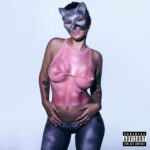
There is a moment, in Ditonellapiaga's new album, in which everything stops seeming under control: not by mistake, but by choice. “Miss Italia” (or the title it will become) moves right there, in that less than photogenic moment in which the identity cracks and it stops wanting to please at all costs.
Far from any consolatory pose, Margherita Carducci talks about a work born in a phase of total exposure, where writing becomes a tool for restoring order without taming chaos. Between a title that ended up at the center of a legal dispute and a personal journey that also involves therapy.
We met her at her press conference in a Milanese nightclub. Between velvet and red lights Ditonellapiaga returns the portrait of an artist who has stopped asking for permission, at least from herself.
THE INTERVIEW
The album's title is also its most exposed issue. How was “Miss Italy” born?
It comes from my complicated relationship with canons. The idea of the “miss” is that of the winner, of the impeccable figure.
I, on the other hand, have always perceived myself as off-axis, not so much with respect to aesthetics but with social expectations.
Even in my way of making music I often feel out of place. That title holds all this waste inside.
Yet today that title is also at the center of a legal issue.
There is a hearing underway at the Court of Rome. I don't know if the album can continue to be called that. It's a suspended situation. I care a lot about it because for me it is a declaration of expressive freedom, even if it draws on a now collective image. But now the decision no longer depends on me.
This work seems to have a strong autobiographical component.
It's a comparison album with myself. I also wrote it to go through moments of crisis, especially related to my career. It is a very personal work but inevitably intertwined with my way of being in music.
At a certain point you talk about a crossroads: mainstream pop or indie world.
It's a real passage in my life. I was asked to choose, because that middle area wasn't working. I have always felt in the middle, and I have tried to stay there, even at the cost of losing myself. The problem was probably that I wasn't in focus yet.
The album has a very precise narrative structure.
I thought of it as a path. A sort of therapy, in which each track adds a step towards a form of liberation. It's not just a sequence of songs, but a crossing.
Until the closing with “The truth” which actually explains this liberation.
It was the last song to be written. It talks about the fall of the mask, the moment you stop defending yourself. There's that image of dancing in a club and suddenly feeling the weight of an awareness. It's something I started to recognize also thanks to therapy.
On the album you talk a lot about truth. What have you discovered about yourself?
Therapy and music went hand in hand. I discovered that I have a difficult relationship with judgment, especially my own. I tend to ask myself first what others might like, rather than what really interests me. This led me to get lost. The work I did was precisely to re-center myself.
In the song “Miss Italia” you play a lot with the idea of beauty and mask.
It is a language that has always belonged to me: the gloss that cracks, the perfection disturbed by an error. I'm fascinated by that slightly grotesque aesthetic, where beauty becomes excess. It's also an ironic way of telling myself.
How much can this mask become a cage?
Depends. I feel authentic precisely when I am ironic, theatrical, even exaggerated. Paradoxically, when I tried to be more “true” in the traditional sense, I felt less free. My spontaneity is eccentric, and it may seem constructed, but it is my natural way of being in music.
You collaborated with Ornella Vanoni: what did it leave you with?
A very concrete idea of freedom. He is a deeply cultured figure, an intellectual. I was struck by his way of experiencing culture, of going through history. She has an experience that is almost inconceivable for my generation, and being next to her was like breathing in that intensity.
On the topic of public exposure: you participated in “No Kings”. Do you think the mainstream is struggling to expose itself?
It's easier not to do it, yes. Exposing yourself has a cost. But I believe it is a question of personal conscience: understanding how much one's values matter more than convenience. I don't make political music, but if I can make my visibility available for certain causes, I'll do it willingly.
TRACK BY TRACK
Yes I know
Programmatic opening, almost an anti-rhetorical statement. The tone is open, self-deprecating, deliberately imperfect: a statement that rejects filters and constructions, immediately making the album's posture clear.
Tropicana Hotline
Gossip as a narrative device. Here reality deforms in a continuous flow of exposition, where intimacy evaporates and the private becomes entertainment. A song that intercepts the neurosis of visibility.
Bibidi bobidi bu
Unstable, emotionally slippery area. Between desire and compromise, the piece moves like a choice never truly made. The lightness of the title betrays a more ambiguous, almost irresolute subtext.
Hollywood
Suspended ballad, with a cinematic feel. Piano and strings build a rarefied emotional landscape, crossed by disillusionment and emotional dependence. The trip hop burst cracks the surface, introducing a rhythmic fracture that amplifies the sense of loss.
How annoying!
Pop heart of the album, but with a thin edge. Direct, caustic, built on an irony that does not console but exposes. Everyday life becomes friction, and discomfort is transformed into a shareable language.
Sooner or later
The awareness of time passing is treated without emphasis. There is an almost philosophical lightness: accepting the end as an opening. The song breathes, leaves space, does not force conclusions.
I
Return to interiority. Fragility and resistance coexist without resolution. The narrative avoids victimhood, preferring a precarious balance where every mistake becomes a matter of redefinition.
The good girls
Memory and training. Adolescence is not nostalgia but an archive of contradictions: MSN, late nights, uncertain relationships. Femininity emerges as a fluid construction, never disciplined, crossed by irony and disenchantment.
Miss Italy
Body and image in tension. The rhythm invites movement, but the text delves into inadequacy. The myth of perfection is dismantled from within, revealing a vulnerability that does not ask for redemption.
The truth
Closing in a club key, but anything but evasive. The straight case accompanies a process of unmasking: the identity is recomposed only by passing through the fracture. The truth is not a conquest, it is an inevitable failure.
THE TRACKLIST
1. Yes I know
2. Tropicana hotline
3. Bibidi bobidi bu
4. Hollywood
5. How annoying!
6. Sooner or later
7. Me
8. Good girls
9. Miss Italy
10. The truth
VIDEO
INSTORE
Friday 10 April at 6.30pm @Locale CAP 10100 of Turin
Saturday 11 April at 5pm @Discoteca Laziale in Rome
Sunday 12 April at 5.30pm @CC Centronova in Bologna
Tuesday 14 April at 6.30pm @Feltrinelli Milan Cathedral
Wednesday 15 April at 6.30pm @Feltrinelli Via Melo di Bari
Thursday 16 April at 6.00 pm @Feltrinelli Piazza dei Martiri in Naples
LIVE
May 26th @L'Aquila – Cooltura Fest
04 June @Cagliari – AteneiKa
18 June @Rivoli (To) – Sguardi Live
June 26 @Bologna – We Make Future
28 June @Perugia – Umbria That Rocks
02 July @Cremona – Lots of Robba Festival
03 July @Bergamo – NXT
15 July @Treviso – Suoni Di Marca
July 16th @Arezzo – Men/Go Music Fest
30 July @Montesilvano (PE) – Montesilvano Summer Fest
July 31st @Montecosaro (Mc) – Mind Festival
1st August @Livorno – Venice Effect
03 August @Locarno – Rotonda By La Mobiliare
09 August @Roccadaspide (Sa) – Aspide Festival
11 August @Milazzo – Mish Mash Festival
04 September @Trento – Trento Live Fest
12 September @Padua – Pride Village
WEB & SOCIAL
@ditonellapiaga