“We Will Always Be The Way We Were”, the ninth chapter of Jack Savoretti's discography, arrives as a work of subtraction: less construction, more intimacy and creative centrality.
The return with an album in English after “Miss Italy” which renounces the rhetoric of evolution to embrace something more unstable and human, an internal continuity that resists time.
Thirteen songs in which there is the awareness of someone who has reached middle age and has gone through the discipline of the profession while also recognizing its limits. The urgency is no longer to demonstrate, but to let it happen. The writing becomes porous, the sound breathes, the control retreats. It is not a return, nor even a turning point: it is rather an alignment, almost a lucid surrender to what remains when you stop looking for a better version of yourself.
The meeting with Savoretti moves along this fine line. We talk about crisis and romanticism, about loss of control as a form of freedom, about collaborations born out of instinct and about an aesthetic that shuns the centrality of the ego.
What emerges is the portrait of an artist who, after twenty years, chooses to inhabit his own contradictions without filters, finding a new, unexpected precision right there.
INTERVIEW
Let's start from afar. Listening again to “Between the Minds” from 2007, it almost seems like this new album closes a circle. Is this a correct feeling?
Yes, absolutely. It was like that for me too. It's like it's the same impulse, the same intensity, the same intimacy. This is the record that maybe I would have liked to make twenty years ago, but I didn't have the tools to do it yet.
I didn't have twenty years of experience. It's not a complex album musically, but it's complex to make. Doing something authentic, where substance counts more than style, seems natural, but instead it is very difficult.
It took twenty years. As Miles Davis said, you have to imitate before innovating. I imitated just to learn. This is my most innovative record precisely because it is the simplest: it's like a pair of jeans and a white t-shirt.It's not easy to be like this, without protection. It's not completely naked, because there's my band, the producer, people who support me. But it is a return without nostalgia.
What does “without nostalgia” mean?
Accept that I will always be that. The boy from 2006 who made his first record. The child who doesn't sleep the night before Christmas. That part never changes. You grow, of course, but the soul remains.
And this is where the title We Will Always Be The Way We Were was born.
We can evolve, but inside we remain the same as always. And it's something that I think concerns everyone.
The previous album, Miss Italia, was an important step. How much did it impact this work?
Very, very much. Without “Miss Italia” I would not have been able to make this album. There I had to give up, because I was the least prepared in the room. I'm a student again. Working with people like Simone Zampieri and Tommaso Colliva forced me to let go of control.
A radical change in your method.
Absolutely. I've always been someone who decides everything in the studio. Not this time. I brought the song and asked the others: show me what you hear.
So a more open process.
Yes, I wanted them to be an active part, not at my service. The result matters, but for me the real value is in the process. Writing, recording, building: that's where it all happens.
Let's talk about the collaboration with Mille. How was it born?
I discovered it like I discover all music: online. It appeared on Instagram and immediately struck me.
The fact that he made authentic but not nostalgic Italian music. Classic and contemporary together. And it amazed me that she wasn't better known.
An implicit criticism of the system?
Yes, I also got angry. Artists like this should be supported more, even abroad. She has the elegance of Patty Pravo and the spirit of Lou Reed. Working with her has been an ongoing revelation as she embodies everything I love about Italian music, bringing the past into the present. I can't wait to see what he does next.
And then?
I wrote to her. Soon after I had this single, I Hear You Calling, and I immediately thought of her.
Did you give her any directions?
None. I told her: do Mille. After 24 hours he sent me his share. And I'll tell you: I prefer the Italian version to the original one.
This album seems to be born from a forty-year crisis, but it is crossed by a strong romanticism. How do these two dimensions coexist?
I read something beautiful by Gino Paoli: a poet is not because he uses words well, but because he decides how to look at the world. The midlife crisis, in a way, takes you there.
You become better able to see the beauty, even in the cracks. You accept that you don't know. At twenty you think you have answers, at forty you realize you don't. And when you accept it, it's a liberation.
An almost instinctive approach.
Yes, and it was new to me. In the past I arrived at the studio with a precise idea, almost with the answers already written. This time I only had questions. The answers came by doing.
The album was recorded in just a few days, with a very direct approach. How important was the live dimension?
Fundamental. Spontaneity was everything. After twenty years I know how easy it is to ruin something beautiful by adding too much, rethinking, correcting.
After the first take I would have already gone home. Luckily Tommaso Colliva was there to tell me: let's do another one.
A necessary productive tension.
Yes, but we share the same idea: music must remain alive, not crushed. We didn't want perfection, we wanted truth. We had a few days and this forced us to be present, not to waste energy. A constraint that has become freedom.
Let's talk about collaborations. How did the one with KT Tunstall come about?
It was all very natural. We've known each other for years, since our beginnings in London. We played in the same pubs, on the same circuits.
A voice that was both vulnerable and strong. It's a song about responsibility for your choices, about stopping blaming fate.
And she embodied this tension perfectly. His voice has that strength that comes from fragility. It brought a very physical energy, almost an emotional slap.
And what about the collaboration with Stephen Fraser?
It was born by chance, at the end of a concert. We met backstage, she told me her story, a very tough one: years inside a record system that was trying to change her.
Yes, but she came out of it with a strong awareness. He sent me some stuff the next day and I was impressed.
I asked her to come to the studio. In a few hours a song was born. It wasn't intended for the album, it was something of ours.
Can you tell us about the album cover?
There are several stories behind it. I worked with photographer Leah Powell, who has collaborated with Radiohead and Adele. With this album I wanted to avoid it being centered on me: I was looking for something that gave back a sensation, rather than an identity. That of the “forever young”. The idea that what we were continues to exist, not as nostalgia but as acceptance. Something to celebrate, not regret.
And how does it translate visually?
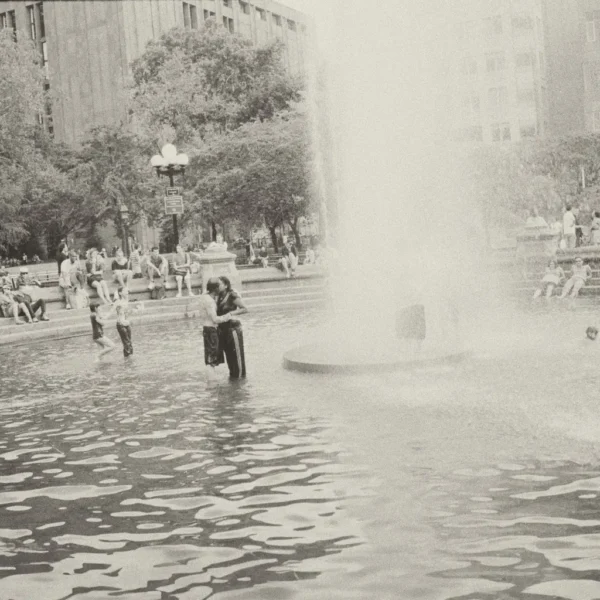
I didn't want to be on the cover, which I had always done. I was looking for an image that evoked youth and romance. She sent me some proposals, and one in particular struck me immediately.
What does it represent?
There are children playing, young lovers and a fountain. It made me think of Fountain of Sorrow by Jackson Browne, a very important song to my wife and me. But that fountain is also a “Fountain of Youth”. It holds loss and rebirth together. In that urban, cosmopolitan scene, I saw my whole life, even if in reality it had nothing to do with me. And this is the point: when art reflects you without explaining you.
Black and white also plays a strong role.
It is the most ambiguous element. It might seem nostalgic, but instead it makes everything more contemporary. I can't explain exactly why, but it was immediate.
On April 23rd you will be at the Royal Albert Hall. Then you will also return to Italy. What is the difference between your international lives and the Italian ones?
In reality, for me Italian live is already international. I am English at home, but as an artist I feel more English than Italian, while as a man the opposite. In England my career is twenty years old, so I can dig deeper into the repertoire there. In Italy it is a more recent story.
So the lineup changes rather than the approach.
Exact. In England I go further back in time. In Italy I also keep a space for Italian songs.
And after Miss Italy?
Paradoxically it went better in England than in Italy. It could remain my only album in Italian. A closed chapter, perhaps.
THE TRACKLIST
The new album “We Will Always Be The Way We Were”, produced by Tommaso Colliva (Muse, Damon Albarn to name a few) and recorded live in eight days at Eastcote Studios, was preceded late last year by the release of the previously unreleased “Do It For Love” (Listen here), a Morricone and Bassey-style love song written with friend Miles Kane that conveys the sweeping drama and soulful grandeur that have become the hallmark of the band's songwriting. Italian-English chansonnier and the title track “We Will Always Be The Way We Were”.
1.The Making Of You
2.Can Hurt Sometimes
3.We Will Always Be The Way We Were
4.Tick Tock
5.Only Gonna Cry For You feat. Steph Fraser
6.Time Will Tell
7.Do It For Love
8.Anything But A Fool
9.Tempting Fate feat. KT Tunstall
10.I Hear You Calling
11.Step By Step
12.The One
13. If I Get The Chance
TOURS
23 February De Montfort Hall, Leicester, UK SOLD OUT
24 February Liverpool Harmonic, Liverpool UK SOLD OUT
23 April Royal Albert Hall, London, UK SOLD OUT
15 October Fabrique, Milan
CLICK TO BUY TICKETS
WEB & SOCIAL
https://www.jacksavoretti.com/
@jacksavoretti