Language, identity and confrontation from the dance floor.
The Irish trio turns Gaelic rap into a political and sonic tool that connects beyond language.
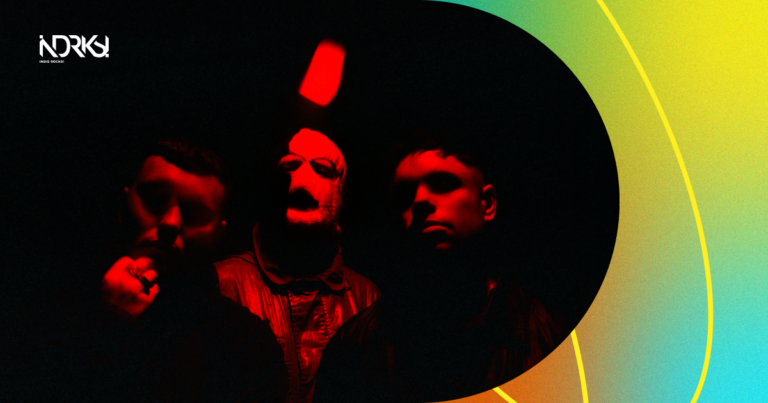
At a time when its reach is growing internationally, KNEECAP It keeps the focus on what sparked it all: making music in Irish as an act of cultural resistance. Between festivals, cinema and a new album on the way, the project has found a way to translate history, identity and confrontation into collective energy. In this conversation with DJ Próvaíthe band talks about the weight of their language, the impact of their film, the new album Fenian and why his proposal goes far beyond the literal meaning of the words.
Indie Rocks!: I think there are more points in common between our stories, between Ireland and Mexico, than people imagine. I'd like to start there: they started making music in a language that was being displaced and now they're playing big festivals all over Europe. When you are on stage, do you feel that the audience connects with the meaning of the words or with something deeper?
KNEECAP: It's an interesting question, because we speak Irish and it's not even a widely spoken language in Ireland. There are around 80 thousand people who use it daily, although in the last five or ten years it has grown a lot.
When we started, we knew that it was not the best business model to sing in a language that almost no one understands. But when we go to festivals all over the world, it's beautiful to see how people react.
There is definitely something deeper than the literal meaning, because most do not understand what we are saying. It's a different connection: people sense the passion we have for the language and for supporting cultures that have been oppressed or almost erased. That's what connects.
GO!: There is also something very particular in your sound. I've seen it described as a collision between rap and rave. Do you agree with that label?
K: We don't like to be pigeonholed in just that. There are also punk elements. We come from a very eclectic background.
When we started, it was challenging enough to rap in Irish, so we didn't want to limit ourselves to just one genre. We do what we feel at the moment. In Fine Art That is very noticeable: it is another party album, a journey through genres and through our lives at that moment.
The new album is different: darker, more mature. It has melancholic moments, but also songs to dance to. There is ravethere is hip hop… it's a pretty complete mix.
GO!: Before talking about the new album, I would like to touch on the theme of the movie. In fact, I discovered them there. The reception was very strong, even global. Did you expect that impact?
K: (Laughs) The thing about Brad Pitt…didn't get the role.
But no, we did not expect that reach. We thought it was a local story, about the Irish language and its recovery. But when we started taking the film to other countries, we realized that it was a universal story.
In the United States we met many people from Mexico who told us about indigenous languages, about how their grandparents spoke them and now they are disappearing. And when a language disappears, it is very difficult to recover it.
That is why it is so important for us to make ourselves heard, coming from a country where culture was almost erased. That's in the movie and also in the music.
GO!: Before entering FENIAN2025 was a very intense year for you. Amid all that, what do you consider your greatest achievement?
K: We hadn't thought about it like that. When we started, we believed that our ceiling were venues small.
But that limit has been moving. And that's the best thing: that what we thought possible became much bigger.
People connect with honesty and passion. And for us, the greatest achievement is being able to do this on a global level without having to change languages or adapt. We can be ourselves and that is enough.
GO!: That same year they released “No Comment” with Sub Focus using a Banksy work as the cover. It was a very powerful moment. How did it come about?
K: Banksy He has always been very connected to what is happening, his work is provocative and points out abuses of power.
We came across that piece right when we were going through a legal case and it was out of court. We felt like it made sense to us.
We managed to contact him and he agreed for us to use the work. It was the first time he allowed something like that. I guess it was because we shared certain positions.
When they told us yes, we were like children.
GO!: Now yes, FENIAN. They have said that it is a darker album, even “sinister”, but it also has a charge of identity and community. How do those two things coexist?
K: the word Fenian In itself it has a duality. It was used as an insult against the Irish, but its origin comes from mythology: Finn and the Fiannaa group of warriors.
For us it is recovering that term, turning it into something positive.
The “ominous” comes from the current reality: British government figures trying to censor a band that raps in Irish. It sounds dystopian.
But at the same time it is an album with humor, with satire. Because when what happens is absurd, you have to approach it that way. There is criticism, but also irony.
GO!: The album was produced by Dan Carey, known for taking artists to new places. What did you contribute to the sound of KNEECAP?
K: His approach is very organic. Use analog instruments, create soundscapes that accompany the message.
If a song talks about a “media carnival,” it creates that circus atmosphere. Build the world where the letters live.
Furthermore, he saw the energy of the public in Wembley and he understood that we needed big sounds, that filled spaces like that. That was key.
GO!: Yeah Fine Art I lived in a pub, where would I live FENIAN?
K: He would be more of a vagabond. Someone who goes from one place to another: parliaments, bars, streets. He doesn't have a single home.
GO!: In closing, what are you listening to lately?
K: A disk called Four Green Fields of The Flying Column. It's Irish folk music, from the 60s or 70s. It's a great entry point.
GO!: Thanks for the conversation. I hope to see you soon in Mexico.
K: Thanks, that would be great. See you there.