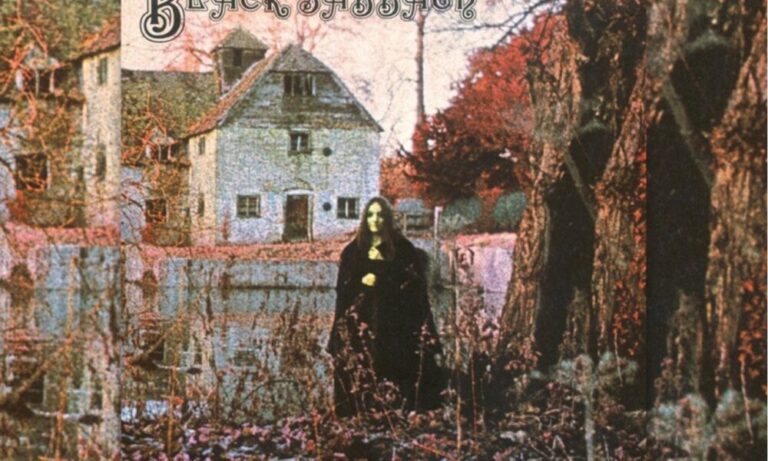
Identified in 2020, Louisa Livingstone, the caped figure from Black Sabbath’s first album, now records under the name Indreba. She talks about the songs she wrote on this cover and her mini rock opera inspired by Alice in Wonderland.
For half a century, the identity of the hooded, witch-like woman staring at metalheads on the cover of Black Sabbath’s debut album remained a mystery. Then, in 2020, an article from WECB revealed that the woman photographed was called Louisa Livingstone, and that she had also appeared on Queen covers and visuals (Jazz) and the British rock band Fair Weather.
Prior to this article, she had spent the previous fifty years working as a model, actress, and musician, among other creative pursuits, and had settled in continental Europe, where she recorded electronic music under the name Indreba, short for “Incredible Dream Band.” At the time, she wasn’t prepared to see the band’s huge fan base embrace it.
To respond to the interest of Sabbath fans, she tried to put her autograph in a raffle for a lucky winner, in order to finance her cat rescue actions, at the time when Black Sabbath reformed one last time for the Back to the Beginning concert. “The winner never claimed his prize, despite several attempts to contact him”she said. “My autograph therefore remains extremely rare and unknown. »
Alice, a mini rock opera in the age of algorithms
She now turns her musical desires towards the fantastic: a mini rock opera entitled Aliceaccording to the books ofAlice in Wonderland by Lewis Carroll, which her father read to her every evening when she was a child. The idea came to him while discussing panpsychism, “the theory that everything (including AI) is conscious”with an artificial intelligence chatbot. The conversation “led to the concept of myself (or Alice!) falling in love with AI, before realizing that ultimately it’s just a beautiful illusion, like everything else on the internet… and returning to yourself and nature”.
Louisa Livingstone today. Courtesy of Louisa Livingstone
The 23-minute work is divided into five parts and opens with a rock tango (“Feed Your Head”) with lyrics like “One pill makes you scroll for hours”where she updates Jefferson Airplane’s “White Rabbit”: “Go ask Alice, when she’s 10 feet tall, staring at the digital wall. » The rest of the EP, which sounds like blended psychedelic rock, talks about algorithms,“silicon gold” and synthetic angels made of code. It ends with “The Red Queen’s Wake-Up Call.” “The digital palace crumbles to dust in the light of true day”sings Livingstone.
Livingstone grew up in a home steeped in music, her mother being, she says, a “virtuoso violinist”and then turned to guitar and keyboards. She owned a Framus guitar which she said had belonged to Jeff Beck, and recorded on a Sony tape recorder. Since moving to Spain, she has played lead guitar on stage with a few groups. Today, she uses Logic as her digital audio workstation and mostly plays keyboards.
“AI will always reflect who uses it”
She began recording under the name Indreba, she says, when she discovered the power of her computer as an instrument around 2014. Among the musicians she reveres is Jordan Rudess, the keyboardist for Dream Theater, who created iPad apps that serve as musical instruments. “He believes everyone should enjoy and make music, no matter how”she said. “The iPad truly can be incredibly versatile as a musical instrument, in the right hands. »
Her plans now are to explore what programs like Logic and Omnisphere can do, and she hopes to find a theater to play Alice on stage. “I plan to continue creating enjoyable music, which I enjoy making, in whatever way I can.”she said, “and get rid of everything that tries to put me in a box. »