Hope. Death.
Michael Alden Hadreas talks about the process behind his albums with Blake Millsabout how a song stops belonging to him as soon as he releases it and about returning to the most intimate format with which he started: just him and Alan on stage.
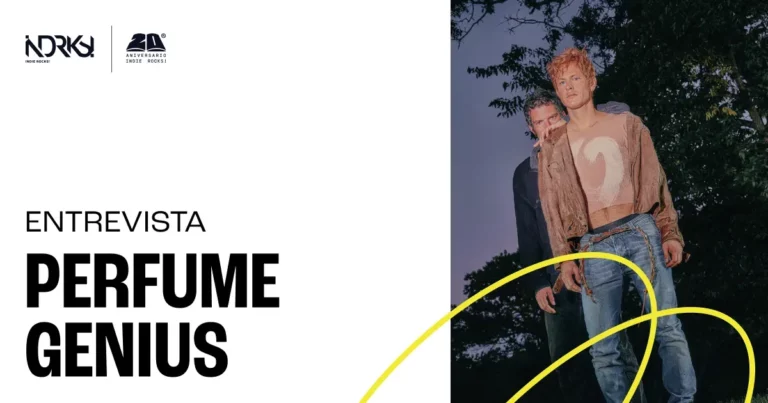
Michael Alden Hadreasknown as Genius Perfumeis one of the most unique artists in contemporary pop: someone capable of turning fragility and desire into songs that feel both private and monumental. With more than a decade of career and several albums made with the producer Blake Millsher music has explored vulnerability, the body, and memory from a deeply personal place. On September 23, it is presented at the Indie Rocks Forum! as part of the Pitchfork Music Festival CDMXin a stripped-down format that returns it to its origins. He talked about the process, the magic of writing and the strangeness of reliving a dream in front of an audience.
Indie Rocks!: I want to start by talking a little about your process in the studio. Tell me what it was like to make your last album and how you see it a year after releasing it.
Genius Perfume: I’ve made the last four albums with Blake Millswhich at this point feels like family when we’re in the studio, along with Joseph Lordthe engineer. I feel very close to them. But also blake He surprises me all the time, he surprises me with his ideas and his decisions. And that’s my favorite part of music and production, and the technical side: when I hear something I haven’t heard before, or when the song goes in an unexpected direction.
So I leave a lot of room for that in the songs I write. Especially on this album, I wrote almost everything alone on piano and voice. I would come in with ideas, like: I want this to be a full band song, but I’m not loyal to that idea. I want to see what happens when we move forward. If it feels important to keep the song just piano and voice, I do it. But if we start playing, yeah blake starts playing or someone has the idea that maybe this should be huge, very distorted, even though my demo is very quiet and whispery, I’m willing to listen to what that sounds like. And if I like it, I forget my old idea and go with that one. That’s how I work.
GO!: I love this part that you mention, because sometimes I hear artists who are more jealous of the process of making a song and others who are more open. I’m not saying one is better than the other, but it’s interesting. What is your writing process like? Do you have the songs written years in advance or do you write them for the album in question?
PG: I have many fragments, half-finished or even finished songs that don’t make it onto the album, but they are all written at the same time. I always intend to listen to them again for the next album and see if there’s something there, but I never do. I always do everything in the moment, and whatever is good about it I take to the studio.
I don’t know why. I also hate missing the magical part of writing, when you feel really inspired and just flow. I hate to lose that. So if I start working on something and it doesn’t work, I stop and do something else. I have a harder time listening to old things again and trying to find that magic again. But really, the magic is only a small part of the ending, because the rest is just work. It’s like mathematics: discover the structure and build around it. I think that’s why I’m so protective of that little part, because it’s the heart of it all. Without that, it’s not going to be good. Without that central spark.
That’s why I tend to write each record in a couple of weeks, but that’s after months and months of doing a lot of stuff that’s no good, a lot of experiments and ideas, until I land on something that feels like I’m really inspired and I’m not thinking about other people or in the studio or anything. And I say: this is it. And then everything comes out. I don’t know if it’s a good idea, maybe some of the other songs are better, but I’m going with what feels best to me. And I try not to think about what that means because so far it’s worked.
GO!: I don’t think there are good or bad ideas in music, but rather how well they work for you or other artists. Now that you talk about that magic of writing, when you perform the finished song on stage, do you feel like that magic disappeared a little or do you find a new one?
PG: I remember writing, I remember how I felt, but it can’t be recreated, because I usually write the song in isolation, like in a dream. But being on stage, with a bunch of people watching you, trying to relive a dream, is difficult. So I try to find a new dream. I try to be as present as I was when I wrote it, but within that moment, not in an old one. And that may look and feel very different than when I first wrote it. I try to go to the same place, but with what surrounds me on stage, with the audience in the room. There is a common thread to my connection with the song.
But also, when I release the songs, they don’t really belong to me anymore. And I don’t listen to them, you know? Because I made them for the people who come to the shows. So in some way it belongs to them. It’s a lot to throw in the air and try to hold. It’s a weird thing to charge people money to watch you for an hour. It’s strange. And you have to think about that pressure in a good way, as fuel to do good work. But you also have to pretend it doesn’t exist if you want to be present and in the moment and find that magic, because it has to transcend. You can’t be too self-aware, because then… I’m not good at being self-aware. It would be too scary if I thought about it too much. But I think that tension makes it better, honestly: you go in and out of all that. The tension between the internal and the external, the people being there, which is a show, but it is also as if you are seeing something you shouldn’t see, something private. I think that tension is good.
GO!: There are so many people excited to see you in Mexico this year who haven’t had the opportunity before. What can we expect as an audience? How are you structuring the setlist? What is the idea of the concert?
PG: When I started playing, and actually for a long time, it was just Alan and me on tour. On the first two albums, every show we were just Alan and me, no one else. Over the years we started playing with a band and it became something, but the core has always been Alan me too. And those shows felt very different than the show feels now. Going back to that style of playing is very confronting, honestly.
Like what we were talking about: how you stay connected to the songs while you’re playing them. This style of playing, coming back to it, changes the way I think about songs in real time. I connect with the old songs and the lyrics because it’s much more intimate and it’s just me singing. I’m not rolling on the floor or licking the wall like I’ve done before. And it costs me. Now I feel weird if I’m just standing and singing. I feel like I should be doing things to a chair or something. It’s hard for me to just stand up and sing, but honestly, it’s given the show a spark.
Alan and I have been together for 18 years. We’ve been making music all that time. Now I see people at the shows I saw at the beginning, and they are 15 years older, just like me. We are different but the same. And the songs: I remember how I felt when I wrote them, but sometimes they mean something different to me now, or I’m surprised by how much I haven’t changed. I’m singing a song from 15 years ago and I could have easily written it yesterday, which is a little heartbreaking, especially with my music, but yeah. It’s scarier. I’m looking at Alanand then I look at the audience. I feel like I look at everyone a lot more.
And we played songs we hadn’t played, but in all my setlists I try to touch them hitshonestly. I hate going to shows where they don’t play the songs you want to hear. Even if I sing certain songs at every show, I will always sing them. Even though I get fed up with them on tour, I’m always going to sing them, because that’s what people want to hear and I feel like it’s my job.
GO!: I couldn’t agree more. In closing: if you could describe Perfume Genius in just three words, what would they be?
PG: Three words. Hope. Death.
That is. Two words.
GO!: Two words? Okay, it’s valid. There is one more if you want to use it in the future, you have the wild card.
PG: Sure, absolutely.
GO!: Many thanks for everything.
PG: I’m very excited. It’s been a long time. It’s going to be great. Many thanks for everything.