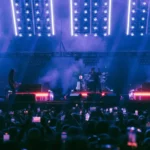
I never planned to be the vocalist of OMD.
The leader of Orchestral Manoeuvres in the Dark It talks about half a century writing songs, the difficulty of finding something new after so much time and the almost irrational relationship that the band has with the Mexican public.
Orchestral Manoeuvres in the Dark is, together with The Human Leagueone of the bands that basically invented British synth pop in the late 70s. What started as a hobby between Andy McCluskey and Paul Humphreyswhen one was going to study art and the other electronics, ended up becoming half a century of songs that don’t age. After a summer of 33 festivals, OMD returns to Mexico for his own show: October 18 at the Pepsi Center WTCalso stopping in Guadalajara.
Indie Rocks!: It seems like they’ve been coming to Mexico quite a bit lately.
Orchestral Manoeuvres in the Dark: We are making up for lost time. We didn’t get to Mexico until ’91, and there we discovered that we love Mexico and Mexico loves us, so we want to keep coming back all the time.
GO!: They’ve come to festivals, but I guess this time it’s going to be different.
OMD: Yes, we have played some own shows but many festivals. This time we have a festival in Cancun, but we play in Mexico City and Guadalajara, and we are really looking forward to it. We had a great time in Guadalajara with him Mute Festivalbut that was about 14 years ago, so we’re excited to get back to that area. And of course, last year Crown Capital In Mexico City it was crazy.
GO!: We say it was crazy as an audience, but why do you say that?
OMD: Because the audience was crazy, it was incredible. In the end we posted something on Facebook and instagram: My bass tech came out on stage and filmed the audience. we were playing “Enola Gay”you don’t listen to us, you listen to the public singing it, everyone.
GO!: And the funny thing, or rather the funny thing, is that you think it’s like that everywhere you go.
OMD: I wish it were like that. Sometimes it is, but Mexican audiences with OMD They are wonderful. They’re probably wonderful for everyone, but when you give 100% from the stage and you get that back and more, it becomes a positive cycle: everything grows and grows and gets crazy. It’s an incredible feeling.
GO!: Being your show headline in it Pepsi Centr, do you prepare in a special way for this concert? Have you already talked about setlist?
OMD: In Mexico City it is the 18th, in the Pepsi Center. At a festival you have an hour and you hit them with every single you have, pure hits one after another. When we play our own 90 minute show, we do play all the hits because we are proud of them and people want to listen to them, but we have the opportunity to play a little more with light and shadow, to tone it down a little to give ourselves a break. If we’re going to go crazy for 90 minutes, we’re going to need a moment in between to rest.
We have a very beautiful new song called “Veruschka” and we will have a chance to touch it. People love that song because we all go down to the front, move from our instrument stations, and get in a line right in front, with the big screen behind us. It’s a beautiful moment. But the truth is that we can’t wait to return. We just did 33 festivals in the summer, so I had two weeks off and today I went to the gym to get in shape. I have to play my bass because I don’t want my fingers to get soft, because then they hurt, and I’ll be singing again and ready for Mexico.
GO!: Not only are they still playing, they’re still making music, which is amazing after decades. Does the process of making new music still feel natural, does it still flow?
OMD: I admit that it gets more difficult, because when you’ve been writing songs for 50 years, you sit down to write one and say: well, I can’t sing that, I already sang about that, and that melody sounds like something else. Finding something totally new is quite difficult. We trust that yes Paul and I have a new idea or sound when we work together, it’s going to sound like OMDbut finding something new becomes increasingly difficult. Still we have a new idea for next year that is going to be interesting, so there will be new music next year.
GO!: You do bass and vocals at the same time, something that is not so common, there are not many bands that do it. When you started, did you feel like it was weird?
OMD: The truth is, it was just the way things happened. I wanted to be a drummer, but it was too expensive. I started playing guitar and my fingers hurt a lot. I had a friend who had a bass, and I grabbed it and said, this is easy, I’ll get one of those. Then I joined a band that had a singer, and after three weeks they said: hey, we’ve heard you sing, you’re better than our singer; If we run it, would you be the lead vocalist? So becoming a vocalist was an accident. I was only going to be a bassist, but the first band I joined asked me to be the singer. I’ll be honest with you: my bass lines are very simple so I can focus on the singing. It is more continuous, it is pure power.
GO!: I was thinking about bands that started around the same time as OMD, or a little before or after, and are still active: The Human League, Pet Shop Boys, Erasure, Simple Minds, New Order. How does it feel to look back and say “we were, and are, a good generation of musicians committed to this”?
OMD: It’s certainly not what any of us would have expected, I’ll be honest with you. When we were young, music was on a timeline: this is new, that is old, everything was always changing, styles were changing. Now we are in the postmodern era, where all music eats its own history, so nothing is new and therefore nothing is old. And if you’re lucky like us and you’re considered, for lack of a better expression, iconic within your genre, the one who started the movement, people say: they’re still good on stage, their music still sounds fresh, we want to see them again. We are very lucky. The Human League It has great songs Simple Minds It has great songs New Order It has great songs, and they haven’t gone out of style. So hallelujah, here we continue.
GO!: I’m glad you say that, because thanks to festivals like the Crown Capital, There are people who tell me “did you go to see OMD? I didn’t know them, it’s the first time I’ve heard of them.” Isn’t it amazing that people continue to discover you decades after you start?
OMD: I don’t think we’re the biggest band in the world, but we and The Human League We basically started British electronic pop, and neither of us expected to have massive success. For Paul and for me music was just a hobby: I was going to go to university to study art, he was going to study electronics. I can’t believe it’s been 50 years since Paul and I started writing songs and 48 since we started the band. But we are doing something right. The number of people last year in Mexico City who looked as if their mothers and fathers, or even their grandparents, might have known the songs. I looked at the audience and thought: they know our songs, and they are so young. It feels amazing.
GO!: Anything you want to say to all the people in Mexico who are waiting for them in October, here and in Guadalajara?
OMD: We are very excited. What we now have is expectation, because our concerts in Mexico are always incredible. If it’s less than 300% fun, we’re going to be surprised and disappointed, so we’re going to give it our all, hoping that the audience gives us everything in return, as always happens in Mexico. And it’s not a festival, so they’ll have a little more variety, but I promise we’ll still play 17 singles. I promise we will not disappoint.
GO!: We are going to make you keep that promise. Thank you very much, Andy.
OMD: Thanks to you. Have a good night. Thank God.
Stay tuned for Indie Rocks! for more details.
TikTok / Instagram / x / Facebook