Melancholy as a refuge
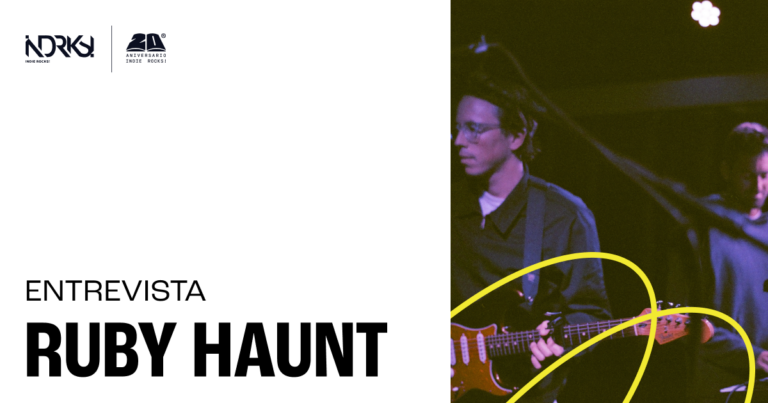
Wyatt Ininns and Victor Pakpour met at the age of 13 and since 2015 they have been making music together as Ruby Haunt a duo from Los Angeles that moves between dream pop and slowcore. Ten years and eleven albums later, all published independently, they arrive in Mexico for the first time to perform live Paper Halotheir new album.
They will do it on October 24 at the Former Christ Church Templea Gothic church from 1893 in the Historic Center, in an experience created together with Kinesthesiawith fog, lights, surround sound and an aromatic essence inspired by petrichor (the fresh, earthy aroma produced when rain falls on dry ground)
Before their arrival, we talked with them about their friendship, melancholy, the ghosts that inhabit their music and what it means to create with total freedom.
Indie Rocks!: They wrote their first EPs while they were still studying, one in Los Angeles and another in Portland, exchanging ideas by email and recording together on vacation. It sounds like a huge challenge and, at the same time, something magical. Do you miss anything about that way of making music, or is some of it still present in how you work today?
Victor: Both forms have their beauty, and sometimes we still work that way. We try not to overthink the process. In the end, what we seek is to make albums that first provoke something to us, before sharing them with the world. That is the main objective.
Wyatt: We still send each other demos and work on them separately. It’s very nice to be alone with music and have time and freedom to try ideas without anyone around. It’s also a lot of fun to send each other ideas by message; that generates its own anticipation and excitement. We usually start writing records together in the desert, which is amazing, but writing separately will always be part of the process.
IR!: Listening to your music leaves me with a kind of longing, as if certain moments are already gone while they are still happening. When I found out that they have been friends since they were 13, it all made sense: their songs sometimes feel like a conversation with an old friend, someone who is also a treasure chest of shared memories and who reminds you, gently, that those days will not return. Do you feel like your friendship is part of the sound? Is there anything from those years, before Ruby Haunt, that still appears in your songs?
W: We lived through a very formative period together: we discovered music and went to our first concerts together, and I think that gives our music a certain nostalgia, a certain naivety. There’s also a level of comfort and trust that would be hard to find with someone you haven’t known your whole life. Neither of us worries about the other judging him, because we know each other too well.
V: I think friendship was what started the project, because we always loved doing creative things together and this was one more way to do it. Now it’s incredible, because we’ve built a whole world within Ruby Haunt, and when we make a record it’s a lot of fun to enter that world, both sonically and visually.
Melancholy is often described as sadness, but on his albums it feels more like a warm place, to which one returns on purpose. What is melancholy for you?
W: I think the moments in which I feel most inspired and connected to the world come through melancholy. My favorite music, books, and movies are very sad, but they always have some hope or kindness in them, and they lift my spirits, even if other people find them depressing. Even when we work on a more energetic or bright song, I add the vocals and it goes back to that melancholy that all our songs have.
GO!: Jacques Derrida coined a word that later the writer Mark Fisher led to music: hauntology. Songs inhabited by a past that never completely goes away and by futures that never came. His name already brings a ghost inside (hauntin English, is to haunt or bewitch), and many of their songs sound like memories that continue to play in a room when everyone has already left. Do you feel like your music is haunted? What ghosts live inside Ruby Haunt?
W: Definitely. I think most of our songs talk about longing and the passage of time, and that has changed over the albums and years. At first it was the obsession with becoming something bigger than what we were; Now maybe it’s more about slowing down enough to reflect on the world and the beauty around us.
IR!: Reading your recent interviews, there was something that caught my attention: lyrics that come out before you know what they mean, songs that stop playing as soon as they feel good, the intention to capture an atmosphere instead of chasing perfection. They seem like a band that trusts their intuition above almost everything. Is this how it feels from the inside? And after eleven albums, what has helped you remain true to that instinct, with all the noise that comes with releasing music today?
W: Every time we make music we try to follow our instinct and let ourselves be guided by what we feel, not by an idea of what we think we should do. We usually have an idea and references for each record, but we try not to get too attached to them and just explore until we find something that moves us. The best thing about all of this is the moment when you feel like a new song clicked. It may happen right away or it may take a while, but it’s the reason we’ve been doing this for so long and making so much music. Each song feels like a stepping stone to something more; We don’t give it too much thought and we try to preserve that original feeling.
IR!: Ten years, eleven albums and all published on their own terms. What has independence given you that you wouldn’t trade for anything, and what has it asked of you in return?
V: It requires a lot more work and self-discipline, but creatively I feel like it has given us a lot of freedom to share our vision in the purest way possible. I think that’s difficult to achieve with huge teams and too many people getting involved.
GO!: I know you prefer to leave your titles open, so I won’t ask you what it means Paper Halo. But they have said that “Big Room”, the first song they wrote for the album, was about finding a kind of refuge, and that it set the tone for everything else. From what did it become a refuge? Paper Halo for each one? And now that you’re out in the world, how does it feel to let go?
W: I think it was a return to some roots of our music, closer to Sugar and from our stage more guided by synthesizers. Our previous album was closer and more organic, almost all with live instruments, and it felt good to try to create something bigger and stronger. Plus, I had just had my first baby and we hadn’t worked together for about six months, so getting back to making music felt amazing. That is heard in the chorus of “Big Room.” We need this escape valve to live.
IR!: On October 24 they will play for the first time in Mexico, and not in just any place: a Gothic church from 1893 in the heart of the city, with fog, lights, surround sound and an aroma that evokes the smell of rain on dry land. What goes through your mind when you imagine that night, wearing Paper Halo to a country where they have never played, within a place that already has more than a century of echoes in its walls?
W: We feel very lucky to work with the Cineestesia team, who have helped us create a world for music. With our covers and videos we try to build an atmosphere that truly transports the listener to a place that complements the sound, and this show will be the next evolution of that. It’s going to be incredible, sublime, and it’s going to give our music a dimension that we’ve never been able to experience.
On the night of the 24th, someone will leave Christ Church towards the noise of the Center. Maybe put on your headphones for the drive home and look out the window, which you say is the best way to listen to this album. What would you like him to take with him?
W: That same kind of collective melancholy that I was talking about before. Hopefully they leave in a state of reflection, slowing down enough to see how beautiful everything is.
Ruby Haunt performs on October 24 at the Old Temple of Christ Church, Mexico City, in a Kinesthesia experience. Tickets available at Fever.