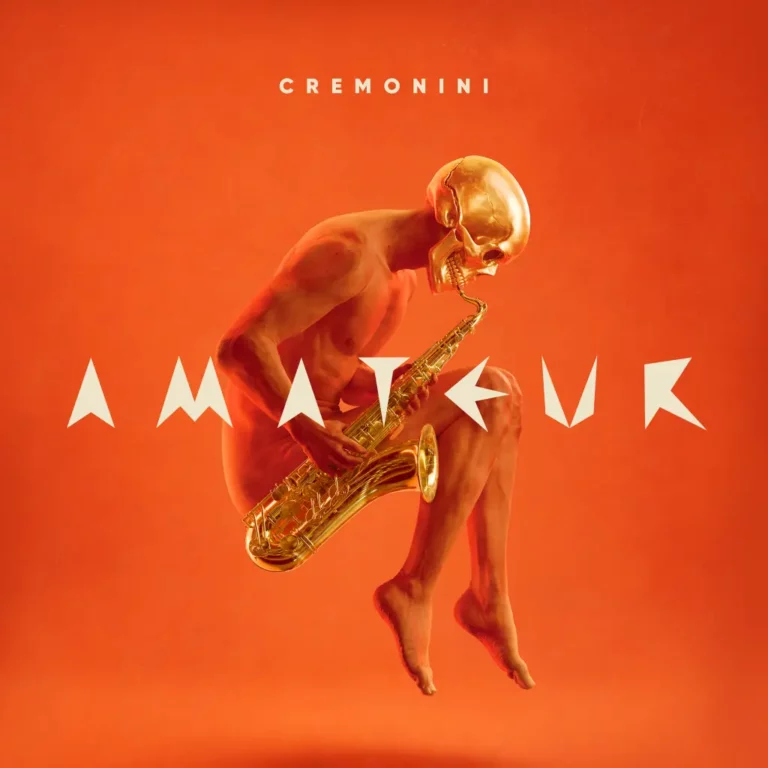
Cesare Cremonini wants to have fun, and with this album he can really allow himself to do what he wants.
«Amateur», his tenth record, travels quickly in this dimension. He doesn’t care!
He plays, has jam sessions, plays with the sax and guitars, improvises, lets himself go lyrically.
It is not experimentation but evolution. The base remains Cremonini, and on that he builds new balances together with a band of champions: Donny McCaslin on saxophones, Malcolm Catto on drums, Alessandro Magnanini on production and guitars, Leonardo Caligiuri on Hammond. The record is designed like a vinyl, with an A side and a B side, you don’t skip it, you listen to everything and halfway through you have to get up and turn it over.
The title track seems to have come out of the «Aristocats» soundtrack: urban groove, entirely played backing track, McCaslin’s sax around a rusty voice that opens with «My girlfriend left me, Nietzsche said to Sigmund Freud». Salmo enters with his own language and delivers the verse that supports the entire album, «Do not look for yourself in lost things».
Paparazzi she is already known, but on the album she teams up with Fabri Fibra, who adds a bar on the instrumental part.
Racehorses, born from a fragment that Elisa gave to Cesare, it recalls Dalla’s structures mixed with a Sixties aftertaste: arpeggiated classical guitars and then the strings. It is the slow track of the album and at the same time its little thesis, a song that takes the time that the market no longer allows.
With We don’t tell anyone we change register again and travel through Bowian memories, among glam, grotesque choirs, Dalla’s Piazza Grande and the mayonnaise borrowed from Luca Carboni.
The garden of saxophones it is the most ambitious passage, built like an opera with an ear turned to the strings of «Abbey Road»: it recounts the months of Cesare’s relationship with the saxophone, and Morgan also appears in the orchestral parts. Because I know you it’s just a divertissement, born in a tavern and recorded on the birthday with old friends and a swing arrangement from New Orleans. It’s fun, but in terms of the disc’s economy it weighs little.
Side B opens with Mega Linzonce again with Bowian echoes and Nineties guitars saturated to the max, and with a question that seems written throughout the album: «Who cares if we look like monsters?».
Very small things it’s a little gem, the delicacy of the album, Malika Ayane again alongside Cesare to sing a metropolitan love made of ashtrays to be emptied and dinners to be decided. Mental disorder it is anxiety-inducing, a labyrinthine loop over a text on mental suffering without filters. Only and only it is transversal, a tribute to the lateral songwriting of Graziani, Gaber, Gaetano and Jannacci. The final one Athena envelops: the change of tempo before the finale opens the way to McCaslin’s solo, pure virtuosity, which closes the circle to perfection.
Did we like the new Caesar? He puts his hands forward and says that this will be the biggest failure of his career, indeed, that if he succeeds it will mean that he has done everything wrong.
It is a challenge to his own habits, between deviations from pop and a superband, a record that served his discography to question itself without the need for hits. Although, for me, there are a couple of hits. He has nothing to lose, and he did well.
“Amateur” is someone who does something for love rather than for profession and this can be felt from start to finish. It is sonic freedom, the sign that you can still make music without sitting at a table listening to algorithms and commercial logic.
TRACK BY TRACK
SIDE A
Sound is a decisive factor for AMATEUR and the first track of the album, the title track, is its first declaration of intent.
Cremonini’s dance hall opens its curtain with an urban groove and a fully played backing track, a distinctive feature of the album. On sax, Donny McCaslin accompanies a dirty, rust-colored voice, which sings the first verse: “My girlfriend left me, Nietzsche said to Sigmund Freud.”
The front page of AMATEUR is an analysis session. The narrative moves along these tracks: a constant close comparison between the self-image (the ego), internal and external conditioning and the search for one’s own truth in the midst of opposing forces.
From the point of view of the metrics of the text, Cremonini sinks his feet into the blues and its stories of dusty and surreal streets. There’s no need for a refrain. It is the visual and sonic sensations that drive the song.
«Don’t look for yourself in lost things»: the central crux of the entire album comes at the intersection with Salmo, which enters the title track bringing its own language into that of the record. Music played, urban, blues, hip hop, folk and rock coexist in the same mix. It will be the rapper, like a Virgil borrowed from our fairy tale, who will indicate the way forward.
«Paparazzi» carries out this challenge, especially in terms of sound production. Malcolm Catto plays dry, syncopated drums, bordering on drum’n’bass, which seem to have been recorded in a cellar in a Manchester suburb, accompanied by a distorted bass riff. Cesare’s voice is still scratchy and instinctive.
Rock and electronic mix together in a compact way. Fabri Fibra enters with his distinctive vocal brand in a new verse on the instrumental part, giving the song a new shape compared to the single already released. Donny McCaslin’s solo takes the place of that of the electric guitar, chasing its distorted sounds.
«Racehorses» it’s the slow one that Cremonini’s new dance floor was waiting for.
«It’s a great little gift received from Elisa and it would never have been born if we hadn’t met artistically a few years ago, on the stage of my tour. Since then, our human and writing relationship has never stopped. There are musical fragments and demos that we constantly exchange and this song was born from one of those fragments.”
«That beauty will save the world and whoever says it today seems crazy» is one of the central lines of the song. The arpeggiated classical guitars and orchestral accompaniment of Alessandro Magnanini and the British composer Rosie Danvers look to the Italian orchestral tradition of the 1960s. The electronics complete the picture of a song written like a Neapolitan serenade.
Racehorses also become an image of songs forced to run faster and faster, in a market that allows less and less time for listening. The piece tries to move in the opposite direction: giving yourself time and relying on poetry.
«We don’t tell anyone.” it changes the pace of the album, opening it up to a lighter and more rock’n’roll dimension. Seventies synth strings, saxophones and choirs designed by Cesare together with producer Alessandro Magnanini build a chaotic and grotesque atmosphere, with echoes of Bowie’s glam rock that meet the tradition of Italian singer-songwriter storytelling. In the finale, Donny McCaslin’s sax returns, in a song that talks about nocturnal romantic adventures. There is also the “Piazza Grande” by Lucio Dalla, symbol of a Bologna which for Cesare was a place of passion and life; there is the “mayonnaise” borrowed from Luca Carboni, on the fingers of a newborn love.
It’s with «The garden of saxophones»written, composed and produced by Cesare, that the album reaches one of its most ambitious stages. A song constructed like an opera, between rock, pop, jazz, classical, orchestral and theatrical, with progressive references, at other times profoundly Italian.
«When I wrote “The Saxophone Garden” I understood that the album was taking shape. It describes these months of my relationship with the saxophone, from the beginning to the last day. The ink with which I composed it is made of pain, but, singing these rhymes, one after the other, I come to the light. “Beyond the walls that make men there is a garden of saxophones”. After writing it I felt relieved. In the production I pursued some of the orchestral sounds that I love from “Abbey Road” by the Beatles. Alessandro Magnanini wrote the orchestral parts, to which Marco Castoldi, aka Morgan, was added, almost by chance.”
The last track on side A comes from another suggestion: the rediscovery of the Derby di Milano repertoire, from Jannacci and Gaber to Cochi and Renato ei Gufi. And here comes what Cesare defines, self-deprecatingly, as “the most important song of his career”.
«Because I know you» it is a divertissement born for fun during a night in a tavern with old friends. Cremonini records it on his birthday, surrounded by his band of friends and life partners, perhaps after a few too many glasses of wine. Accompanying her are the horns led by Matt Roberts, to whom Cesare, having just returned from a trip to New Orleans, asks for a swing arrangement that recalls the sounds of the musical tradition of Louisiana.
Here, ideally, the turntable needle reaches the end of the first side of the vinyl. To continue you have to get up and turn it over. A small interval, almost a theatrical pause, before the music fills the room again.
SIDE B
«Who cares if we look like monsters?», Cesare asks his generation, diving in «Mega Linz». And again: «I have never seen anyone feel worse than me!».
The sound of the nineties returns without becoming nostalgic. Guitars saturated to the max, horn section played live even if it seems sampled.
The mix also tightens the sound field and cuts the frequencies to give a vintage and at the same time pop color to the song.
«Very small things» it is the return, after sixteen years, of Malika Ayane in front of a microphone together with Cesare. It seems like only a day has passed since then, because their friendship returns to talk of love. It’s a metropolitan love they sing about, immersed in a daily life made up of minimal gestures and habits. A television that offers tasteless jokes, paths that now only cross on a sofa. “Words like crumbs, dinner to decide, emptying an ashtray, and then there’s nothing left.”
«When this verse of the song was born I immediately thought of Malika. His voice always collects and rearranges “small, intimate things. He brings them to the forefront of the songs. I believe that Malika is an extraordinary artist of reality, capable of giving perfect color to the still lifes that surround us, like a fantastic scholar of truth.”
«Mental Disorder» is the song in which AMATEUR most directly addresses the topic of mental health. Cesare talks about mental suffering with a direct and unfiltered text. It is the music that restores the tension through an anxiety-inducing and labyrinthine loop built together with Malcolm Catto.
With «Only and only” AMATEUR looks at a more lateral Italian songwriting, a research that Cremonini links directly to the time in which these songs were born.
«The album also recovers a more lateral Italian songwriting. I have thought a lot in recent months about what is the best reference to describe us today, in this shabby and uncertain time. The freer and naïve voices, such as Ivan Graziani, Giorgio Gaber, Rino Gaetano and Enzo Jannacci, seemed particularly close to the times we are living in. “Only and Only” is a tribute to that world.”
The album closes with a ballad suite, «Athena”full of atmosphere. Cesare entrusts the most exciting instrumental part to Donny McCaslin’s sax solo and the grand finale, suspended and atmospheric, which closes a concept album that began with a psychoanalysis session and reached a new awareness.
The change of tempo before the finale, with Donny McCaslin’s solo, Leonardo Caligiuri’s Hammond, Alessandro Magnanini’s guitars and Cesare’s piano, goes beyond the homage to the sound constructions of the seventies. Cesare lets the album race towards the finish line with the freedom that working for weeks in the studio with his musicians gave him.
In «Athena» he writes words about life and brings AMATEUR to its ultimate explanation: a record that faces life without fear, supported by the love of music, to which he feels he owes everything.
«If you close your eyes it’s easy, to cross the barrier that keeps souls in cages… and stop crying.»
TO LISTEN NOW
The saxophone garden – Very small things – Athena
TO BE SKIPPED IMMEDIATELY
Two or three songs are quite useless (Why I Know You, Mega Linz, Disturbo Mentale) but perhaps they are fine in the flow of the album.