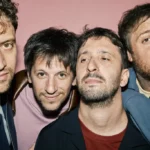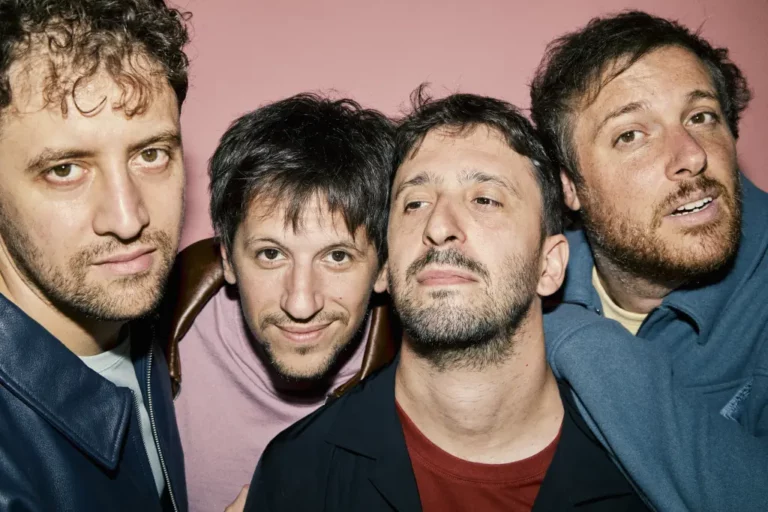
“N OI” is the new EP by EUGENIO IN VIA DI GIOIA. Six songs, previewed by Hello beautiful Italy with the Piccolo Coro dell’Antoniano and da Let’s kissunder a title constructed so as not to be confined in a single reading: us, n 01, a typo, a multiplied and reversed ego.
On the cover the band stands inside the reflection of a spoon, upside down and grainy, the same image as the video poster with which they announced the album. It is the bubble in which we look at ourselves, and the algorithm that looks at us, with everything else reduced to the background.
The EP arrives in an already crowded year: their first book, Stories of a band that hasn’t broken up yeta choral tale of the group’s personal and artistic journey, and on 5 May 2027 they will go on stage at the Unipol Forum in Assago for the first time, after the club tour which will take them to the main Italian clubs from November.
On the occasion of the presentation of the album to the press we spoke with the band.
THE INTERVIEW
Let’s start with the title and cover, which are linked to the video manifesto. What’s the idea behind it?
We find ourselves submerged, and I think it affects everyone, by the need to define and find meaning in every single frame that appears in our lives.
We look at the world around us and see a great desire for speed in interpreting, to immediately find solutions. Cover and title are a provocation. You can try to define this thing: us, easy. “N OI” is already different, it might seem like a number one, a new beginning. Or, since we’re talking about the need to define oneself, an I for n, written backwards. It can really be anything: a little while ago, in another interview, someone even hypothesized “oi” as an exclamation.The truth is that we want to leave the freedom not to interpret. Indeed, we ask those who watch it to slow down, to suspend judgment and meaning, and to find the time while waiting for things to take shape. And to listen to the songs.
In Stone everyone would like to be someone else. Who would you like to be?
A stone. We have realised, I don’t know if because of this historical period, that we always aspire to something else and are never satisfied.
We are sure that even the man or woman who seems the happiest in the world, deep down, would change something about themselves.
So we asked ourselves: what if we aspired to something that has no aspirations? If we were a stone we would be truly happy, because we would have nothing else to aspire to. It’s the way to block the circle: you have to aspire to something that aspires to nothing.
Even if they kick you.
Exact. The beauty of the stone is that, not wanting to be anything else, it doesn’t move. To define themselves, animals must chase, pursue or escape. The stone is, a bit like the plants, which at a certain point decided to evolve in the direction of not moving. That firmness brings with it great possibilities, and we are not the first to say it: Eastern philosophy has always invited us to this reflection, while we Westerners are used to defining ourselves, analyzing ourselves, scientifically giving ourselves a place. To cut reality ever finer: what is an atom? And then go further.
Let’s go back to the spoon. What’s inside that bubble, and what’s left outside?
That separate us says that reality exists only when we look at ourselves inside a bubble that represents us. And everything around, what is it? We live in a time made of algorithms: we define ourselves in the algorithm that looks at us, and we look at ourselves inside that algorithm. But what’s outside? This is the question we wanted to ask with this cover, which is more of a doubt than an answer.
The photograph is by Alessandro Treves and it’s a real photo, not a photo montage with the spoon inserted afterwards, and it’s not artificial intelligence. I know how many shots we took in the sun with our jackets on, in Milan, in July. It’s grainy because it’s zoomed in, and this is also a metaphor for what we experience every day: we try to look at things closely without getting really close. When you zoom with a camera it is much more difficult to focus. The invitation then is to take a step back, de-zoom, look at the whole picture.
Many plurals occur in the titles and texts. How much has music helped you change your perspective? And is this the invitation you make to those who listen to you, especially to the younger ones who have grown up digitally?
We thought that us was a point of arrival. It’s a big step, but we believe it’s the beginning: this cover that can be read like us opens up something even bigger. The new generations, like us, are used to living in a world of many separate selves. When they realize that there are us, they will experience a first phase of rebirth. Then there will be another one, which will release that bubble even more.
The beautiful thing about music is that you think it’s playing, but the most important lesson it gave us as a band is listening. If everyone played all the time, nothing would be understood. Even now I’m talking, but Paolo and Emanuele are not distracted: they listen, and they know that if I say something strange or wrong, or get stuck, they will intervene. That listening is very difficult to find and it makes the difference. I’m someone who talks a lot, and I needed people to listen, which is different from staying quiet.
Those who have come to our concerts know it: on stage there is a dialogue, with the audience and between us.
Was there an artistic movement, a current or personal event that pushed you towards this album? Or is it the evolution of previous projects?
Dadaism. It is a process that has been going on for a long time, but there are moments that emerge, a bit like the emergent properties that are so dear to us: you add an event many times and at a certain point one arrives that makes something emerge. When I read about Dadaism I thought exactly about what I am experiencing today: one must not always respond to an event in the world or in one’s life with rationality.
At the beginning of the twentieth century they were surrounded by wars and terrible events, and the response could have been almost surreal. Not dystopian, psychedelic: not in the sense of substances, but in the sense that it does not propose a rational solution. Through the expression it already determines its own meaning, because very often the what is contained in the how, and there is no need to add anything else. Here is the Dadaism that emerges in this cover, which does not need to be explained…
But you’re trying to explain it.
It’s an incredible effort, because how can you not respond? People need to suspend judgment, and I need to suspend explanation.
In reality we have never worked by imagining a theme and writing accordingly. It could happen in the future, the concept album intended as “let’s start from here and build”. Ours is a more deductive path: the songs came out over a year and a half, almost two, from the end of “L’amore è tutto”.
Then you look at what was born from the outside and you realize that some songs express a certain state of mind more than others. I think about How to do itwhich opens the EP: it doesn’t give solutions, it turns the gaze upside down. As children we thought that adults knew everything, but what really defines an adult is the ability to not necessarily have to search for meaning in everything. And even if the songs are born independent of each other, due to the period you live in, the listening, the way you play, there are necessarily connections. Being a band helps in this.
Why an EP, in a market where the single song is sold and the record is often collected rather than listened to?
It arises from a structural need. We no longer want to just make singles. We realized that, from the point of view of effectiveness, we write ten songs and the most distracted listeners, not all, listen to only two of them, the individual extracts. So we said to ourselves: instead of making one of ten, let’s make one of five, so it’s more likely that they will all be listened to, because they all have dignity and importance. Then this choice also becomes structural in the narration of what you are seeing and will see. An EP is out, which is also a physical CD, and it’s a work in progress.
In We’ve been missing each other forever sing about listening to Battisti. What song would you play?
Time to die my father always listened to it in the car. But also My free singing. In the car we listened to a lot of singer-songwriters, Gaber, Battisti, Jannacci, De Gregori, so there are many. If I have to choose one, My free singingthe first one that comes to mind. But it was more the moment itself than the song. I wrote this song thinking about the relationship with my father, but if I think about my mother I think of myself in the car with her listening to It’s not Francescaand I wonder what this one is saying. By the way, I married a Francesca!
THE DISC
How to do it
Two drops of water
Hello beautiful Italy (with Piccolo Coro dell’Antoniano)
We’ve been missing each other forever
Stone
Let’s kiss
THE TOUR
The N OI EP will be presented live for the first time, together with the most iconic songs from their repertoire, during the Club Tour 2026 which, in November, will take them to the stages of the main Italian clubs:
16 November – Estragon, Bologna
17 November – Hall, Padua
20 November – Tenax, Florence
21 November – Mamamia, Senigallia
23 November – Afterlife Live Club, Perugia
25 November – Alleanza, Rome
27 November – Eremo Club, Molfetta
5 May 2027 – Unipol Forum, Assago
THE VIDEO
WEB & SOCIAL
heugenioinviadigioia.it
@eugenioinviadigioia
Zero algorithm, more choice. If you want WECB’s critical mediation to remain central in your reading ecosystem, you can save the publication among your favorites.