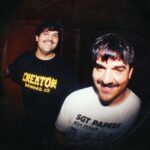
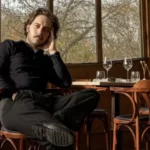
Hugo Russo was born and raised in northeastern France. He discovered CCCP as a teenager, and the band became his gateway to an Italianness he only knew through his paternal grandparents.
Years later he dedicated a chapter to the group of his doctoral thesis on the Bolognese countercultures of the Seventies and Eighties, discussed in Bologna.
“Belles Infidèles. Hugo Russo chante CCCP – Fedeli alla Linea” is released, ten songs from the repertoire of Ferretti and Zamboni translated into French for the first time, from Amandoti and Annarella to Emilia paranoica and Guerra e pace.
The title recalls the expression used in seventeenth-century France to indicate elegant but free translations compared to the original. The album also marks the return, after almost thirty years, of Dischi del Mulo, the label historically linked to the band.
Amandoti, the first extract, is accompanied by a video shot in the Po Valley on August 15th directed by Germano Maccioni, in which Giovanni Lindo Ferretti and Massimo Zamboni appear.
With Hugo we talked about a cover created for fun and ended up in an album, the difficulty of getting Ferretti to sing in a language without accents, the twenty years spent propaganda for the CCCP among his French school friends and a scene shot under the gaze of the two authors.
Let’s start from the genesis: how did this cross between you and CCCP come about?
It is difficult to give a short answer, because the genesis of the project dates back many years. I was born and raised in France, in the north-east, and discovered CCCP as a teenager. They were an open door towards my Italianness, which I already knew because my paternal grandparents were Italian: I am a quarter of Italian origin. However, having grown up in France, I had never needed to explore it, to build my own version of it. The CCCP were important in the growth and definition of this Italian-French identity. So important that I dedicated a chapter to them in my doctoral thesis, which I did in Bologna, on the Bolognese countercultures of the Seventies and Eighties. At the end of that countercultural comet that began with the Seventy-seven movement I connected the trajectory of the CCCP Fedeli to the line.
Between 2016 and 2018, more or less, I met Massimo Zamboni, who I interviewed for my university research. I told him: do you know that I did a cover in French of Emilia paranoica, just for fun? He got curious and listened to her. Then years passed in which I did something else musically, I released a solo album, Covid arrived and the situation changed a lot. After my doctorate I returned to France and I had put the covers project aside.
I dusted it off a couple of years ago, because I needed new stimuli and above all to have fun again. I returned to my solitary dimension, in my bedroom, with my instruments and my self-productions, and I started making these covers again. Massimo liked them again, and he encouraged me to make others: why don’t you do this, why don’t you do that? One fine day we woke up with ten songs and Massimo told me: then we have to make an album.
An important endorsement, so much so that Ferretti and Zamboni appear in the video. Your approach is more acoustic, more intimate. What difficulties did you encounter in translating their songs into French, both lyrically and musically?
There were the classic difficulties of translation, lexical and syntactic: some terms work better in one language and do not have a perfect counterpart in another. These are the challenges of those who translate, of those who interpret. With the songs, others are added. The first concerns Ferretti’s texts, which are very evocative, polysemic, and ask questions rather than give answers. Translating them means making choices, and therefore there is already a first level of interpretation.
Then there is the interpretation of the voice. Ferretti’s is very particular, for the way he sings, declaims and whispers. I had to find my voice for these songs, and I also had to find a melody in French. Italian and French work on different rhythmic tracks: French is a plain language, it does not have the accents of Italian. It was also a musical, rhythmic challenge.
The result works. Even the other songs on the album that I listened to have a different, more retro charm. Will the project remain linked to Italy or will it also go to the French market?
I think the first impact is that of a record for Italy, because CCCP are a very important band here. Amandoti has become a cult in the canon of twentieth-century Italian song, and I would very much like to present it live to the Italian public. But it must be said that, in my own small way, I have been doing propaganda for the CCCP Faithful to the Line in France for twenty years. I’m just continuing to insist, like when I was fifteen and I told my classmates: do you know that I listen to this band? Yes, they are punk, yes, they are Italian, but listen to them, maybe you like them. So probably both.
It’s a covers album, but you already have a solo album behind you. Do you see it as a driving force for something of your own?
Now I’m focused on the release, the promotion and the opportunities that will arise to take it live. But I don’t consider it a separate chapter in my creative history. While I was recording I came up with ideas for my own songs, and I already have several songs ready, conceived. I just need time to arrange and record them, but I’m already working on new things, absolutely mine.
In the video of Loving you you are in the most remote Po Valley, with Ferretti and Zamboni in the finale. How did it go?
It was very nice. I’m happy with the result, but perhaps above all with the human adventure behind it. The word that comes to mind when I think of the video is gratitude, towards the director Germano Maccioni and towards the whole team. They were two very intense days of filming, due to the heat of the Po Valley in August, and we also had fun. We had some unexpected events: the mechanical failure of the machine seen in the video actually happened to us, as expected.
The final scene with Ferretti and Zamboni was also the last one we shot, and it was the first time I met Ferretti. A handshake, a chat, and we immediately had to get to work, because technical preparation takes a lot of time. Without any transition I found myself posing in front of them playing the song. We looked into each other’s eyes. For me it was a strong emotion: finally meeting Ferretti, seeing him next to Zamboni and singing their song in front of them, almost defending it under their attentive gaze.
Will there be a live appendix? Maybe with some special guests?
We’re still in the preparation phase, I’m trying to figure out how to carry the record around. I like the full band size, because the arrangements are quite rich. But I also like the idea of presenting it in a very intimate, vulnerable way, almost like the house concerts that were held a few years ago. For now I’m exploring these two paths. I can’t tell you about the guests.
Maybe they only come as spectators, as in the video, hidden in the shadows.
Exact.
LISTEN TO THE RECORD
THE VIDEO
WEB & SOCIAL:
@hugorussomusic/
Zero algorithm, more choice. If you want WECB’s critical mediation to remain central in your reading ecosystem, you can save the publication among your favorites.