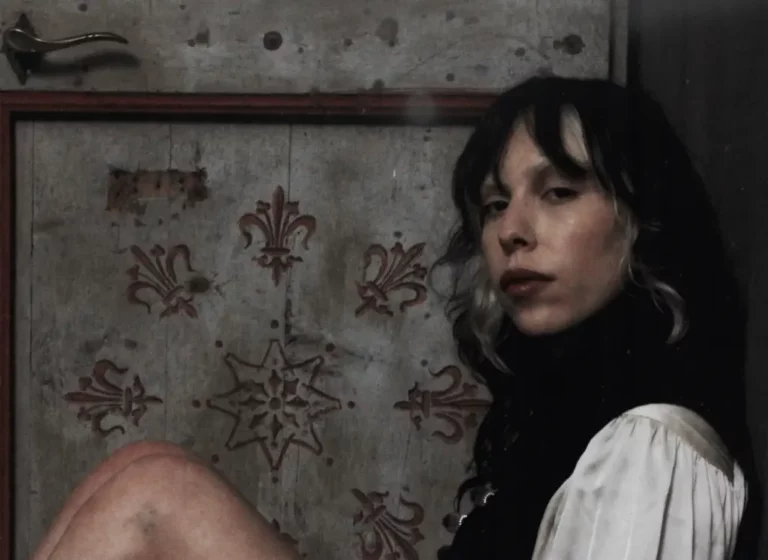
The climate outside seems like a detail, but it becomes essential to the narrative of our meeting. An entry threshold: rain, wind, a season, spring, which is tinged with winter and which tightens and forces one to take shelter.
It is from this forced intimacy that the dialogue with Lamante begins, between interior places and real territories that mirror each other without ever completely coinciding.
All around her music and her new album “Non dice addio” an album that marks a profound and necessary passage in her creative journey, entirely written by her and produced together with Taketo Gohara.
Here is our conversation…
Let's start from here, from this day that seems to have everything on it.
I'm under the duvet, and I'm fine with that. The cold belongs to me more than the heat, it is almost a mental condition.
I come from Schio in Veneto, a place where the light is never aggressive, and I believe that this has also shaped my way of being in the world.
The new album arrives after “In memoria di”. What changed in between?
The silence. Not the external one, because I did a lot of dates, a lot of things happened. But inside there was a full, layered void.
“In memory of” was a work immersed in the words of others, in my family, in archives, in letters. Then everything retreated.
It remained a silent space, lasting almost two years. And that's where the real change was born.
Silence therefore as a matrix, not as an absence.
Exact. It wasn't subtraction, it was transformation. The words no longer came from outside, and I wasn't looking for them.
It was as if I had to listen to something else, something slower, less sayable.
A strong idea of territory also enters the album. Schio, the deep Veneto.
Schio is an emotional structure even before a geographical one. I live in a place where the earth is concrete, but the sky is always very close.
There is a continuous tension between these two poles. I come from a family of farmers, so the material has always been primary, but at the same time there is an almost pre-Alpine verticality that takes you elsewhere.
This dualism enters the writing without asking permission.
The album was recorded in a church. A non-neutral choice.
It's not at all. At the beginning we tried a studio in Milan, with a direct recording logic similar to the first album. But it didn't work anymore. The producer understood that the thematic center was the overcoming of bereavement, and therefore needed a place that contained everything: life, love, death.
The answer was a church.
And even better if linked to my family.
We found it in Schio, a church that has been part of my personal history for generations.
There the disc found his body.
You have mentioned the idea of “middle world” several times in your songs. What does today mean to you?
It's an unstable area. For me it also has a more concrete declination: the border between the living and the dead, between what remains and what continues to speak within us.
Can Schio be read as a place in between?
Yes. It is a place full of abandoned industrial stratifications, of presences that are no longer present.
And then there is a political, social, even conflictual memory, which has never completely dissolved.
It is a city that lives with its ghosts. And in this sense it is perfectly a middle world.
A very personal dimension of mourning and loss also enters your story.
Yes, but not in a linear autobiographical sense. It is more a reflection on what remains in bodies, in languages, in voids. Even language has limits in saying certain things.
There are experiences that remain suspended, and the thought always returns there. The middle world also arises from this: from what cannot be completely named.
The visual imagery of the project seems to have a dreamlike genesis.
Almost everything comes from dreams. I have been transcribing and drawing them for years. I have notebooks full of this material. We work together with the director, he decodes them.
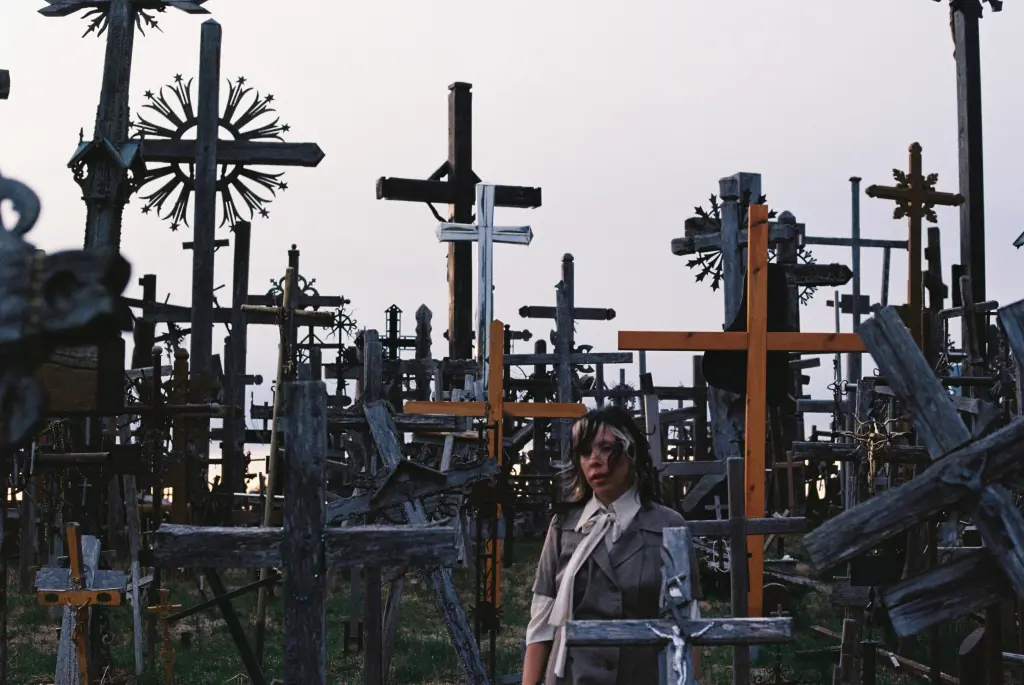
One of the recurring dreams was a hill full of crosses, with a small house and red birds trying to pierce the ceiling.
And that image became real.
In a certain sense yes. We started looking for it and finally found it in Lithuania, the Hill of Crosses. When I got there I realized that it was not a place of death, as I had feared in dreams, but an archive of life and resistance. In fact, the hill was born as an ex-voto sanctuary: people carried crosses for grace received, not to commemorate the end of something. It is not a cemetery, it is a place crossed by a very strong vital tension. Even the small house next door was full of signs, objects, traces left by people. At that moment the whole dream changed meaning.
So even the dream, in the end, was corrected by reality.
Or it was reality waiting to be reached. I do not know. But a circle was closed there.
What if you had to summarize this album in a single mental image?
A place that breathes between two states. I don't know if it's a church, a hill, or a room. But it's something that never stops swinging.
And now, where are we going?
I'm not saying goodbye. I say that we can return to the places where things were born. Even just to listen to them again from another distance.
I dedicate this album to my mother. To the day she was born. To my mother, child, daughter, sister. To my motherless mother who became a mother herself.
This album talks about the fortune of being her daughter and of trying to understand what it means, thanks to her, to give birth to the life that is only fulfilled in one's mourning as a daughter. I had never been able to write in the pages of my notebooks because it was always easier for me to talk about pain, because pure love cannot be sung, and she is a love song.
TRACKLIST
VIDEO
The video of “A magic stronger than death” shot in Lithuania on film, in the place that Giorgia had dreamed of and then searched for together with Nicolò Bassetto, director of the video clip.
In the dream Giorgia saw herself on a hill full of crosses next to a house with flocks of birds flying over it. After a long search, they discovered that that place really existed: it was not a cemetery, but a shrine of votive offerings. Those crosses, therefore, did not speak of death but of life, memory and devotion. For this reason the video accompanies “A magic stronger than death”, a song that talks about mourning as an experience that is both collective and profoundly private, but crossed by a strong vital tension: in the face of emptiness one can succumb or choose to celebrate life.
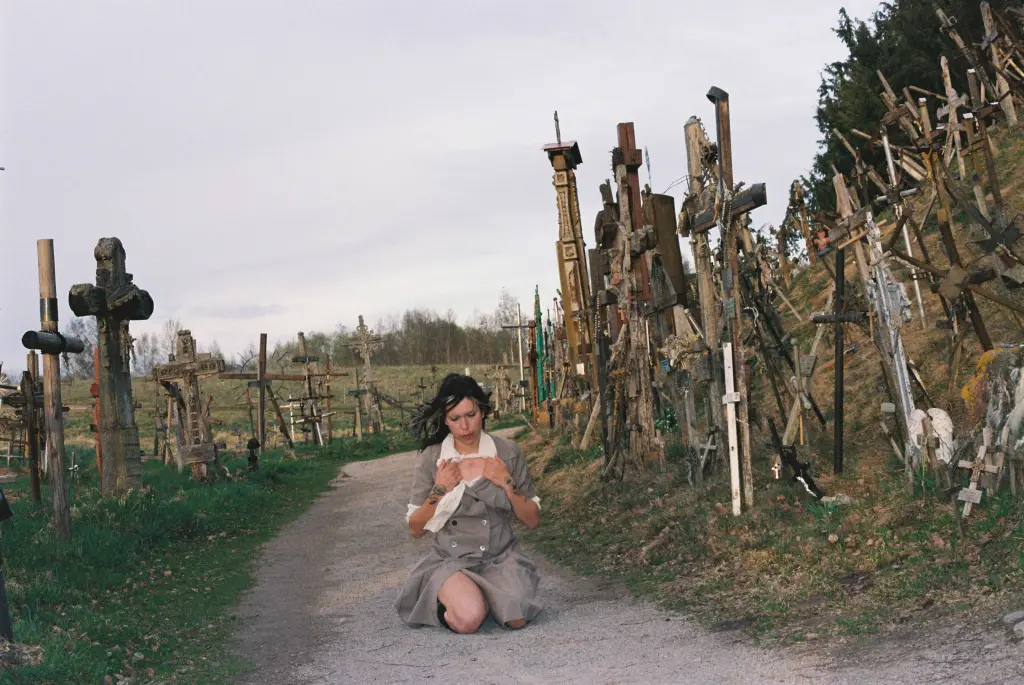
A little girl appears in the video, dressed like Giorgia as a child. He seems to be a victim of the violence that runs through the story, embodied by a man armed with a rifle, a figure inspired by Giorgia's painter great-grandfather but also a symbol of a toxic masculinity, incapable of disarming himself. Next to the little girl there is always a dog, a sign of innocence and protection. Adult Giorgia instead appears next to an ostrich egg, a symbol of fertility and rebirth. When she runs towards the little girl's scream we understand that the video moves on two temporal planes: the little girl and adult Giorgia are the same person, having survived and grown over time. In the finale, the dog protects the egg, transforming itself into a symbol of salvation and continuity of life. The final answer of the song is precisely this: the strongest magic of death is the love that survives.
LIVE
23-May | Milan @YOU LOVE ME
29-May | Rome @Spring Attitude Festival
03-Jun | Schio @Church of San Francesco
12-Jun | Padua @Sherwood Festival
13-Jun | Forno (MS) @Music on the Apuan Alps
05-Jul | Recanati (MC) @Memorabilia Festival
10-Jul | Florence @Ultravox
11-Jul | Santa Sofia (FC) @Rumors Festival
16-Jul | Collegno (TO) @Flowers Festival
24-Jul | Corigliano d'Otranto (LE) @SEI Festival
26-Jul | Conversano (BA) @Casa delle Arti
30-Jul | Monteverdi Marittimo (PI) @Musicastrada
31-Jul | Bagnacavallo (RA) @80th anniversary of universal suffrage
01-Aug | Gradisca d'Isonzo (GO) @Onde Mediterranee
19-Sep | Tonadico (TN) @Saz in Town
ABOUT
LAMANTE is the musical project of Giorgia Pietribiasi (1999), singer-songwriter born and raised in Schio (VI). A musician and visual artist, she has been writing and playing since she was very young, bringing an expressive urgency made of memory, family roots and emotional tension to her music. His dark and sharp voice and intense writing transform personal and collective experiences into sound images with a “tribal and matriarchal” character. In 2023 she debuted on digital platforms with “L'ultimo Piano”, a song that took her to the Musicultura final and earned her the Nuovo IMAIE Prize. With the prestigious collaboration of the producer Taketo Gohara, the singles “Come wanted to be” and “Rossetto” followed, and an intense live activity which also led her to open the Negramaro concerts at the Verona Arena. In 2024 he released his debut album “In memoria di”, a powerful and visual record that traces origins, memories and identities. The video clip for “Don't call me beautiful” wins the PIVI 2024 and, in 2025, three Videoclip Italia Awards. With the album Lamante he was a finalist in the Targhe Tenco 2024 (First Work), received the recognition of best Italian album 2024 from Rockit and won the special “Emerging Artist” award at the Rockol Awards 2024. In the same year he collaborated with Levante and Paolo Benvegnù. After the release of the album she chose to focus on writing and live: over 50 dates throughout Italy, until she was chosen by Coez as the opening act for the entire tour in the arenas.
In 2025 he continues to tour and continues to work on the songs for his next recording project. In 2026 he published two songs “Un canto nuova” and “Ritorneramo a Guarda il cielo” which anticipated the publication of his second album “Non dico addio”.
WEB & SOCIAL
@lamante.giorgia