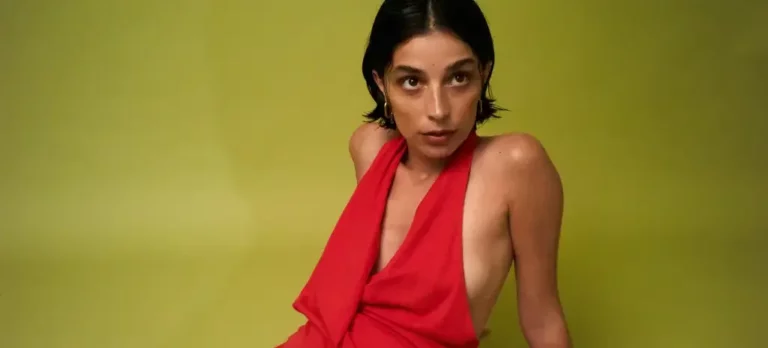
Lea Gavino's first EP “11 VOLTE” will be released on Friday 1 May, representing the musical debut of the Roman singer-songwriter and actress.
Lea Gavino puts together fragments that do not seek definitive order. There are relationships that repeat themselves, identities that slip, images that remain open. The transition to music is not treated as a turning point, but as a lateral, almost inevitable continuation.
After the singles released in recent months, the EP functions as a first testing ground: six songs that bring together intimate writing and attempts to break free, without establishing a stable balance. Inside there is still a lot of melancholy, but it is never compact; it cracks, it becomes lighter, it leaves room for a more irregular, at times ironic component.
We met Lea and ideally crossed this uncertain space, starting from the birth of the songs, from the relationship with the image, the work on sound and a writing that prefers to remain mobile rather than define itself.
Here's what he told us.
THE INTERVIEW
This EP has the flavor of a personal anniversary. What kind of milestone does this represent for you?
It's really an anniversary, yes. A point where I stop and realize that these songs really exist, that they have taken shape. It makes me happy in an almost physical way. It's like closing a circle but without the feeling of an end, rather of a beginning. There is a very lively energy today, something that even surpasses me.
“11 Times” seems to arise from an almost instinctive writing. Is that so?
Yes, it's one of those pieces that arrive without asking permission. You're not sure where they come from. It comes from a moment of confusion, especially in the way I experienced relationships.
I felt empty, as if I no longer had definitions for myself. Actress, yes, but also more. And I couldn't say that “other”.Inside the song there is this short circuit between past and present.
I found myself thinking: here I am again, in love for the eleventh time. With a kind of defensive self-irony.As if to say: look, I'm a mess, I'll tell you first.
The number eleven returns almost as a sign. How important is this symbolic dimension in your process?
It haunted me, but in a good way. I saw it everywhere. At a certain point I started to think it was a sign.
I couldn't rationally explain why, but I felt it close, necessary.
It was also the first piece I really produced, the one that I felt was “big”. And perhaps for this very reason I associate one of the most intense moments of my life with him.
You chose to release the project in the spring. A coincidence or a narrative necessity?
A necessity. For me the year begins there, not in January. It's the moment when something is reactivated, even emotionally.
This album has within it an idea of re-flowering, even a little messy.
There is the desire to love yourself, of course, but also the opposite: making mistakes, getting lost, experiencing things that then become a story.
“Serratura” on the other hand opens up to a different dimension, also in the writing method.
Yes, it's another chapter. There I started working in co-writing (with Fares – Pietro Serafini and Erin. Dario Lombardi of Bnkr44).
At first I was terrified. I've always been used to writing alone, without even asking myself what I was talking about. The idea of a confrontation blocked me.But then something very simple happens: three heads, three sensibilities that meet. And if it works, the authenticity remains intact. Erin, in particular, has the ability to take you out of your comfort zone. He succeeded with me.
The song addresses the theme of secrecy, almost the betrayal of the gaze.
Yes, that's exactly it. The moment you choose to see something that perhaps it was better not to see. And at the same time the nostalgia of when you didn't know it yet. It's a constant tension: wanting to know and wanting to remain in the dark. Nothing ever goes well for me, after all.
A year ago I would never have imagined being here. And yes, maybe I'm still a little awkward in telling it, but that's exactly what I want to remember.
Live, choose a band size, almost “classical”. A position?
I believe in it a lot. I'm not interested in the idea of the solo singer. I want a band, in the full sense of the word.
I will play with Jacopo Antonini and Valerio Smordoni, who is also the producer I worked with.
They're people I really lean on, not just musically. When I turn around, I know they are there.
I can't wait to play on stage on May 1st in Rome. A dream!
What is your visual imagery for this project?
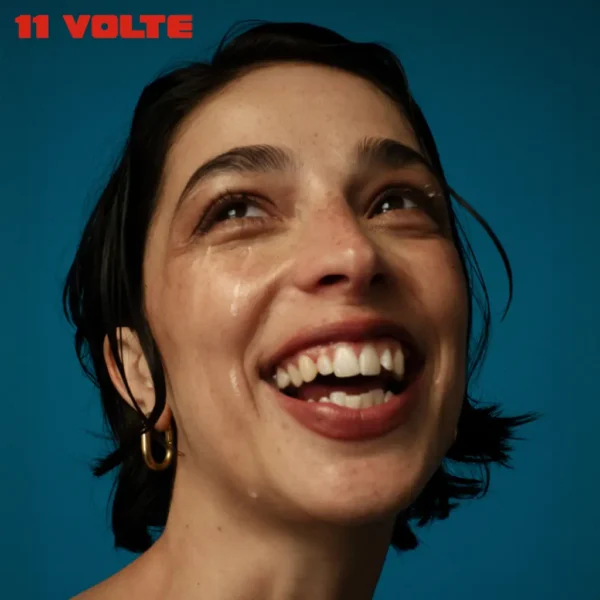
The cover is very representative. It's elegant, simple, but also a little messy. She doesn't want to be “cool” at all costs, at least that wasn't the intent.
It's closer to how I experience feelings: very intense, sometimes exaggerated, capable of crying and laughing about it immediately afterwards.What I like about the shot is that it doesn't run out right away.
It's an image you have to look at multiple times to really grasp.
Every time you find a different detail: the tears, the smile, the teeth, the look.
You wonder what happened, what he's thinking. In that sense it already tells a story, and that's exactly what I wanted.I believe I have an elegant aesthetic but a soul that is not elegant at all. I'm interested in something more cheeky, more playful, even when I touch on melancholy. Indeed, I often prefer to go through it rather than remain rigidly inside it.
There is a constant tension between melancholy and lightness in your songs. Is it a conscious choice?
It really depends on the moment I'm in. This first phase of my writing is still very linked to melancholy, sadness, certain wounds. But lately, lighter, more ironic parts are also emerging.
I like things that are not easily defined. I don't want a piece to be just “sad” or just “happy”.
Even in “11 Times” there is this contradiction: if I'm well I'm bored, if I fall in love I already know that I'm heading towards something complicated, but I do it anyway.I think that's how sincere feelings work. In the most difficult moments I actually laughed, and in the lighter ones I felt a sudden sadness. This ambiguity is what I try to bring into the music.
Has your career as an actress influenced your musical writing or made it more complex?
I think the two things help each other. This idea of double reading also comes from cinema. A film does not exist without conflict.
There is always an accident, something that breaks the balance and then you look for a resolution.For me a song works the same way. It must start from a conflict. I would never be able to write a simply celebratory, linear song. It doesn't belong to me.
The work I do on lyric analysis as an actress is then reflected in my songwriting. They are two different languages, but they communicate continuously.
THE TRACKLIST
Flowery World
Children
Distant Friend
The Trains
Lock
11 times
ABOUT LEA
Lea Gavino is an Italian actress and singer-songwriter, born in Rome on 14 January 1999. Since she was a child she has cultivated a strong passion for the world of art: she approached music by starting to study the piano and discovered her love for cinema thanks to her father, with whom she shared the weekly ritual of “cinema Friday”, an evening in which she watched great films together, fueling her curiosity and her desire to tell stories.
After high school, she enrolled in the faculty of Psychology and during her university studies she was called for an audition which marked the beginning of her acting career. In 2018 he undertook a training course at the Jenny Tamburini Acting School, and then graduated in 2022 from the Gian Maria Volonté School of Cinematographic Arts.
She made her debut in 2019 in I remember Piazza Fontana, directed by Francesco Miccichè and, in the same year, she appeared in the series Oltre la threshold, broadcast on Canale 5. In 2022 she played a symbolic character of twentieth-century feminism such as Artemisia Gentileschi in the film L'Ombra di Caravaggio by Michele Placido, alongside internationally renowned performers such as Louis Garrel. The film won 3 Nastri d'Argento and 2 David di Donatello. The real success always comes in 2022, when he becomes the protagonist of the fifth season of Skam Italia.
The role earned her the Next Generation Award as “Revelation Actress”, awarded by Man in Town during the 80th Venice International Film Festival. He then returns in the sixth season of the series, confirming himself as one of the most promising faces of his generation.
In 2023 he starred in A Black Story, directed by Leonardo D'Agostini, and took part in the second season of the international series SAS: Rogue Heroes, directed by Stephen Woolfenden.
In 2024 he was in the cast of the Rai series I casi dell'Avvocato Guerrieri, alongside Alessandro Gassmann, and in the film Dieci Minuti, directed by Maria Sole Tognazzi.
WEB & SOCIAL
https://www.instagram.com/leagavino