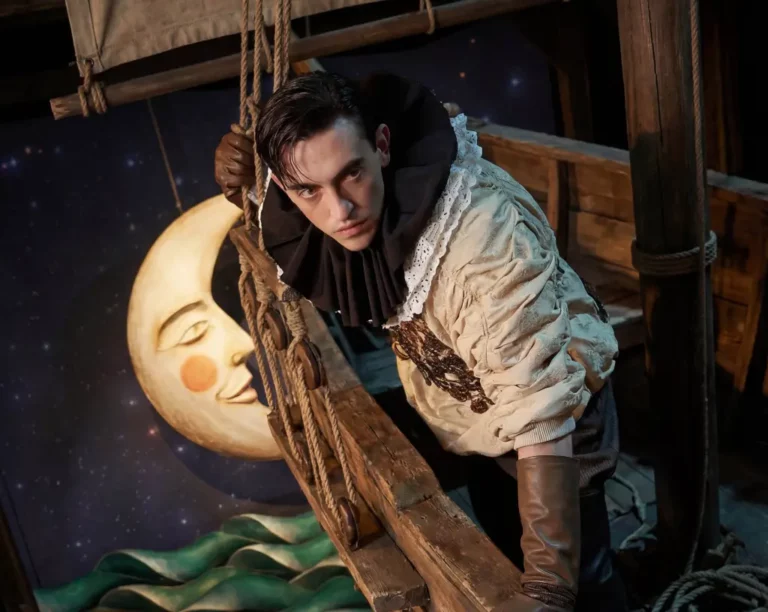
He humbly calls it “A musical that didn't make it.” And instead Commedia Musicale by Michele Bravi is an eclectic, multifaceted, multifaceted work, which certainly succeeds.
A world-class musician once said that writing and talking about music is like “dancing about architecture”. Although we can hardly criticize that guy (Her Majesty Frank Zappa, ed.), I think I can say with some certainty that Michele Bravi would have no difficulty even cooking in the theater or walking in the cinema.
It's true, music doesn't need to be explained, but perhaps it can be told. And the Umbrian singer, revelation of the seventh edition of
After all, Bravi is not just a singer and author: he has tried his hand at directing, acted in some films (remember the splendid “Amanda”?) and will soon be at Cannes with a film project directed by Bertrand Mandico, with Marion Cotillard in the cast.
The art of the word, spontaneous, thought or recited, therefore, exists.
“My passion is stories, more than the vocabulary used to tell them,” he says. “My concerts are very close to shows, sometimes it's just a question of changing the language.”
We need to understand, now, what the reception of the “Musical Comedy” idiom will be, but Bravi borrows the words of Federico Fellini – “If everyone likes my film, I have failed” to explain his relationship with this album and proclaim the pride of the result:
“For me, music must remain diversionary. It's a sectoral record and I want to speak to this type of audience,” he adds.
We must therefore prepare for a job that goes off track to a safe destination. One thing is certain: the journey that you will travel while listening to “Musical Comedy” enjoys the favor of sunlight. It all started from cultural contents of which Michele retains happy memories, starting from that “Il Culetto Independent”, the first book he read, up to “Don Quixote”, the work that definitively opens the doors to the absurdity of life, in which we are allowed to be clumsy, crooked, out of place.
In the wake of this newfound awareness, Michele Bravi allows himself the freedom to give us back the words rather than the meanings, to be able to say “poop” instead of a more polite – but much less evocative – periphrasis, without giving up a sophisticated and elaborate musical construction.
“I wrote this album already thinking about it live. Until recently I wrote with the listener in mind, here I wanted to insert a rougher, more direct humanity, which almost comes with violence. I wanted to break the fourth wall, a narrative concept that I have always liked”
It is the essence of comedy, a genre which in terms of audience and themes has always been unfairly downgraded compared to its tragedy sister, it is the lifeblood of the entire album.
“I have always been accused of being
but this time I wanted to win a challenge with myself: to write the happiest piece I had ever composed. And I did it.”
…do you know what it's called? “Funeral”!
TRACK BY TRACK
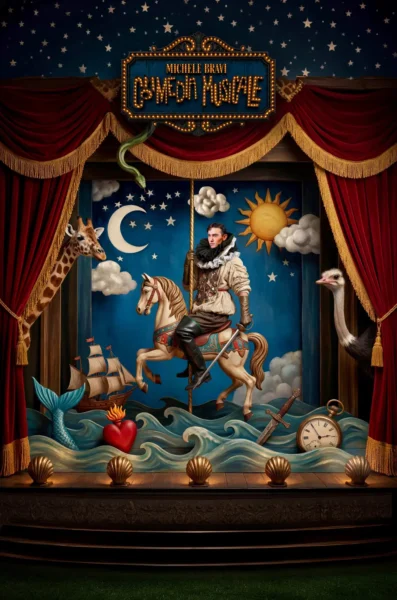
CABARET
A dreamy and enchanting song that defines the musical character of the entire album.
A song that plays with sudden changes in harmony and tempo. In this sense, it is immediately clear that the technique of musical writing becomes, throughout the entire album, a way to play with the listener and to guide him in a dynamic and vibrant creative experience.
In “cabaret” the brushstrokes of irony draw, without ever distinguishing the boundaries, realistic and dreamlike images: the dream mixes with the concreteness of reality.
An overture that extends its hand to those who want to listen and be carried away.
Meanwhile, a sleepless cat dreams on the roofs of the city.
SCENE 02
LOVING EACH OTHER IN THE MESS
A song that dreams of the recklessness and idealization of a cursed love and a damned life but which cannot do without a more clumsy everyday life made up of sofas and shopping lists.
In this second scene of “Musical Comedy” we understand that the entire investigation material of the album is the human sphere, a tenderly ordinary and heroically coarse humanity.
A song that has its pivot in a nostalgic and satisfied question: “How come this has never happened to me?”.
From here, the cinematic expectation of life begins to battle with the advance of a more anthropic plot.
SCENE 03
SOONER OR LATER
“Sooner or Later” is a tender look at inadequacy and out of place.
The story of someone who is soaked in the rain and doesn't remember which is the right intercom to ring.
A cascade of splintered images composes the script of a feeling, escaping from the desire to make a caricature of it and instead trying to give it a human three-dimensionality.
The text develops in a tight harmonic articulation, mixing major and minor scales with violent but inevitable passages.
SCENE 04
PARENT 3
The figure that is par excellence the most inadequate of all is the parental one.
There are no instruction manuals for learning how to manage a small life that overlooks the world.
An imaginary dialogue with a non-existent son who, on a musical play mat, looks with a clear gaze at the world around him without losing hope.
The song questions the simple and feared question: “is it right for me to think about having a child?”.
It is not clear whether this question is asked by the individual conscience or by the political world.
Maybe whoever listens to the song will be able to answer.
SCENE 05
FUNERAL
A dive into the comedy of contrasts.
Within “Musical Comedy” only a song with a similar title could be the funniest and most irreverent parenthesis.
How does an inadequate declare his love?
The answer is simple: talking about your own funeral.
The result is a blend of prose and music that defines this song as the most exhilarating and hilarious on the record.
SCENE 06
BEYOND THE SONGS
If this song were an element within the theatrical comedy then it would be the scenography.
In front the scenography is sparkling, epic and surprising but behind it the wooden planks and nails hold the cinematic dream alive.
With songs the rule is the same.
But what is hidden behind instead of boards and nails?
A piece that develops on a homemade and poor vocabulary like a stream of consciousness on those who no longer need to creatively translate what they see.
SCENE 07
POPULAR
A song about folklore and the viscerality of music where the sacred of the ritual and the profane of the square merge.
Music becomes an inevitable, carnal and epidermal experience that explodes in a carnival of colours.
A mischievous and hypnotic pace that celebrates the mysteries of New Orleans and its unstoppable desire to keep the music going.
SCENE 08
THE INVISIBLE MAN
The protagonist of “Musical Comedy” questions the meaning of invisibility.
Not being seen certainly gives you the opportunity to play with the world, but it can also become a condemnation, the consequence of a crude and Pharisaic judgement.
A song that investigates invisibility, transforming it into a powerful and human declaration of love.
Only for those who made us transparent will we never be invisible.
SCENE 09
TOMORROW IS ANOTHER DAY
A necessary homage to Ornella Vanoni within an album that celebrates the magical connection between theater and music.
A song that is a nostalgic and conscious manifesto on life and regret in which dramatic irony establishes the closing of the circle.
SCENE 10
THE FIRST ONE IS GOOD
Every comedy aims for recognition from the public and critics.
But are we sure we look like a comedy?
Are we sure we can raise the Oscar statuette in front of an ovation?
This is the most painful song on the entire album in which the regret of mistakes eclipses optimism.
The only possible look is towards the past, when there was still so much to say.
SCENE 11
FAILURE
What could be the final word of a tragicomedy in music?
Clearly we can't talk about anything other than failure, theaters without spectators and an evil cowboy who strikes his last blow.
Retro verbiage contrasts with a disco vibe to give the comedy the right happy ending.
INSTORE
20 April – Milan – Mondadori Duomo – 5.30 pm
21 April – Bologna – SEMM 2.30 pm
21 April – Florence – Galleria del Disco – 6.00 pm
22 April – Rome – Mondadori Galleria Alberto Sordi – 5.30 pm
24 April – Naples – Mondadori Galleria Umberto – 3.00 pm
THE TOUR
19 May Mestre (VE) – Teatro del Parco data zero sold out
22 May Milan – Cariplo Foundation Auditorium
24 May Rome – Teatro Olimpico
CLICK TO BUY TICKETS New
WEB & SOCIAL
@michelebravi