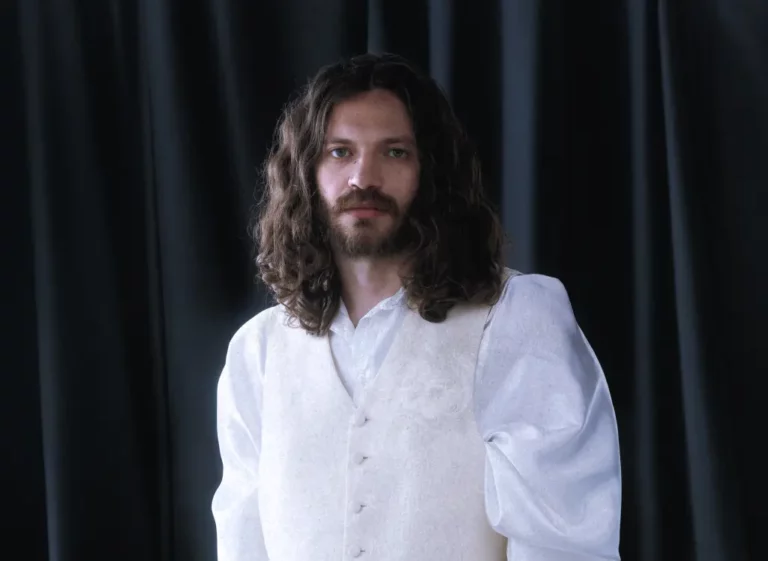
For years Paolo, Paolo Antonacci, aka Paolo Santo, wrote songs for others. Songs ended up at the center of new Italian pop, alongside names like Annalisa, Tananai, Geolier, Achille Lauro, just to name a few.
Then the need to exit the function. No producer album full of guests, no chase for the surgical hit.
“Paolo Santo Superstar” is a compact, narrative album, full of characters, crooked images and emotional coordinates that look more at the construction of an imaginary than at the functionality of the individual. Bologna becomes a mental language, the songs seem like communicating rooms, writing ceases to be a profession and returns to being personal exposition.
We talked about it with him starting from that enormous, ironic and at the same time programmatic title.
INTERVIEW
It almost scares me to interview you! Right from the title. “Paolo Santo Superstar” is a huge, provocative, almost theatrical title. Where did it come from?
I liked the idea of borrowing the name of a high-sounding work. Even just for the fact that, in the end, even a light album still remains a work of the intellect. And so this contrast intrigued me. Of course, there is also an underlying irony, but above all it is a declaration of intent. It's like saying: now you enter my world.
I have written many songs in recent years, but almost always for others. This is the first time I've really sung something that I feel is totally mine.
And so I needed the title to sound almost like a manifesto. “Paolo Santo Superstar” is my universe, my first work, my little inner musical. Not so much in the classic narrative sense, but as a construction of imagery.”
There is also a certain self-irony inside though.
Yes, absolutely. The term “superstar” should also be taken in a parodistic way. But at the same time I really believe that having ideas and being able to develop them without compromise makes you feel enormous. Not in the egocentric sense of the term, but in the creative sense. When you manage to build something that feels totally yours, that thing makes you feel gigantic.»
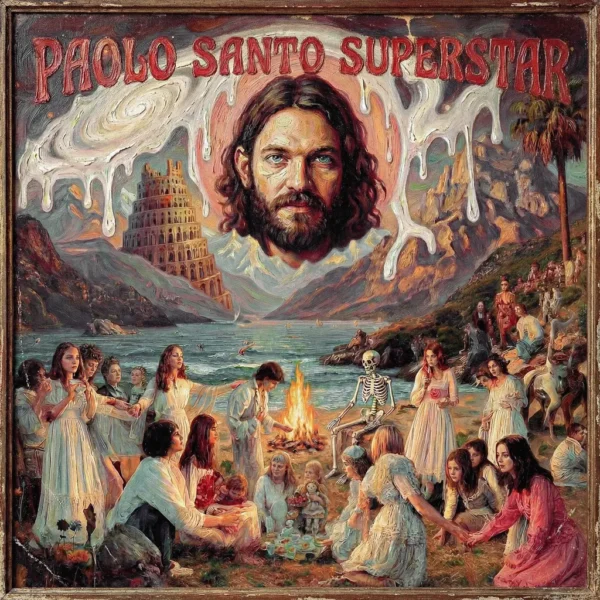
The cover also seems to go in that direction. It's very constructed, almost cinematic.
Because it had to function as a window into that world. This album, even if I don't really like the term, is a bit like my calling card. I needed to create a recognizable space, an imaginary where I could find myself.
The cover at the beginning was even a painting. We created it together with an artist and then subsequently processed it digitally. But the initial idea was truly pictorial. It must have seemed like a glimpse into the cosmos, almost a diorama. As if I were observing a small universe built inside my head.
Inside there are characters, stories, details that belong to the songs. It's kind of a narrative window into the record.
Listening to the album, the feeling is that you have deliberately avoided the structure of the contemporary album producer. There are no strategic featurings, there is no obsessive search for the hit.
Look, while you say this I'm really rejoicing. Because that's exactly what I wanted to happen.
Over the last few years I've had to stop and really figure out what I like. When you write a lot of pop, especially for other artists, you risk going into an almost automatic mode.
There is such a thing as algorithmic writing, let's call it that. The formula. The search for the magic potion that should turn a song into a hit.
Even if no one really knows how to make a hit.But I didn't want to use formulas here. It would have been a betrayal of the original idea of the record. This project had to tell about me as a creator, not my job as an author. They are two different things.”
In fact, one perceives a very clear rejection of the radio compromise.
Because before even asking myself if a piece could work on the radio I had to understand if it was really about me. In the life of individuals I have written many. Here, however, I didn't want to build songs that worked separately. I wanted to build a unique world.
This is why the album comes out all together. Because these seven songs make sense as a compact journey. The first pieces I published were almost experiments, born from the need to make my voice heard. This, however, is much more thoughtful. He's less impulsive, less reckless.”
Listening to your first songs, “L'Età dell'Oro” or “Lei”, it almost feels like listening to another artist.
Because I probably was. Or rather, I was still in a phase where I was trying to understand where to place myself. When you spend years building worlds for others you also risk losing your center.
At a certain point I realized that releasing singles one at a time wasn't enough to really open a dialogue with the listener. I felt that I didn't have time to tell myself. This album, however, finds meaning precisely in its entirety.”
Bologna is almost a character on the record.
Yes, because for me Bologna coincides with the place where I learned to imagine. I grew up there and inevitably my dreams speak that language.
When I dream, I dream of Bologna. Maybe transformed, maybe transfigured, maybe full of different scenography. But the emotional landscape always remains the same. This record is completely written within the walls of the dream.»
“Bolognese Spaghetti” seems to be the point at which this imagery definitively explodes.
I always say that's the song I would like to live in. When that initial dialogue starts I immediately enter that world. It's a kind of parallel reality where everything has a different logic.
Musically the album has many references to the Nineties, but without ever becoming a revival. How important were the references?
References are always important, but I struggle to cite them openly because I'm always afraid of lèse majesté. But I can say one thing: I never fail in taste.
Even though in my life I continually move from one project to another in an almost schizophrenic manner, here everything has been designed to fit within a single narrative. In the studio with Simonetta and Placido we built the pieces exactly as I would have liked to hear them.
From the structure to the arrangements, everything had to belong to the same sound universe. I consider it a very organic record.”
Yet each piece has a very strong identity.
Because the common thread is the voice. And the voice is not just a narrative means: it is actually a sound. I wanted to finally hear my voice in songs truly designed for me.
There was very precise work on the timbres, on the sounds, on the way in which the voice had to fit into the production.»
“Zombie” is one of my favorite songs, perhaps the most emotionally exposed piece on the album.
Yes, probably because the production there really talks to me. It's not simply a support for the song. He's almost an additional character.
Then it is a very autobiographical piece, even if I only realized this after writing it.»
Is it true that he was born in a deconsecrated church?
Yes, in a deconsecrated church in via Orfeo, in Bologna. We had this instrumental and the song came out almost straight away. At first I thought I was telling just any story, but then I realized that there was much more to me than I thought.”
Have you played the album to the artists you work with? Annalisa, Tananai, your father…
To very few. Some hold a special place in my life and therefore have heard something in advance. But a lot of people will find out I'm making a record pretty much when it's announced.
I needed to disappear a bit. To also detox from the judgment of others.
I believe that being continually immersed in the dynamics of the market sometimes risks making you lose contact with yourself.I, on the other hand, needed to find Paolo again. And perhaps the whole meaning of “Paolo Santo Superstar” is right there.»
TRACK BY TRACK
“Paolo Santo Superstar” develops as a work in seven movements, an emotional and visionary journey in which each piece represents a fragment of the microworld constructed by the artist. Between autobiography, allegory and cinematic imagery, the album traverses desires, relationships, illusions and falls, always maintaining a deeply personal gaze on the world.
Bolognese Spaghetti
It opens the album like an overture: the entrance into a possible world, in the place where Paolo Santo would really like to live. Bologna becomes an imagined and sentimental city, suspended between love stories, art academies and butterflies that cross the rooms. It is a declaration of intent that introduces the entire universe of the album: an open window on the artist's world, observed with desire and melancholy.
The Crisis after the Three
It tells a fragmented story, almost like a film made of broken images. At the center of the song is a betrayal that occurred during a beach holiday with friends, but the story soon turns into a broader allegory. The “vanilla holocaust” evoked in the text mixes tragedy and sweetness, staging emotional dramas that seem enormous but which, when faced with real life, reveal all their fragility.
The Desire
The album here enters the territory of adolescent love: tender, instinctive and inevitably cruel. The song tells the story of the birth of a feeling during a party, restoring that impulsive innocence in which desire and ferocity coexist without contradictions.
Tower of Babel
The piece addresses the theme of incommunicability. Two souls continually try to get closer without really being able to understand each other, transforming every dialogue into a new distance. The biblical reference thus becomes a metaphor for a relationship destined to crack under the weight of misunderstanding. But within the song there also survives a tension towards reconciliation: the stubborn search for a new language to finally be able to find each other again.
The Great Fire in Via Rialto
At this point the album reaches its poetic and conceptual manifesto. Inspired by the imagery of the burning of the vanities, the song transports that symbolic fire to contemporary Bologna, transforming Via Rialto into the center of an almost provocative vision. Here the ambiguous heart of the concept of “superstar” emerges: an exaltation that continually oscillates between irony, desire for greatness and self-destruction. The song showcases vanity and the need for recognition, asking what it really means to feel special in a world that seems to ignore you.
Zombie
The piece was born inside a deconsecrated church in Bologna and develops as a continuous reversal of perspective. Initially, it seems to tell the story of a devastated and unattainable female figure, but progressively the narrative is reversed: the “zombie” is the protagonist himself. The production takes on a central role, communicating with the voice until its final explosion, one of the emotional peaks of the entire album.
She's a Maniac
A “space sex love song” which closes the opera and which intertwines love, comedy and tragedy in a succession of cinematographic images, culminating in a poignant refrain. Musically, the song looks to certain atmospheres of the best Italian pop art, taking inspiration from Luca Carboni, and then opens into a string finale that accompanies the definitive exit from the world of disco. It is the moment in which the narrator's mask falls: the most intimate, fragile and emotionally discovered piece of “PAOLO SANTO SUPERSTAR”.
LISTEN TO THE RECORD
WEB & SOCIAL
@paolosantoo