Years of experience musicalized.
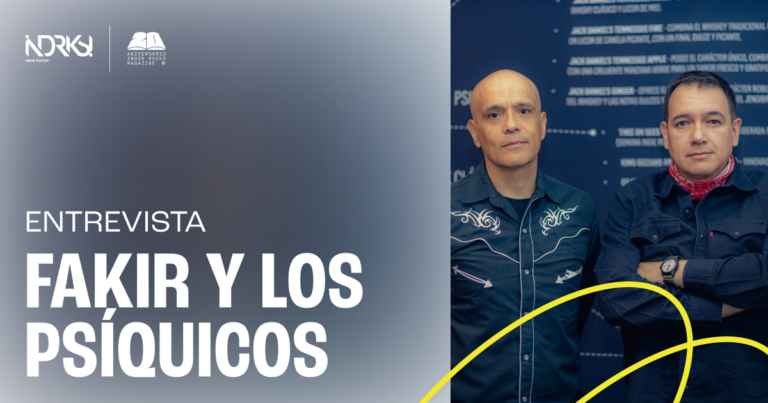
Some musical projects have creative minds behind them who have been part of the industry from different trenches and understand music from a mature and reflective perspective. That is the case of Fakir and Psychicsa project that, although it may seem relatively new, brings together decades of history, learning and artistic sensitivity.
In an interview, we spoke with Rafael Zepeda and Erick Spartacus about their most recent collaborative release, Love Hits You Like Lightningan album made up of nine songs and published on June 5.
Indie Rocks!: With this time passed, how has the reception been? How have you experienced it? Because it is also a whole process from creation until the material finally comes out.
Fakir and the Psychics: Yes, well, it has been a very interesting process. The album is titled Love Hits You Like Lightningis already on all platforms, but, well, we had the dynamic of releasing a couple of singles before, in such a way that we were warming up to make ourselves known on the platforms, to begin to exist in this sense prior to the album.
And, well, now that the entire album is published, the truth is that there has been a reception that exceeded the expectations we had. Above all because the strategy of having released a first single was not only for the fact of doing it in the conventional way, but we did it with a video clip, because this depends on a series of videos, which we are going to release three video clips, which, once they are there, we will move on to the second, after the World Cup the third will come, and these together will be like a small short that will accompany the entire history of the album.
So, what has happened, which has been incredible, is that this first video clip had a very good reception. He was part of the official selection of the Chaostica Festivalwhich is a film festival and we were in the official selection, Bilbao, Spain, and they considered us to be there. This is very relevant to us.
This festival is part of the curators of the Goya AwardsSo, well, I guess they have a good eye. So, the fact that they selected us was a very, very, very good thing.
And, to top it all off, a few days ago we received news that this same video, Love Hits You Like Lightningwon in the category Best Experimental Video Clip in the Europe Music Video Awards. So, well, that has been very good for us.
GO!: Congratulations on the awards. We are at a time in the music industry where the video clip is being left aside. Maybe there is a music lyrics or something like that so that the band keeps the lyrics of the song, but the power of the audiovisual, the power of cinematography behind a music video is being neglected… with the death of MTVwith the death of the horizontal format, what can you tell us about this? Why make such an experimental music video, so important at this time in music?
FYLOP: Well, the concept of the album itself did not demand it. It is an instrumental album, so a lot of the content of the album has to do with cinema.
That is to say, there are phrases in the songs, phrases that we take from golden cinema films, from the golden age of Mexican cinema, like the films of Buñuelin this case, that from there there is a great variety of phrases that give the rhetoric to the pieces and also to the album as a whole.
So, based on that, it was super relevant that the visual support was almost as important as the songs themselves. That is, try to make a project a little bigger, in the sense of not only the music, but also this visual part. We approached people who are dedicated to making films and they were the ones who helped us resolve this issue.
So, well, the concept of the album itself goes very hand in hand with the cinema part. Even from the very gestation of the album, it has like that input important of graphic things and cinematographic things. In fact, the creation of the musical part first starts from a graphic and visual question and then becomes a song or music.
GO!: That is very interesting because the process almost always happens in reverse, why do they do it that way?
FYLOP:: Because, well, if you can visit our networks you will be able to see that the graphic part that is there I have developed since I was a child.
This little one was my first approach to anything that has to do with something called artistic, but parallel was music. So first I would draw something and then I would imagine what it sounded like.
And that is something that developed over time until, after years, this album process occurred and I realized that it was a natural process that I have always worked with. First I see and then I imagine what it sounds.
GO!: The cover of “La Crisis” has a child and the album cover also has a child, is there any connection between these?
FYLOP: Yeah, Fakiris a fairly old project, in the sense that it is something that was planned many years ago. Since I started with the graphic part since I was a child, the way to represent a little of what I did is like me reflecting on myself as when I was a child. In fact, I self-drew the drawings.
GO!: Ok, it’s you, it’s you as a child.
FYLOP: Yes, that’s how I was as a child. So, at the beginning it was that, well, because I was working on the project personally. So, well, I gave it this treatment until I released the first, let’s say, the first album, which is titled 89which was a rescue from an old shed tape, where it was only electric bass.
Later this became a project where more people have been integrated producing, contributing guitars, keyboards and other musicians. But that was the process. Maybe it is the coincidence of why there is a child, but it was like a reference to me unconsciously making it, drawing it, where my experience comes from, my references, well to now transform them into music.
GO!: To close the interview, with what message do you invite people to listen to this new album?
FYLOP: Well, I think there are things, even though there is an instrumental side, the other is a little more concrete songs, let’s say. It would be good if you sat down and listened carefully, because there are many things, let’s say, hidden, so to speak. There are many details that give it a personality, we feel that it is quite unique to discover that.
For example, all the movie quotes that are there, if you’re a little curious, find out where they come from, who they are. Maybe you dare to see The Forgotten and you can see that Mexico in the fifties, how it was versus how it is today, and how there are things that are constant, and that Mexico has very positive things over time and other very terrible things that are constant, no matter what time you look at it, right?
So, I think it’s like a window to look out if you’re curious and not leave it alone in what music is, otherwise you can find more things that enrich you, right?, as a person, as a human being, as a Mexican.
I invite you to listen Love Hits You Like Lightning because the message that I have always wanted to convey through music is for you to believe that there are small ways in which one can make the world change and things change. I don’t like to feel that they have made us feel, to give the feeling that there is nothing anymore, that we are a little hopeless in the face of what we are finding in this world, in many ways.
I like that music inspires people to radicalize and have strength and energy to show themselves and be able to change things with what only sound can inspire you with.
There are songs that are in Chinese, in Japanese, in Arabic, in English, that sometimes we do not understand the lyrics, but the feeling of the music is super powerful, and I hope that it can inspire, that the music that is on this album inspires you to that.
Dale play to “Love Hits You Like Lightning”part of the album of the same name, here: