Popa returns with “Nuda Property” an album that behaves more like a narrative journey.
The starting point is a real estate term, removed from its technical use and transformed into an emotional condition: a space that is habitable but never truly owned.
A short film. An emotional script at the center of which moves the “Lady”, a recurring and mobile figure, who holds the story together between domestic intimacy and symbolic slippage. A filtered Italy is created around her, between everyday Milan and the imaginary Eighties, where musical production becomes part of a broader staging.
We met Popa goes through the coordinates of the project: the genesis of the concept, the construction of the character, the sound work with Gaetano Scognamiglio and the visual dimension of the album, up to the accidental episodes that defined the final aesthetic.
INTERVIEW
So, “Naked Property”, this naked property… what can you tell me?
For me, bare ownership, when I discovered that this concept exists, I was shocked. I knew it. I saw “bare ownership” written in Milan and I didn't understand what it meant. Then they explained it to me.
But even there I thought: it's not a bad concept. Especially looking at how we live today. It's a time when there are so many single, unmarried people, and we don't know what the future will be like. I'm 30, so I'm thinking maybe this will be my future.
It's not a dark thing, like a house that someone waits to enter when you die. I wanted to translate bare ownership into something more positive.For me it's also not knowing what awaits you. You don't know where you're going. I'm not Italian, I'm Lithuanian. I came from Lithuania, which was my home, and moved to Italy, to Milan. I don't know how long I will stay here, maybe I will return to Lithuania, maybe not.
So bare ownership is a state of mind: everything can change or remain. This somewhat ephemeral idea of everyday life, where you never know what happens tomorrow. And it's nice too, because you're never still.
The album is also intended as a short film. Who is the Lady? Do you see yourself in her or is she an external figure?
For me the Lady is a character, a figure, an icon in which many can recognize themselves. A woman or a man can see themselves in her.
I wanted to call her “Lady” because she speaks to me of a person who lives in Italy, without age. In the previous album there was a song, Sciura Milanese: there I was further away, I was almost observing it, a little intimidated.In this album however I find it in its intimacy. She's crying, she's at home.
The first sentence of the album, of the first song Signora, says: “Madam, don't cry, because it's yet another day in this bare property”.
I'm talking to her, we're at home, having tea. I try to remind her of the beautiful trips, with Marino, with Princess Diana, who is an icon for me.
The message of the album is this: even in sad moments we must remember that there have been good days and there will be more to come. You have to dance, travel.A little introspection is fine, but thanks to that you can start again. Bare Ownership means staying, but also starting again.
Fashion, Milan, travel imagery and an 80s aesthetic coexist on the album. How does musical research originate?
This album was written and produced with Gaetano Scognamiglio, who I always work with. We liked to define my sound between pop, synth and Italo disco.
Here we were also inspired by Gazebo: that danceable but soulful, slow disco sound. A record that you can listen to on the beach, having an aperitif or going dancing, but with a nostalgic and dreamy mood.
However, everything is set in contemporary Italy. We liked to mix contemporary and 80s to create something that is not new, but reinterpreted today.
Beauty routine, current aesthetics, but sound from those years. A fusion between modern and past.
And on a visual level, do the videos also follow this aesthetic?
Yes. In the Nuda Property videos there is always a film. I like that decadent aesthetic.
Today the world only looks to the future, but I find serenity in the past. I'm nostalgic for the Seventies and Eighties, which I didn't experience but which seem magical to me.
It seemed like a time when anything could happen: a politician in office and then everyone dancing.
Today with social media everything is fast. I, on the other hand, wanted a different time: timeless videos, which could be from the Seventies, Eighties or 2026.
Timeless.
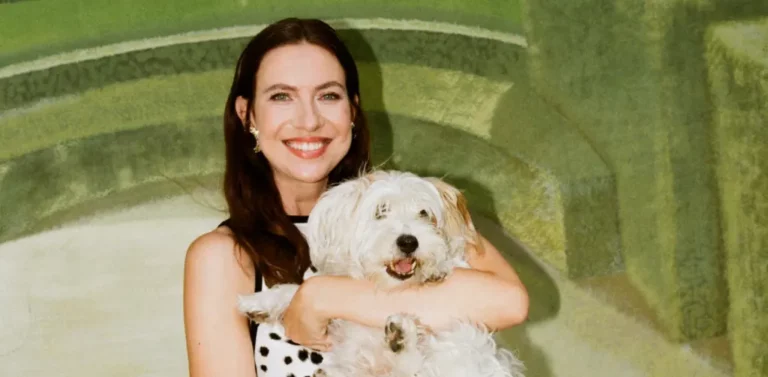
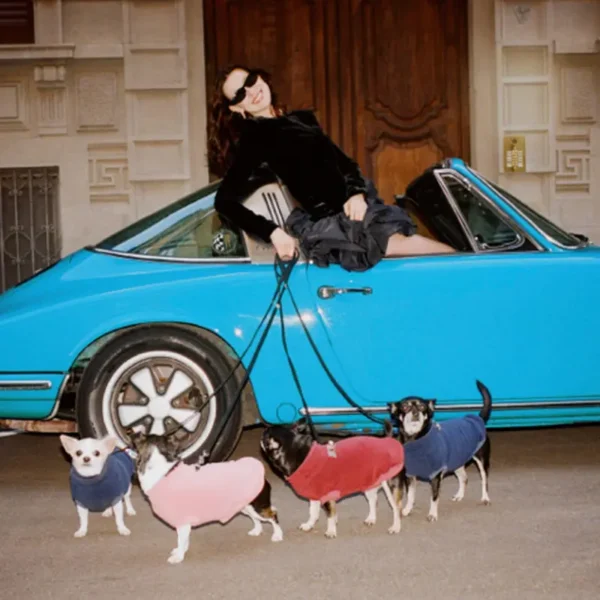
How did the cover with the dogs come about?
It all happened by chance. We were taking photos in front of a door, as if it were a house I was about to leave.
At a certain point the door opens and a lady comes out with some dogs. I couldn't believe it.
We asked to take a photo with them, she was very kind. And so the cover was born.
It wasn't organised. It was perfect like that.
And the live dimension of Nuda Property?
There will be dates this summer: Rome, Veneto, Abruzzo. And next week the presentation in Milan.
It will be a normal evening, aperitif, people passing by, and at a certain point I will sing some songs for whoever is there.
TRACK BY TRACK
LADY
The entry point is already a poetic statement. Signora does not simply introduce a character, but a fragmented interiority. It is a monologue that addresses itself, a domestic dialogue between fragility and self-support. Time doesn't flow here, it accumulates. “Bare ownership” immediately becomes a mental condition: living without owning, existing without stability.
MARCH BEIGE
The urban lexicon becomes epidermal. The beige coat becomes not an accessory but an emotional second skin. Marzo Beige is the restrained melancholy, the one that creeps into the smallest gestures, in the repeated journeys, in the public silences of the city. Milan is not described: it is worn.
GOMMAGE
Here the everyday turns into ritual. The beauty routine stops being superficial and becomes an almost therapeutic gesture. Gommage works on subtraction, on the skin that is freed, but also on the identity that is weakened. It's a song that cleans and exposes at the same time.
ANIMAL
Aesthetics deforms and becomes social language. The animal is no longer a pattern but a condition: instinct, mask, multiplication of the self. The city transforms into an elegant and artificial jungle, where the gaze of others is an integral part of the landscape.
GUARDIAN
Moment of narrative fracture. Everyday life is interrupted through a minimal but decisive gesture: a sound, a threshold, a voice. Guardian is the point where the inside is disturbed. It is the implicit invitation to emerge from suspension, to transform stasis into movement.
WHERE ARE WE GOING TO DANCE THIS EVENING?
The threshold opens definitively. The body of the “Lady” enters the night and abandons the grammar of waiting. The club becomes a space of liberation, but also of conscious confusion. It's not evasion: it's crossing. The dance floor as a form of identity rewriting.
INTERCONTINENTAL FLIGHT
Desire shifts geographically. Distance and imagination overlap. Intercontinental flight is total suspension: neither departure nor arrival, but an intermediate state in which relationships and identities misalign from the present.
MONTE CARLO
The game enters as a narrative code. Risk, luxury aesthetics, emotional acceleration. Monte Carlo is a lucid, almost scenographic escape, where excess becomes a form of control and loss at the same time.
KALISPERA
Time slows down and falls apart. Kalispera is a liminal, Mediterranean and suspended area, where nostalgia is no longer memory but atmosphere. It is a song that does not close but expands, like an evening that cannot find definition.
THREE WEEKS TO TELL
Closing and returning. Fred Buongusto's cover becomes an epilogue and narrative residue. Everything comes together without really being resolved: fragments, stories, images remain. The return is never definitive, but circular. “Bare ownership” is confirmed for what it is: a space to inhabit and from which, inevitably, to start again.
LISTEN TO THE RECORD
VIDEO
ABOUT POPA
Popa is a Lithuanian singer-songwriter and fashion designer transplanted to Milan, she creates clothes for chic women and writes music. His songs tell of cover lives and Italian playboys, turtlenecks, nocturnal animals and daydreams, Caribbean visions and urban awareness on the socioeconomic context that make up the iconography of a contemporary, ironic and decadent Italy. It's luxury pop: sophisticated, sensual and conscious. In 2023 he released his debut album entitled “Arte e Finanza”.
WEB & SOCIAL
https://www.instagram.com/____popa__/