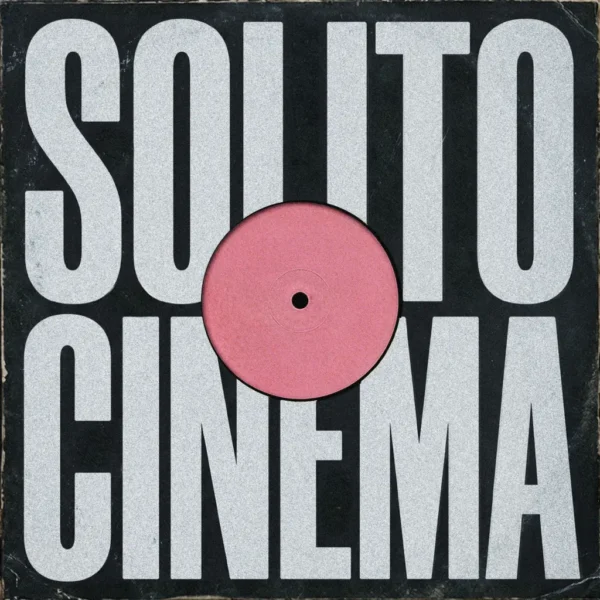
“Solito Cinema”, Juli's debut album, is released. A debut that comes as a natural path, songs born over time, between sessions, meetings and shared writing, then recomposed in a project that holds different trajectories together with a refined and desired coherence.
We met Juli close to the release of the album. What emerges, without particular mediations, is an approach that remains identical to that of working for others.
No change of method, no refoundation. Just a shift of focus: for the first time, everything converges on him. And it is perhaps here that “Solito Cinema” finds its clearest point, in this direct exposition that does not seek to be explained, but simply crossed.
INTERVIEW
On the album the collaborations are not simple “feats”, but voices that embody your vision. Among these, an unexpected name like Fabio Concato stands out. What was it like approaching him and working on “Voilà”?
“Voilà” is a song from 2003, so mine is a contemporary reinterpretation of something that already had a history and an autonomous life. Even if Concato does not belong to my current perimeter, it has always been in terms of influences. He is an artist I listened to and respected a lot. It marked me not only in writing, but also in the way of thinking about production: the guitars, the arrangements, that care that stands the test of time.
Being able to intervene on one of his songs, send it to him and receive approval, with rare availability and kindness, was an important step. There was also an authentic curiosity on his part in putting himself out there in an album by younger artists. For me it's an honor.Opening the album with him, as the first track, is a symbolic choice: it is the best possible “welcome” into this cinema of mine. Ultimately, “Voilà” also works as a declaration of intent: here I am, this is me. And having him there is a gift I gave myself, but also a direction: to continue writing songs with that singer-songwriter breath.
“Vertigo” is instead an atypical episode, only instrumental. How was it born?
It's a song that came together slowly, over the last two years, especially live. During concerts with Olly there was always a space dedicated to the guitar, an intimate space within the show.
The guitar is a central instrument in our songwriting, so it made sense to carve out an independent moment for it.From date to date the piece was transformed: additions, variations, improvisations. At a certain point it seemed natural to bring it onto the record and give it a definitive shape. It's the first time I've recorded it in the studio: everything dubbed, layered, without too many rules.
I left it in the center of the tracklist, with a certain stubbornness. It has no voice, but for me it remains a song in all respects. I hope it is heard like this, without prejudice.
You come from a job often behind the scenes, then with Olly you went on stage. How much does the creative process change in your project compared to that of other artists?
In reality the method remains similar. In recent years I have been lucky enough to only work on projects in which I truly recognize myself, where my writing contribution is central.
The difference, if anything, is in the responsibility: here everything passes directly through me, without mediation.
This album is more exposed, inevitably more mine. But it does not arise from a break with the past: it is rather a continuity brought to light.
How precarious is a musical career like yours today?
It's a job without guarantees. When you start you don't know where you will end up, there is no defined trajectory. You are exposed to dynamics that you often do not control.
Transforming passion into work is beautiful, but the path is unstable: it can take years, or it can be consumed in a few months. And, to be honest, moments of doubt are more frequent than moments of certainty. There were times when I struggled to understand whether to continue.
Today I am happy to have insisted, but the balance remains fragile. Even looking ahead, you can't know if all this will hold up: it depends on too many variables that don't depend on you.
Are you thinking of a live dimension of the album?
I'm working on it. I would like to find a form that lives up to the idea. This is a record that lives thanks to the artists who are part of it, so the live dimension implies enormous complexity.
Organizing a concert with just one artist is already complicated, imagine with twelve. But I would really like to bring “Solito Cinema” to the stage, transform it into a shared experience.
In addition to Concato, Biagio Antonacci also appears on the album. How did this collaboration come about?
Totally unexpectedly. This summer he wrote to me while I was on holiday with friends, sending me a piano and vocal audition of what later became the final song of the album. He asked me if I wanted to work on it.
It was surreal: getting a message from him in that context. Then we met, we developed the piece together and at a certain point I asked him if he could be included in my album. He accepted very naturally.
Working with him was strong, also due to the generational distance. He has an enormous career, and finding him next to him in the studio, in such an everyday dimension, has something alienating.
What is the common thread between such different artists?
They are all songwriters. People who write what they live. But above all there is a very strong human element.
With some I share pieces of life, with others perhaps only isolated moments, but always authentic. The album was born from real, unconstructed relationships. And I think this is the key: a mutual respect that goes beyond music. Making music is already powerful, making it with people you have a connection with is even more powerful.
“Solito Cinema” evokes a ritual. Where, however, is the unusual element?
Paradoxically, today the unusual is normality. We live in a condition where everything is so out of alignment that it becomes ordinary.
“Solito Cinema” has become “usual” precisely because I keep calling it that, by repeating it. But in reality it arises from a perception of deviation from normality. And perhaps it is precisely that lack of normality that makes it so.
Does this album mark a starting point or a closing of a chapter in your life?
It's a point. Not so much about arrival or departure, but about definition. I am 27 years old and I felt the need to stop for a moment, look back and focus on the path taken.
I've always moved very fast, working on records that represented the beginning or continuity of other artists.
For the first time I want to experience a project as if it were final, even if it isn't.It's a way to breathe, to put things back in order, to recognize what I've done. Also to allow myself, every now and then, to be proud of it.
Is there anyone you wanted on the record but didn't make it?
No, and that's perhaps the most beautiful thing. I didn't search for anyone specifically. Everything that ended up on the album was born naturally, from real sessions and meetings.
I didn't want to build a project on the table. I was interested in it being a spontaneous collection of what happened. And the fact that I only realized it later, putting the pieces together, makes it even more true.
Dreams in the drawer?
More than secret dreams, I realize that I have already realized many of them without even having focused on them. They were there, just hidden better than I thought.
Now the perspective has changed. The goal, as basic as it may seem, is to be happy. My private life has changed a lot and I feel the need to find real serenity.
If I can stay healthy, then I can continue to do this job the right way. And maybe, for once, even allow myself to really live what I do, not just chase it.
THE TRACKLIST
“Voilà” with Fabio Concato
“Who cares” with Tommaso Paradiso
“Passatempo” with Fulminacci
“Serenemente” with Bresh
“Curse” with Franco 126
“The Last Song” with Biagio Antonacci
“Those like me” with Coez
“Vertigo” (instrumental)
“Brutta storia (unplugged)” with Emma and Elisa
“We, disillusioned” with Enrico Nigiotti
“Everyone cries here” with Tredici Pietro
“Cantilene” with Olly
BUY THE RECORD ON AMAZON
ABOUT
JULI, pseudonym of Julien Boverod, is a producer, author and musician born in '98 originally from Aosta but raised artistically in Turin. From a very young age he made his way into the musical panorama, managing to emerge at a national level, achieving gold and platinum certifications for his productions and compositions. Since 2018 he has produced for Shade, Boro Boro, Oliver Green and subsequently broadens the field of collaborations by also working together with Mambolosco, Fred De Palma, Alfa, Dargen D'Amico, Baby K. Starting from the end of 2020 he collaborates with Olly, an artist with whom a special artistic understanding is established which leads to the production of the album “Il mondo gira”, published in December 2022, and the participation in Sanremo 2023 with the song “Dust”. In 2024 JULI returns to the Sanremo Festival as author, arranger and producer of the songs “Apnea” by Emma and “Il cielo non ci liberi” performed by Fred De Palma. He is also among the composers and producers of the multi-platinum single “L'ultima Politica” by Ultimo and Geolier. In May 2024 he joined the roster of EMI Records (Universal Music) and immediately after released the single “Hoviamo di te” with Emma and Olly, which has 60 million streams on digital platforms and has already gone platinum. At the end of 2024, Olly's second album, “Tutta vita”, was released, entirely co-written and produced by JULI, which debuted at #1 in the FIMI charts and has already been certified platinum. At Sanremo 2025 JULI is the author and producer of the winning song of the Festival: “Balorda nostalgia” by Olly. In April the song “Bella really” was released, written by Ultimo and produced by Juli and in October “Tutta vita (sempre)”, the repack of Olly's album, was released. At the same time, Olly's tour of the sports halls starts, of which Juli takes care of the artistic direction.
WEB & SOCIAL
@juli__