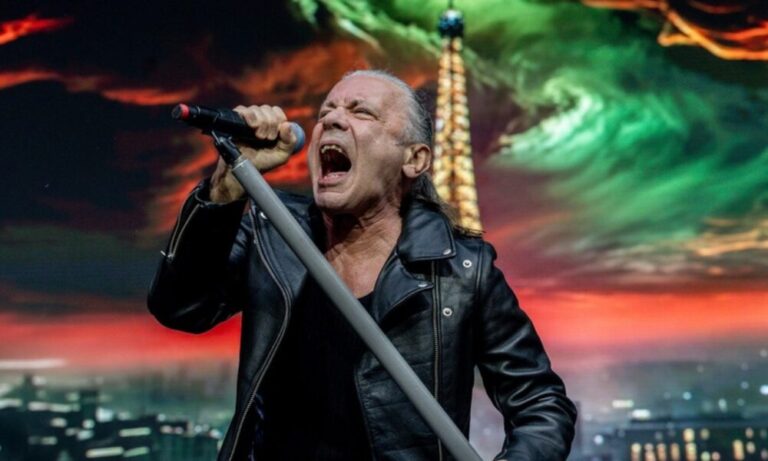
For the first time in 50 years, Iron Maiden are opening their archives to an outside filmmaker. Directed by Malcolm Venville, the documentary Burning Ambition hits theaters on May 7 and recounts the golden cage of touring, the departures, returns, and deaths of Paul Di'Anno and Clive Burr. Bruce Dickinson, Adrian Smith and Steve Harris speak to WECB, while the Run for Your Lives anniversary tour is already crisscrossing the planet.
In the early 1980s, Iron Maiden set out in search of Promethean fire, driven by the almost spiritual mission of delivering “Run to the Hills” and “The Trooper” to humanity. But within a few years, the incessant touring exhausted them and the bickering undermined unity. The documentary shows Bruce Dickinson begging manager Rod Smallwood to cut dates: “You don’t change the strings of a voice”. The singer, like guitarist Adrian Smith, would eventually slam the door at the top of the group – before both returning in 1999, and never leaving since.
In Burning Ambition, which hits theaters May 7 and features an obscure B-side from the band, Dickinson compares touring to “five years in a golden cage”. In images from 1993, we hear him muttering: “Is all this madness worth it? » His response today is no longer rhetorical. “The madness is worth it”he slips to WECB, by videoconference from London. “When you leave, you come back down into daylight, and you’re like, ‘You know what? It's pretty cool. The world really needs Iron Maiden. » »
Adrian Smith: “everything else was terrible”
Adrian Smith remembers that at the end of the 80s, outside of concerts, “everything else was terrible”. The guitarist, who left in 1990 due to lack of inspiration, started a family, played in ephemeral projects like ASAP with Zak Starkey, before understanding. “I finally saw what Iron Maiden really was”he says via video from a hotel in Turks and Caicos, where he is filming in parallel with his Smith/Kotzen project.
1975-2025: the NWOBHM, Eddie and a pantheon
Iron Maiden continues with retrospectives, as the 50th anniversary celebrations extend into 2026. Founded in 1975 by Steve Harris, a former street sweeper turned bassist, the group emerged into the metal mainstream on the NWOBHM wave (New Wave of British Heavy Metal) with its first album Iron Maiden (1980). Galloping riffs like the William Tell Overture, stadium choruses, defiant mantra — die-with-your-boots-on: the band immediately deviates from their elders Black Sabbath and Led Zeppelin. “Steve wanted to do things his way, we lined up behind him to help him do that”summarizes Smith. Fifty years later, Eddie, their macabre mascot, has even appeared on t-shirts worn by Miley Cyrus and Justin Bieber.
Iron Maiden sweeps away nostalgic fans who demand hits, having already played an entire album in one go (A Matter of Life and Death, 2006). Dickinson shrugs when told that the recent The Book of Souls and Senjutsu are too progressive. “Go listen to other bands”he says, laughing. “The world is free, or almost. » This year, however, they agree to turn around – unrelated to their induction into the Rock and Roll Hall of Fame, the ceremony of which they skipped due to the Australian tour. Instead: the Run for Your Lives tour, set lists drawn from the repertoire before Dickinson's departure, and a two-day Eddfest in Knebworth, England, with discarded former members (singer Blaze Bayley, replacement from the 90s) and supergroup Maiden United, where we find Dennis Stratton, short-lived guitarist from the very first album.
Burning Ambition: “not a hagiography”
For Burning Ambition, the British made a cultural exception: letting an outside filmmaker – Malcolm Venville, also author of documentaries on Lincoln, Roosevelt or Churchill – access their archives and their privacy. The film mixes Eddie's animations and talking heads from famous fans: Javier Bardem, Lars Ulrich (Metallica), Chuck D and Simon Gallup (The Cure). The participation of the musicians was limited to off-the-record interviews.
For Smith, the film is “quite emotional”. The hardest passages concern the members who left without return: Paul Di'Anno, first singer with the gravelly voice which defined the first two albums, died in 2024; Clive Burr, drummer whose textured syncopations transformed the group's gallops into autonomous riffs, left after the recording of the monument The Number of the Beast (1982) and died in 2013. The guitarist was also touched by the images of Nicko McBrain, the most faithful drummer, retired from the scene in 2024 after a stroke the previous year.
Bruce Dickinson, the man of a thousand lives
Smith joined Iron Maiden in November 1980, six months after the release of the first album. With Dave Murray as his youth companion and Urchin as his first band, he already knows the DNA of the group. Maiden, without being punk (“we really didn’t like punks”explained Harris), functioned like a DIY band: self-produced EP (The Soundhouse Tapes), intensive touring, cult fanbase built with sweat. “The group has always operated slightly on the fringes of the establishment. It’s almost a big cult group”Smith said. “Our fans identified with the struggle, with the fact that we did it the hard way. »
When Smith arrived, Paul Di'Anno was barely holding his own on tour. “Paul, I think, took a lot of pressure”says the guitarist. “He often lost his voice. My impression when I arrived was that he was happy-go-lucky, not an ambitious or tough guy — he just liked to have fun. So I think he was almost relieved when he left. » Smith adds: “I hope Paul had some happiness after Maiden. » (Di'Anno's life is the subject of another independent documentary, due out this year.)
Dickinson arrived from Samson in September 1981, six months after the Killers album. His masculine operatic voice, an alarm siren, takes Maiden into another dimension. “It looks like Broadway”comments Scott Ian (Anthrax) in the film. But above all, what sticks: his unstoppable energy. Airline pilot, fencer, novelist, broadcaster, entrepreneur — Dickinson led all these lives in parallel while he sang “Hallowed Be Thy Name”. “The idea that he could front one of the biggest groups in the world, qualify as a captain, and even suggest improvements to the British Airways pilot training manual, says a lot about his brain.”smiled Venville. “He doesn’t do anything by halves. And then there's Steve Harris, almost the opposite: a quiet, secretly obsessive perfectionist. This tension between the two of them is the driving force. One is expansive, the other demanding. »
Dickinson, for his part, refuses the opposition. The grit that irrigates the lyrics – often drawn from literature – is their shared DNA. When doctors told him he had throat cancer in 2014, his first question: “When can I start singing again?” » Answer : “About ten months. » “I told them, ‘I’ll do better than that’”beams the singer. “And that’s how we are, and still are. » Now recovered, he walks around with two metal hips and an Achilles tendon stitched together five years earlier. “But I'm still running around like crazy, and the voice is doing great. » He has even just completed a new solo album: “Sixteen tracks in twenty-one days, 100% live. This is the anti-AI generation. »
“Maiden, it’s a giant umbrella”
For Dickinson, Iron Maiden's mission — to provide live shows — is “unapologetically escapist”. “When you go see a film, it’s an escape, depending on the genre you like. And you choose which one. I have no desire to watch a documentary about Bono saving African children, as wonderful as that is. I want to see Jason Statham beat the shit out of bad guys, because that's the mood right now. And people choose Iron Maiden because they're in the mood for it. »
Burning Ambition documents this global mission, relying heavily on the Iron Maiden Behind the Iron Curtain VHS archive — captured in 1984 during a Poland-Hungary-Yugoslavia tour. “We were always looking to go to new places, and no one had really done that before us”says Smith. “These audiences had never seen anything like this. They knew some of our songs, but I almost felt sorry for them. They lived in such austerity… I remember going to the best hotel in Warsaw: there was only one thing on the menu. » “What we do”summarizes Dickinson, “it’s offering people an opportunity to escape from this shitty world we live in, and to find themselves on an equal footing – whether they are doctors, bankers, plumbers, masons, regardless of religion, nationality, color. We don't exclude anyone. »
Bardem, “Run to the Hills” and the Indian misunderstanding
Halfway through the film, an archive scene: Dickinson becomes annoyed by a journalist who despises the meaning of “Run to the Hills”. “It’s an anti-Indian massacre song”insists the singer. “The subject is: 'This is what happened, and it's not like in the cowboy movies.' » » Cut: Javier Bardem, who recites the words slowly, like a poem. The subjective perspective of a Cree begging for freedom from colonial slavery takes on another dimension. “It’s a ‘wow’ moment.”relishes Dickinson. “The way he read the words sounded very deep”confirms Smith. “I had never heard them read like a poem, by a great actor”resumes Dickinson. “I felt a melancholy, a sadness. »
For Venville, that’s the whole point of the film. “There is a depth to their work that is easy to miss. History, literature, philosophy: everything is integrated into the music. » And beyond the group, it’s the fanbase that amazes him. “The real revelation is the public”he said. “It’s not just headbangers in battle-jackets: the community is global, organized, deeply connected. It behaves almost like an ecosystem. »
“Not a tombstone”: a frame, not an end clap
Iron Maiden have always shrugged their shoulders at attempts at institutionalization. They were nominated to the Rock Hall twice before entering this year. In 2018, Dickinson was blunt: “I think the Rock & Roll Hall of Fame is complete and utter rubbish. It's run by a bunch of hypocritical Americans who wouldn't recognize rock & roll if it blew up in their face. »
So, isn’t this review documentary likely to seem like an end point? “When you say 'full stop' you don't mean 'tombstone', I hope? » he laughs. Before parrying the sting with a parody of a Maiden song: “In a serious new world. » Once the joke is digested, he gets back to the point. “Fifty years remains a symbolic number”he concludes. “There is no sign of it stopping, but it will happen, inevitably. How, when, we don't know. »
And he corrects it one last time: “Rather than an end point, I would say that this documentary is a framework. A framework through which to view the rest of our careers. »